Bulk-goods warehouse work: deciding whether larger loads fit you
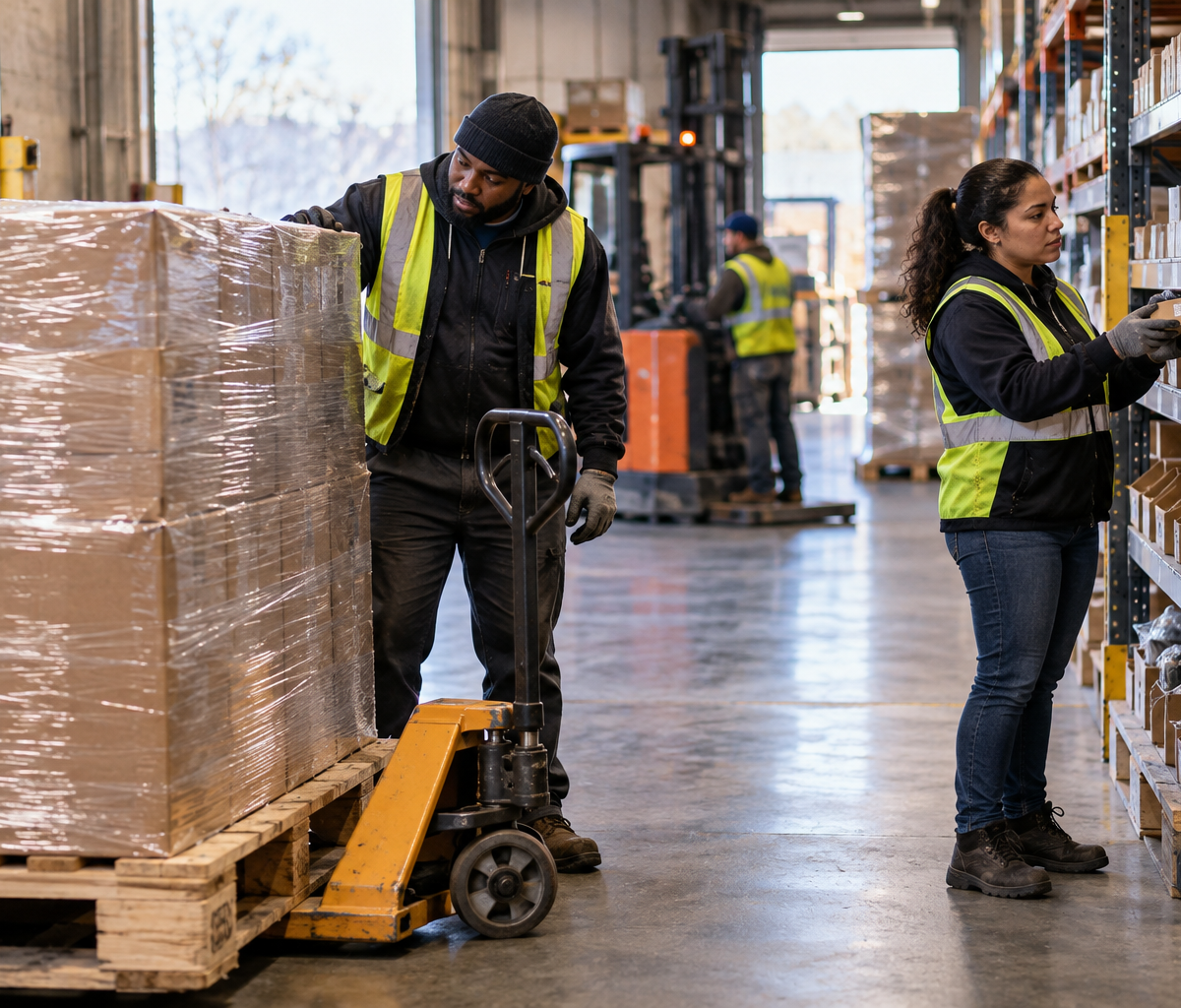
Compare a pallet-oriented warehouse opening with item-level fulfillment by asking about the actual handling units, handoffs, physical tasks and shift pattern.
A candidate has worked in a parcel fulfillment area, picking dozens of individual products for separate orders. Another opening advertises bulk-goods warehouse work, and the description mentions moving pallets between receiving, storage, and shipping. The candidate likes the idea of handling fewer, larger units. Before applying, they need to learn what those units contain, how they move, and which parts of the job are done by hand. Bulk-goods warehouse work can feel different from item-level fulfillment, but the words “bulk” and “pallet” alone do not describe a complete shift.
The useful comparison is the unit of work. In one operation, a worker may count and move cases or pallets for a store or business customer. In another, a picker may locate one or two units from many shelves and build separate consumer orders. Some facilities do both. The candidate should compare the actual tasks and pace in the posting and interview, rather than assume that bulk freight always means less handling or that parcel work always means faster movement.
Find out what counts as a pallet load
A pallet load is a grouping of goods handled as a unit for part of its journey. It may contain one product, several cases of one product, or mixed goods assembled for a destination. A receiving worker might verify a pallet’s identification and quantity, stage it, or help move it to a storage area. A shipping worker might prepare a pallet for outbound transport and check that it matches the right order and trailer.
That description is deliberately broad. A pallet can be built at one station and broken down at another. Some jobs involve the whole unit most of the time; others require workers to open cases and handle individual pieces. A candidate who prefers large-unit movement should ask what percentage of the shift is spent moving intact pallets, handling cases, or picking single items. The answer may vary by season, customer, and assignment.
In the example, the candidate sees “palletized freight” in the job listing. They should ask whether they would verify inbound pallets, stage outbound pallets, count cases on a load, or build pallets from individual cartons. Those tasks involve different rhythms and different chances for a quantity or destination error. A title such as warehouse associate may cover several of them without telling the candidate which is central.
The U.S. Bureau of Labor Statistics describes hand freight, stock, and material movers as moving materials among storage, production, docks, and vehicles. That broad occupational description supports the idea that warehouse movement crosses several work areas. It does not prove that a particular bulk-goods job is exclusively pallet handling, or that one candidate will work in every area. The local posting and employer’s explanation must supply that detail.
Compare large-unit flow with individual item picking
Individual item picking begins with a request for specific products and quantities and requires a worker to find, verify, and move those units into an order flow. A worker may repeat that cycle many times for separate orders. Bulk-goods work may instead follow fewer, larger handling units through receiving, staging, storage, and loading. The number of transactions can differ even when the total amount of freight is similar.
For the candidate, the important question is which work pattern suits their attention. They may enjoy keeping track of a few large loads, checking labels and counts at each handoff. Another person may prefer the variety of locating many products across a fulfillment area. Neither preference proves one operation is easier. Large loads can require careful checks and time-sensitive coordination, while individual picking can require sustained accuracy across many small decisions.
Imagine an outbound order for a store that consists of ten cases of the same product. The warehouse may move a larger grouped load toward shipping. A consumer order containing ten unrelated products could require visits to several storage locations before packing. The example illustrates different flows; real warehouses may mix cases, pallets, and individual items in the same order. A candidate should ask what the ordinary order profile looks like for the specific facility.
Do not infer physical effort from the unit count alone. Moving one pallet may involve manual wrapping, checking, or restacking. Picking many light items may involve extensive walking or repeated reaching. The actual movement method, product weight, workstation design, and schedule determine the demands. Asking to see or hear a normal shift sequence gives the candidate more information than the words “bulk” or “e-commerce” by themselves.
Follow receiving through storage and shipping
At receiving, goods arrive with expected quantities and identities. The worker may compare what arrived with the receiving record, note damage or a count difference, and place the freight in a designated area. In a bulk-goods setting, the unit being verified might be a pallet or case group. A correct count at this point helps prevent a later picker or shipping team from looking for stock that never arrived.
Storage introduces another question: where is the load now? A pallet moved away from the dock still needs a traceable location under the facility’s process. The person performing the move may be different from the person recording it, depending on the operation. The candidate should ask whether the role involves scanning, written checks, physical movement, inventory counts, or a mix. A job that looks mainly physical can still require careful recordkeeping.
At shipping, the team connects the freight to an outbound destination. The worker may stage a load by route or customer, verify labels, check visible condition, or assist with loading. If a pallet for Store A is put into Store B’s lane, the mistake may travel beyond the building. Large-unit work often reduces the number of separate pieces being moved at once, but each unit can represent substantial quantity. Accuracy at the handoff matters.
These steps need not occur in one worker’s shift. A facility may assign separate receiving, inventory, picking, and shipping teams. Another may rotate people among them. The candidate should ask where the open role sits in that chain and how often it changes. The answer reveals whether they will spend most of the day moving prepared loads, resolving exceptions, or helping across several zones.
Ask how the load actually moves
The phrase “move pallets” can hide a major role distinction. Some workers use manual pallet jacks, some work beside powered equipment, and some operate equipment after the employer’s required training and authorization. The candidate should not assume that a pallet-oriented opening includes equipment operation or that prior experience automatically qualifies them at the new site. This article is about choosing the work pattern; the separate equipment-role topic covers that specific career decision.
Ask which tasks are performed by hand, which use equipment, and who is authorized to operate each device. Also ask whether the worker regularly breaks down loads, restacks cases, wraps pallets, or checks freight while another person drives equipment. Those details say much more about the day than a generic promise of “warehouse duties.” They help the candidate avoid accepting a job that differs sharply from the activity they pictured.
OSHA identifies warehouse hazards involving material handling, ergonomics, and interactions with powered equipment. A candidate can use that as a reason to ask about the employer’s actual training and work methods, not as a reason to guess that one facility is unsafe. The employer should explain the procedures and protective measures for the tasks assigned there. A broad article cannot substitute for site-specific instruction.
If the candidate has never moved a pallet, it is reasonable to say so. They can describe related experience accurately: checking labels, following a manifest, reporting damaged goods, or coordinating a dock handoff. The employer can then explain which skills transfer and what training the role provides. Claiming equipment experience the candidate lacks would obscure the very difference they need to evaluate.
Consider the pace and physical pattern
Bulk-goods movement can be shaped by truck arrivals, storage availability, and shipping deadlines. A worker may have a rush of inbound pallets, a quieter period of counts or staging, then an outbound loading window. Individual item fulfillment may follow waves of orders or continuous picking. Those are possible patterns, not guaranteed schedules. The candidate should ask when work peaks and what they do between peaks.
A large load may demand teamwork at a dock or careful coordination with a vehicle operator. Item picking may involve more repeated trips between locations. Both can require standing, walking, lifting, and attention to changing priorities. The candidate should get concrete: what is the heaviest routine item they handle personally, how often do they lift it, and what aids are used? The answer must come from the actual role and site.
The candidate in our example prefers moving grouped freight because they like a visible handoff from one area to the next. That preference is legitimate, but it still needs testing. If the advertised bulk role consists mostly of opening pallets and picking loose units, it may resemble their current work. If it involves checking and staging intact loads, it may offer the change they want. An employer can describe a typical recent shift more accurately than a broad job category.
Schedule also matters. A warehouse serving store replenishment may have arrival and departure windows different from a consumer fulfillment operation. The article does not assume which shift is earlier, longer, or more predictable. The candidate should check the posted start time, any rotation, overtime expectations, weekend work, and how often dock delays extend the day. That information belongs to the specific offer.
Use the interview to test job fit
A short set of questions can turn the vague label into a clearer picture: What units do workers handle most often? Do they move intact pallets, cases, or individual items? Where does the role spend most of its time: receiving, storage, picking, or shipping? Which tasks are manual, and which require equipment authorization? What counts or scans must the worker make? What does a busy shift look like?
Listen for an example with a beginning and end. An employer might describe receiving a trailer, checking pallet labels, moving loads to a staging lane, and handing them to shipping. Another might describe building mixed pallets from many pick locations. Both could be called bulk warehouse work, but they offer different daily activity. If the answer stays abstract, ask the interviewer to describe the last ordinary shift in that department.
Then compare the role with the candidate’s preferences and experience. They may like larger units but dislike constant dock traffic. They may enjoy counting and tracing loads but prefer not to operate powered equipment. They may want a role with more movement between areas or one with a stable station. A good decision depends on those specific preferences rather than a general ranking of bulk work against parcel fulfillment.
For a worker considering delivery as another option, warehouse experience can supply truthful examples of handling freight, checking destinations, and communicating exceptions. Delpack’s transferable skills for a delivery driver resume guide shows how to describe non-driving work without claiming driving experience. Its Fort Wayne driver careers page points to current driver opportunities. Neither page establishes that a bulk warehouse opening is available at Delpack.
Choose the work pattern, not just the freight size
Bulk-goods warehouse work may suit the candidate who prefers tracking larger handling units through receiving, storage, and shipping. It may be less appealing if the actual opening involves extensive each-item picking, frequent manual breakdown of loads, or equipment duties the candidate does not want. The job title alone cannot settle that choice.
The candidate should leave the interview able to describe the ordinary unit of work, the main handoffs, how loads move, the physical demands, and the shift pattern. If the answers point to intact pallet or case movement with the checks they enjoy, the role may be a good match. If the details resemble the work they wanted to leave, they can keep looking with a clearer description of the job they want.
Continue with Delpack
Review the Fort Wayne career overview or contact Delpack with a question about the company.