Checking cold-exposure protections
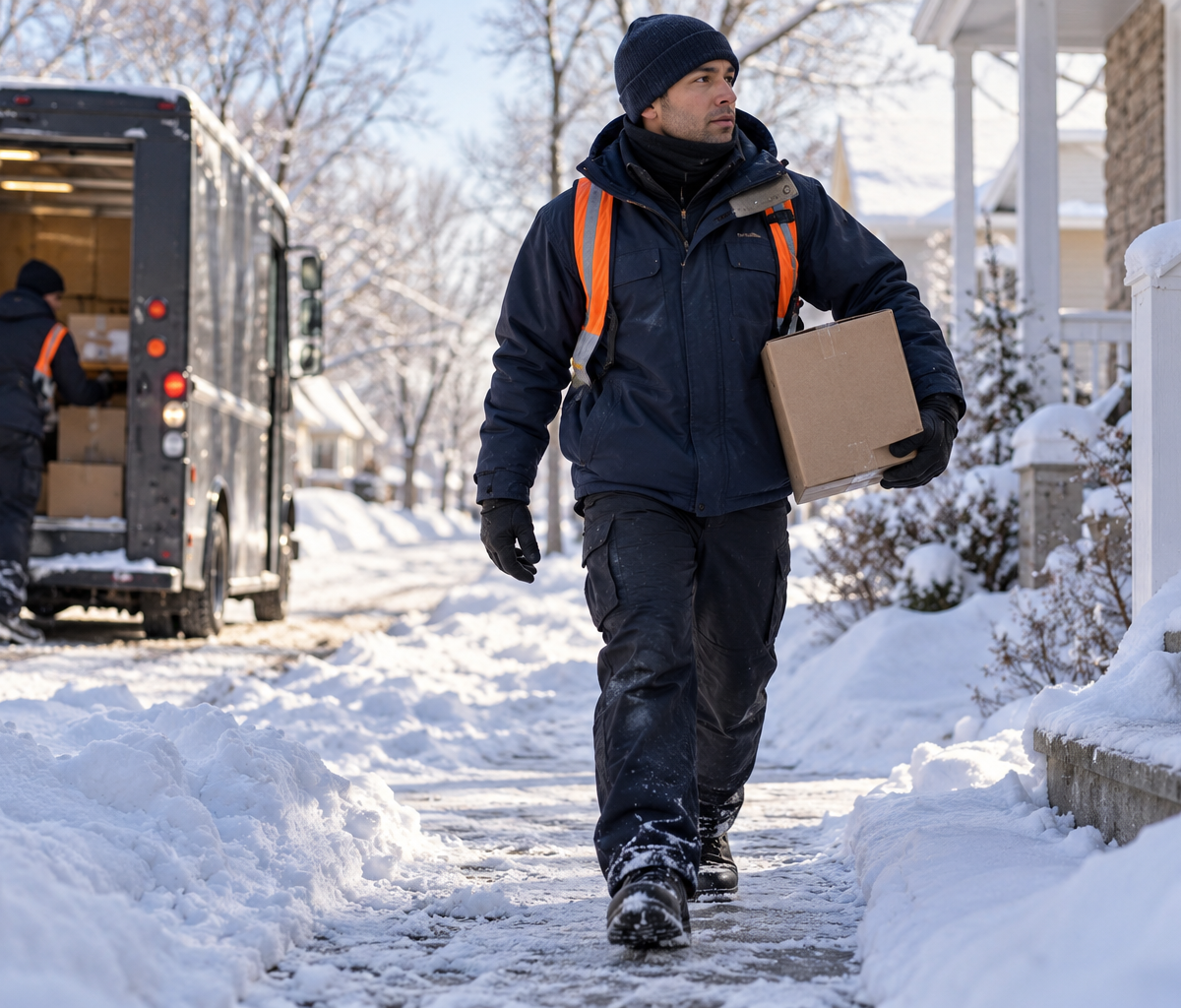
Ask how a winter delivery route provides usable clothing, warm-up access and support when repeated outdoor work becomes unsafe.
A delivery route can look manageable on a map while asking a driver to spend much of the shift outside. A long walk from the van to an apartment entrance, a repeated trip through an exposed parking lot, and the time spent finding a safe place for a parcel all add up in below-freezing weather. Checking cold-exposure protections means finding out what clothing is expected, where a worker can warm up, and whom to contact when the planned work is no longer safe. A heated van helps only when the route leaves enough time and access to use it.
The National Institute for Occupational Safety and Health (NIOSH) identifies outdoor workers as a group at risk of cold stress. Its guidance recommends appropriate layered clothing, warm areas during breaks, limits on time outside in extreme cold, and training to recognize symptoms. Those recommendations give a candidate useful questions for an employer. They do not establish Delpack's winter gear policy, route length, break locations, or response procedure. Get those details from the operation that will assign the work.
Check cold-weather clothing and footwear
The first question about cold-weather clothing is what the job actually requires outdoors. Ask whether the employer provides a jacket, high-visibility layer, gloves, or other equipment, and whether a driver must bring their own. Confirm any fit or visibility requirements before buying gear. A bulky coat may be warm while standing still but awkward when carrying parcels or entering and leaving a van. The right arrangement must work through the whole route, including loading, walking, scanning, and driving.
NIOSH recommends several loose layers, protection for ears, face, hands, and feet, and waterproof insulated boots. It also notes that some clothing can restrict movement. A driver can use that guidance to ask whether required layers can be worn together and whether gloves permit the tasks the route demands. The employer should explain any equipment restrictions around vehicle controls, parcel handling, identification, or required visibility. A winter uniform label alone says little about warmth when the wearer spends repeated periods outside.
Ask what happens when clothing gets wet. Snow, slush, and perspiration can leave gloves, socks, or outer layers damp during a long shift. NIOSH advises workers to carry spare socks, gloves, a hat, and other warm items. A driver may need a dry spare kept in the van, but the practical question is where and when changing is possible. If the route has no place to change or dry gear, ask how a driver reports that condition and obtains help.
Footwear needs a route-specific discussion. The driver may walk on cleared sidewalks, wet steps, gravel, or snow that has not been removed. Ask what traction and waterproofing the employer expects and whether any shoe policy leaves room for insulated footwear. Do not assume an employer provides boots or reimburses for them unless its policy says so. If a required shoe makes the route difficult in winter, raise the conflict before the first cold-weather assignment.
Checking cold-exposure protections includes checking replacements. A glove lost mid-route, a jacket that no longer closes, or a boot soaked through is a work problem, not merely a shopping problem. Find out who can approve a replacement, a return to the station, or another way to restore usable protection. The answer may differ by employer, so ask for the actual process rather than relying on what another delivery company does.
Locate a usable warm-up area
A warm-up area should be identifiable before the driver needs it. NIOSH advises employers to provide warm areas for breaks and workers to move into warm locations during breaks. On a delivery route, possible locations depend on the employer's plan and the route. A van may offer heat during normal driving, while a station, approved facility, or planned break location may serve another purpose. Ask which places the driver is authorized to use and when the schedule permits a warm-up.
The question becomes sharper on routes with long outdoor walks. If a driver parks once and makes several deliveries on foot, returning to the vehicle may take time. Ask whether the route plan recognizes those walks and whether a worker can return to warmth between groups of stops. A nominal heated vehicle does not solve exposure during a long sequence away from it. The driver needs to understand whether the plan allows shorter outdoor stretches and how to request an adjustment when it does not.
Check the practical limits of the chosen warm place. Does the driver have access during the entire shift? Can a vehicle be parked and used there without blocking traffic or violating a property rule? Is the space still available after normal business hours? A café or building lobby should not be treated as a guaranteed refuge without an actual arrangement. If the employer's answer depends on public places, ask what the fallback is when they are closed.
Warm-up time should be discussed as part of route planning. Ask whether winter schedules account for extra time to walk carefully, change wet gloves, and use an approved warm area. The amount of time will vary with conditions and the work; no single fixed interval follows from the general NIOSH guidance. A useful policy explains who may adjust the route or workload when repeated cold exposure makes the original plan unrealistic.
Ask how the employer handles a driver who notices a problem before symptoms appear. For example, wet gloves and a long remaining outdoor sequence may justify contacting the lead for a warm-up and replacement gear. Waiting until the worker is visibly ill would make the support path much less useful. Checking cold-exposure protections means learning the preventive option and the urgent response, with a named contact for each.
Understand outdoor exposure time on the route
The outdoor exposure time is broader than the minutes shown beside individual stops. It includes the walk from parking, waiting for access, carrying an item to the door, returning to the vehicle, and repeated loading or sorting outside. Ask how much of a typical winter shift takes place outdoors and whether the answer changes for apartments, large campuses, or rural properties. A route with many short exits can feel different from one with a few long walks.
NIOSH recommends limiting time outside on extremely cold days and using relief workers or extra workers for long jobs. An employer may choose a different operational method that still addresses the exposure, but a candidate should ask what happens when the planned outdoor work grows beyond what can be done safely. Can stops be redistributed? Can a driver return to the station for dry gear? Is there someone who can take part of a route? Ask for the available options and who decides.
Weather conditions can change during a shift. A route that begins in manageable cold may later involve stronger wind, wet snow, or a vehicle heater problem. Ask how the team communicates changes and whether dispatch can alter the sequence or provide support. A forecast is a planning input, not a promise about each block or doorway. The driver should report conditions actually encountered and avoid claiming that the whole route has one uniform exposure level.
Do not let a stop count stand in for an exposure assessment. Two routes with the same number of deliveries may differ in parking distance, stairs, building access, and time outside. Ask the employer how it accounts for those differences when assigning winter work. If the first day reveals a mismatch, the driver should have a way to report the actual walking and warm-up time so the next assignment can be planned with better information.
Vehicle condition is part of this discussion. Confirm what a driver should do if the heater, defroster, door seal, or other equipment needed for a workable winter route fails. A defect report should identify the vehicle and the problem; the employer must decide whether repair, a substitute vehicle, or a route change is appropriate. A driver should not quietly continue on the assumption that the next warm-up opportunity will compensate for equipment that is not working.
Know the cold-stress escalation path
The cold-stress escalation path starts with recognizing that a worker's condition or the available protection may have changed. NIOSH lists hypothermia, frostbite, trench foot, and chilblains among cold-related illnesses and urges workers to monitor themselves and coworkers. A driver should receive the employer's training on warning signs and response. This article cannot diagnose a condition or replace medical advice; the operational point is to know whom to call, where to get warm, and how the route will be handed off.
Ask for the immediate contact route. Is the driver expected to call dispatch, a supervisor, a safety lead, or emergency services when symptoms appear? What should they do if a contact does not answer? An ordinary route delay and a possible cold-related medical emergency need different levels of response. The employer's training should make that distinction usable under pressure, with contact information available in the field rather than only in an onboarding slide.
Report concrete observations: current location, how long the driver has been outside, whether clothing is wet, whether the van heat works, and what the worker is experiencing. Avoid inventing a temperature reading or diagnosing yourself. The person receiving the report can then arrange a warm location, another worker, vehicle support, or emergency help as appropriate. The driver should follow the employer's instructions and seek urgent medical help when the situation calls for it.
Check what happens to the parcels and vehicle after an escalation. A driver who needs help should not have to solve every delivery exception first. Ask who takes over the route, how undelivered items are documented, and how another worker locates the vehicle. These are handoff questions, not reasons to delay care. A process that requires the affected worker to keep making stops until the route is empty fails to answer the practical safety concern.
Checking cold-exposure protections also means asking how a near miss is used. If a driver became too cold during a repeated long walk but recovered after warming up, will a lead review the route design, equipment, or break access? The worker can record the location and circumstances without asserting a medical diagnosis. That information lets the team correct the conditions for the next shift instead of treating the event as an isolated complaint.
Walk through a below-freezing route
Consider an illustrative driver assigned an apartment-heavy route on a below-freezing day. Several buildings require parking away from the entrance. Each group of parcels involves a long outdoor walk, and the driver expects to make several such trips before reaching a reliable place to warm up. The example does not describe a Delpack route or set a universal temperature threshold. It tests whether the employer's clothing, warm-up, and support arrangements fit the actual work.
Before departure, the driver checks the approved winter clothing, spare dry gloves, and vehicle heat. They ask the lead which portion of the route can be broken into shorter outdoor sequences and where an authorized warm-up is available. The lead identifies a planned break location and explains how to contact dispatch if the walks take longer than expected. The driver now has a route plan that can be checked against what happens in the field.
At the first complex, the driver finds that the usable parking space is farther away than shown on the route notes. A single building takes several trips. The driver records the actual access issue and contacts dispatch before continuing through several similar buildings. Dispatch may approve a different sequence, help from another worker, or a return to an available warm location. Those are illustrative options; the operation must choose what is possible and safe for its fleet and staffing.
Later, snow soaks the driver's gloves. The spare pair helps, but only one dry pair remains and more long walks are scheduled. The driver reports the change while still able to work and asks where replacements or a warm-up can be obtained. If the driver develops concerning symptoms, the question changes from routine adjustment to the employer's urgent response and medical guidance. Continuing solely to preserve the route's planned pace would ignore the new exposure.
Now change one detail: the vehicle heater stops working. The earlier warm-up plan depended on a heated van between delivery groups. The driver reports the defect and waits for a decision about repair, a substitute vehicle, a different warm location, or route reassignment. The specific response belongs to the employer. What matters to the candidate is whether the operation has an owner for that decision and a way to avoid leaving the driver to improvise.
This example is about sustained exposure across a route. A separate question arises when one doorstep, stairway, or parking area becomes unsafe because of ice or another severe-weather hazard. The decision to pause that individual delivery attempt has its own reporting and parcel-recording rules. Here the focus remains on keeping the worker warm and equipped throughout the outdoor shift.
Ask for the support arrangement before accepting the route
A candidate can make the discussion concrete: What winter clothing is provided or required? Where can drivers warm up during a route? How are long outdoor walks reflected in the schedule? Who can adjust the assignment when exposure grows? What happens if the van heater fails or gear becomes wet? What training covers cold-stress symptoms, and who takes over a route when a driver needs help? Ask for examples from the employer's actual winter operations.
Compare the answers as a system. A warm jacket cannot compensate for no way to replace soaked gloves. A heated vehicle helps only if the driver can reach it often enough and the heater works. A supervisor phone number is useful when the person answering can authorize a change. Look for a clear chain from the condition the driver reports to the person who can act and the place the driver can safely go.
Write down the arrangements that matter for your first assignment: clothing and spare gear, approved warm-up locations, the contact for route changes, the urgent response, and the handoff for undelivered parcels. If the policy is unclear, ask the employer to resolve it before a severe cold day. Checking cold-exposure protections is complete when the driver can describe what support is actually available during long outdoor work, rather than relying on a general promise to dress warmly. Related material appears in the driver guide hub, and local openings are listed on the Fort Wayne driver careers page.
Continue with Delpack
Review the Fort Wayne career overview or contact Delpack with a question about the company.