Checking fueling responsibilities
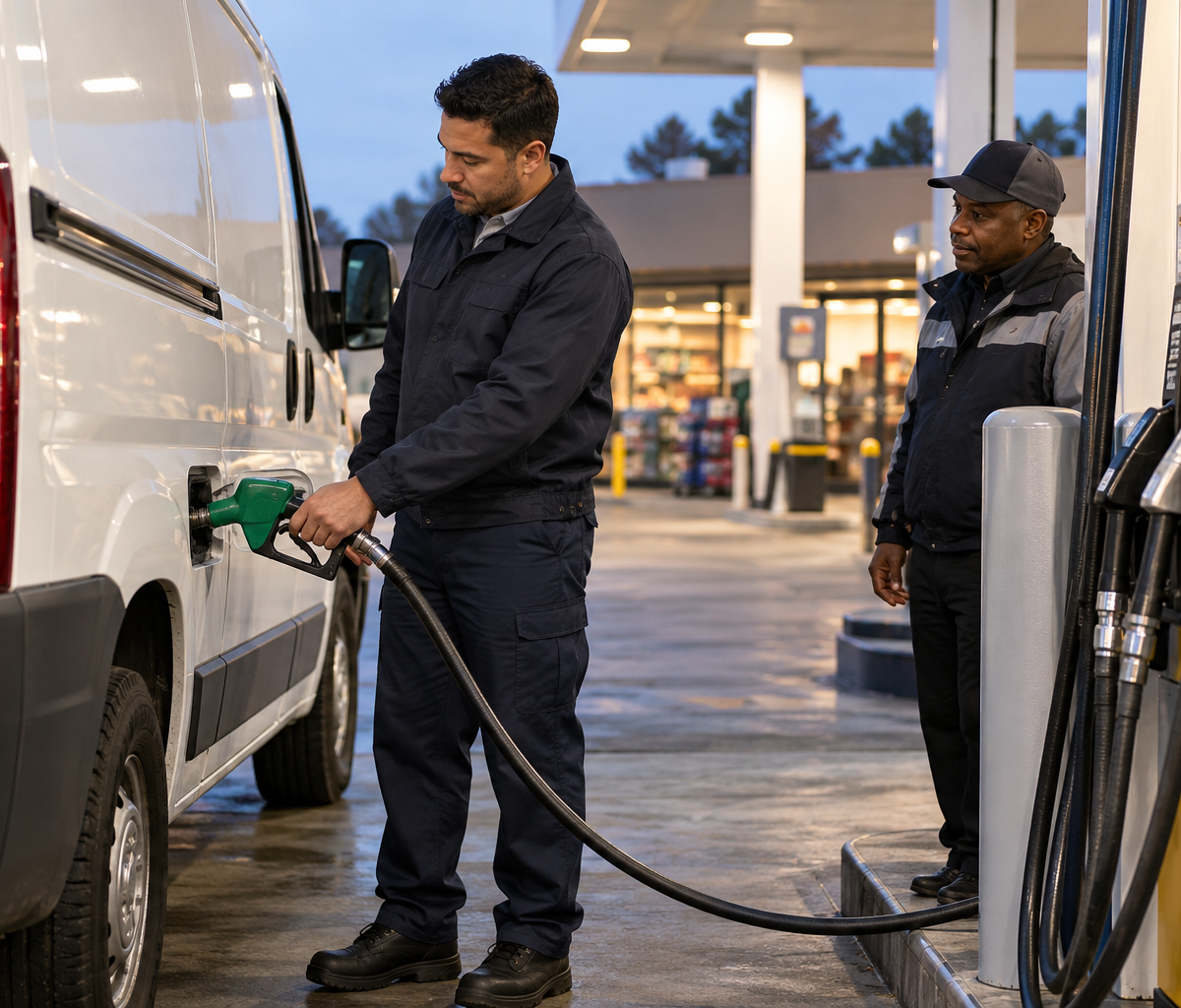
Clarify who fuels a route van, which station and payment method apply, how time is recorded, and who handles a failed stop.
A driver returns from a route, completes the delivery closeout, and learns that the van must be filled before tomorrow's departure. The assigned station is several minutes away. The driver has a fleet card but has never used it, and the shift record already looks complete. Checking fueling responsibilities means finding out who performs the fueling, which station and payment method are approved, how the task is recorded, and what to do when the plan fails. These details belong in the job's actual instructions before a driver is sent out with a low tank.
There is no universal delivery-fleet arrangement. Some operations may assign fueling to the returning driver; others may use a depot worker, a fuel service, or the next shift. The employer must state its own method. A candidate can assess the role by walking through an ordinary return and a late-return exception. The answers should identify one responsible person at each handoff, not leave an empty tank to be discovered by the morning driver.
Identify the assigned fueling task
The assigned fueling task begins with ownership. Ask whether a driver is expected to fuel before starting, during the route, after the route, or only when directed. If another employee normally fills vehicles, ask what the returning driver must record so that person can find the van and know its current fuel level. “Make sure the van is ready” is too broad when several people handle vehicle return and preparation.
Clarify the trigger. Does the operation use a fuel-gauge threshold, a scheduled fueling day, a route-specific range check, or a supervisor instruction? A dashboard estimate can change with driving conditions, so the driver should use the employer's stated rule rather than invent a personal cutoff. Ask whether the rule differs for a long rural route, a spare vehicle, or a van reassigned midshift. The person assigning the next route needs a reliable readiness record.
Find out how fueling fits with the other return duties. The driver may need to unload equipment, report vehicle defects, secure keys, and close delivery records. Ask whether fueling happens before or after those steps, and whether a depot lead must approve leaving the property once the route is closed. An instruction that arrives after the driver has handed over the keys creates an avoidable conflict. A clear sequence keeps the vehicle and its records together.
Ask who checks the result. If the driver fuels, does the employer require a receipt, odometer entry, gallons purchased, or a final gauge reading? If an attendant fuels later, who confirms that the session occurred before the van is assigned again? The answer should distinguish a request to fuel from proof that it happened. A note that says “fuel needed” is useful for a handoff, but it does not make the van ready.
Checking fueling responsibilities also covers shared vehicles. When one driver ends a route and another takes the same van shortly afterward, ask which shift owns the stop and how the handoff is recorded. The first driver may have no approved station nearby; the second may have a route that cannot start on the remaining fuel. The employer should decide the assignment based on its schedule and vehicle information.
Confirm the approved fueling station and fuel type
An approved fueling station may be a depot pump, a contracted retail location, or another site named by the employer. Ask for the exact address or site rule, not just the brand shown on a card. A card may work at several locations while company policy allows only some of them. Confirm whether the driver may choose another station when the usual one is closed or crowded, and who grants that exception.
Check the vehicle's required fuel type before the first stop. A fleet can contain different vehicles, and a rental or substitute may not use the same fuel as the van normally assigned. The driver should rely on the vehicle label and employer instructions, not a guess based on appearance. Ask where to find the vehicle ID and approved fuel grade, and whom to call if the pump selection does not match the record. The cost of a mistake can be much greater than the time saved by guessing.
Station access matters on early and late shifts. Ask whether the approved site is open during the hours when the driver may need it, whether a depot pump requires a gate code or attendant, and what happens after an unusually late return. A station that is convenient at midday may be unusable after the route closes. The fallback should be part of the instruction rather than an emergency search by a tired driver.
Fueling also has a site-safety procedure. OSHA's service-station provisions for flammable liquids address ignition sources and shutting off vehicle motors during fueling. A driver should follow the posted station rules and the employer's training, including any restrictions on phones, smoking, or positioning the vehicle. This article does not decide which regulatory provision applies to a particular site; it points to the need for a clear, safe fueling routine rather than an improvised stop.
Ask where to park if the pump is blocked or the station is unsafe to enter. The driver should be able to contact a lead from a safe place and receive an alternate plan. A low-fuel warning does not authorize using an unapproved pump, driving into a closed depot area, or leaving a van in a traffic lane while trying to resolve the payment method.
Understand the fleet card and payment path
The fleet card or other payment method must be usable by the person assigned to fuel. Ask whether the card stays in the van, is issued to a driver, or is held by a supervisor. Learn how to identify the correct card, any required PIN or vehicle number, and what information the pump asks for. Never share a PIN through an unapproved channel or assume a coworker's card may be used because it worked last week.
Confirm the purchase limits. The card may be restricted by location, fuel type, volume, time, or vehicle. A decline does not necessarily mean the driver has done something wrong; it may reflect a restriction, system outage, or mismatch. Ask who can check the transaction and authorize a safe alternate payment. Repeatedly trying different fuel grades or asking a cashier to split the purchase can create a messy record without fixing the underlying problem.
Find out whether the employer ever expects a driver to use personal funds. If so, ask for the written authorization process, required receipt, reimbursement route, and expected timing before paying. A driver should not assume that a receipt alone guarantees repayment. If the role never requires personal payment, that should be stated clearly too, along with the contact to use when a company card fails. This is separate from parking or toll expenses, which follow their own policies.
Receipts and transaction records should connect a purchase to the right van. Ask whether the worker must submit a paper receipt, upload a photo, or enter the odometer and vehicle ID in a fleet system. If a pump produces no receipt, the driver should know how to record the amount and transaction reference without inventing numbers. A missing receipt is an administrative exception; it should not erase the fact that fuel was purchased.
Checking fueling responsibilities includes card custody. A card left in the vehicle may need to be secured with the keys; a driver-issued card may need to be returned at the end of employment or a shift. Ask how a lost or damaged card is reported, who can deactivate it, and how the vehicle gets fuel while a replacement is arranged. The driver needs an authorized path, not an informal swap with another vehicle's card.
Place fueling inside the shift time record
The shift time record should reflect the work the driver is assigned to do. Ask whether fueling is scheduled before departure, during the route, or after delivery closeout, and how travel to an approved station is recorded. A driver who is told to fuel after the route ends should know whether they remain on duty and how to correct a time entry that closed too soon. Do not treat a completed delivery scan as the end of every work duty.
The U.S. Department of Labor's Fact Sheet #22 explains, in general, that covered employees' work time includes required work on duty or at a prescribed place. Whether a particular worker and interval are covered depends on the facts and applicable rules. The article does not calculate pay or classify a Delpack worker. It does support asking the employer to explain how required fueling and related travel are captured in the time system rather than leaving those minutes off the record.
Ask what happens when a station line is long. The driver may be waiting with a company vehicle and an assigned fueling task. The employer should explain how that interval is handled and who may authorize a different station or defer the task. A route plan that assumes a five-minute stop may be unrealistic at a busy pump. Recording the actual timing helps the operation improve future assignments.
Check the handoff between dispatch and payroll systems. A route app might mark the delivery work complete while the timekeeping app remains open, or the systems may close together. Ask which record controls worked time and how to correct a discrepancy. If a supervisor sends a late fueling instruction by message, keep that instruction with the fuel receipt and time entry so the assigned duty can be reconciled.
The right answer comes from the actual offer and employer policy, together with applicable law. A candidate should ask whether fueling is part of the job description, whether the estimated shift includes it, and whom to contact about an unpaid or missing entry. A vague promise that “we'll sort it out later” is difficult to rely on when the task recurs every evening.
Plan for a fueling exception
A fueling exception could be a declined card, closed station, wrong fuel listed in the system, pump outage, or vehicle defect. Ask for one contact who can decide the next action and a way to record what happened. The driver should report the vehicle ID, current location, approximate fuel level as shown by the vehicle, station or pump, and the error. Avoid guessing the reason for the failure when the card issuer or fleet system has not checked it.
Do not turn an exception into an unapproved purchase. If the card is declined, a driver should not use personal money or another vehicle's card without the employer's explicit instruction and expense path. If the station is closed, the driver should not search farther and farther away while off the planned route. The supervisor may approve another station, send help, postpone fueling, or assign a different van for the next shift.
Know the response to suspected wrong fuel or a spill. Stop the attempt and follow the station's and employer's emergency instructions. Do not start or continue operating a vehicle after a suspected misfuel until the responsible fleet contact assesses it. The driver should identify the vehicle, pump, product selected, and whether any fuel entered the tank. A quick, accurate report can prevent a small mistake from becoming a larger equipment problem.
If the vehicle reaches the depot without enough fuel for the next assignment, mark that status clearly. The next driver should not discover it only after loading. Ask whether the employer uses a vehicle-readiness board, shift note, or direct handoff and who updates it when the exception is resolved. A repair ticket for the card and a ready-to-depart record for the van are different things; both may need an owner.
Work through an after-closeout fueling request
Consider an illustrative driver whose route closes at 19:20. Dispatch then asks the driver to fill van V4 at the approved station before returning the keys. The gauge is near the employer's fueling threshold, and the usual fleet card is in the vehicle. These details are a worked example, not a Delpack shift schedule, fuel rule, or promise about a particular card.
The driver confirms that the instruction is assigned work and checks how to reopen or extend the time entry. They verify the van's fuel type and approved station, then travel there by the authorized route. At the pump, they follow the station's safety instructions, use the assigned card, and record the transaction and odometer if required. They return the van, receipt, keys, and final fuel status through the employer's handoff.
Change one detail: the card is declined. The driver records the displayed error and contacts the named fleet or dispatch owner. If the owner authorizes a different station or payment method, the driver keeps the instruction and receipt with the time record. If the owner defers fueling, the driver marks V4 as not yet ready. They do not report a full tank merely because they reached the pump.
Now suppose the driver had already clocked out when the fueling request arrived. The work instruction needs a corresponding timekeeping answer before the driver leaves for the station. The driver should ask the supervisor how to record the additional duty and travel, then verify the final entry. The example is about assignment, payment and record ownership. Electric-van charging has a different equipment and handoff process, while parking and toll charges are separate expense questions.
Ask for the complete fueling handoff
A candidate can ask: Who fuels the van? At what point in the shift? What threshold triggers the task? Which station and fuel type are approved? How does the card work, and what happens if it fails? Can personal payment ever be required? How are receipts and time recorded? Who checks that the vehicle is ready for the next route? Ask the employer to walk through a late return, because that is where unclear ownership often becomes visible.
Write down the contact for a card decline, the process for an unavailable station, and the way to flag a van that still needs fuel. Those details can save a second trip and prevent a morning departure problem. Checking fueling responsibilities is complete when the driver can describe who performs the task, how the fuel is paid for, how the time is recorded, and who owns an exception. The driver guide hub has related guidance, and the Fort Wayne driver careers page lists local roles.
Continue with Delpack
Review the Fort Wayne career overview or contact Delpack with a question about the company.