Checking medical-emergency response at a logistics facility
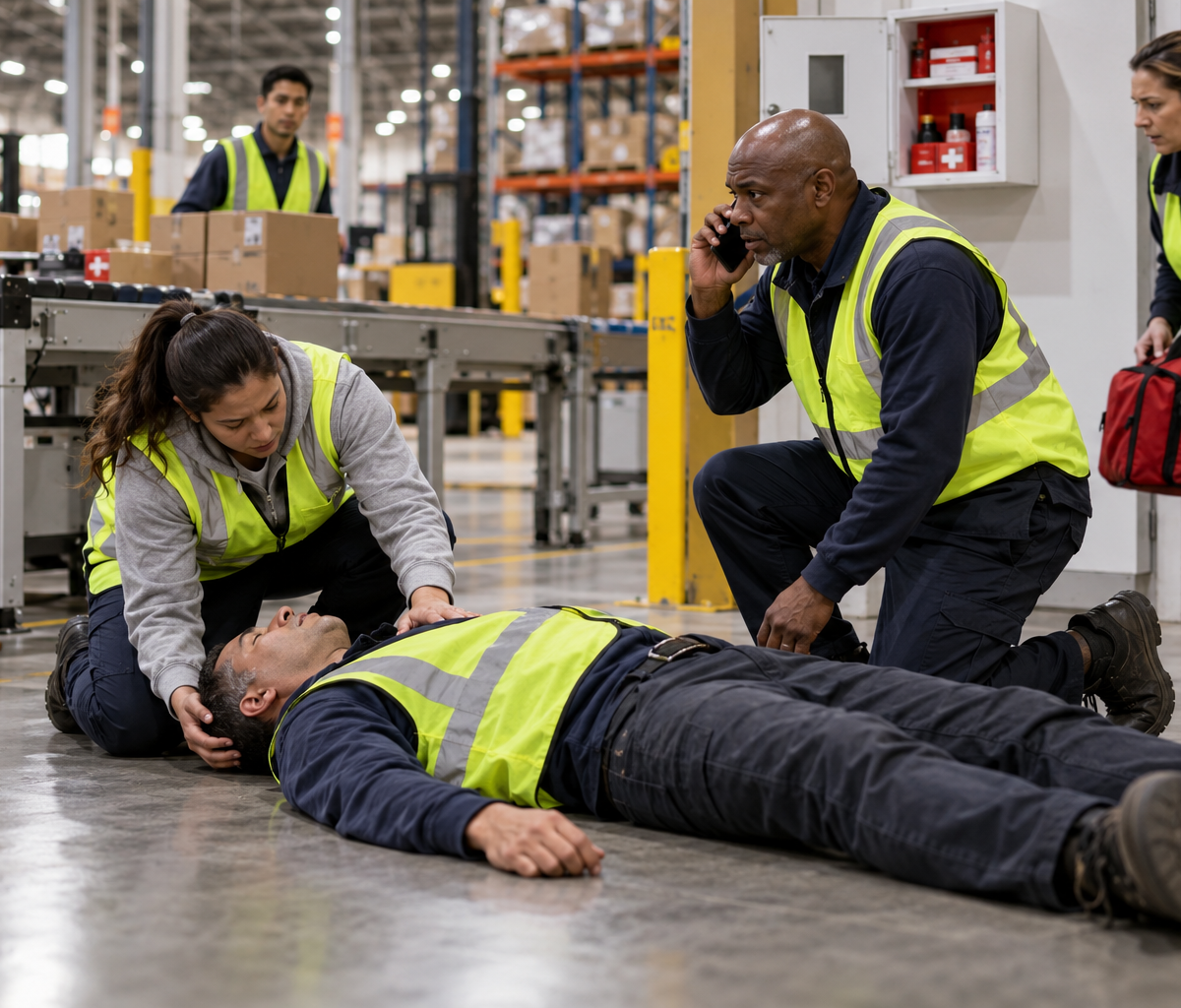
Know the immediate emergency call, first-aid resources, responder entrance, and factual handoff when someone collapses at work.
A picker collapses beside a packing station. Coworkers see the person on the floor, but the first few seconds can be lost if no one knows who calls emergency services, where first-aid equipment is kept, or how responders enter the building. Checking medical-emergency response at a logistics facility means knowing the site's immediate contact path and handoff plan before a sudden event occurs. The worker's task is to raise the alarm, protect the scene, obtain qualified help, and give responders clear location and event information. The article does not ask a coworker to diagnose the cause of the collapse.
Facility arrangements vary. A site may have an internal emergency number, trained first-aid responders, an automated external defibrillator, a staffed security desk, or a direct call to 911. The Occupational Safety and Health Administration says workplace medical and first-aid programs depend on the circumstances of the employer and worksite. A worker should learn the actual local plan rather than assume that a visible first-aid cabinet or a posted phone number is the complete response system.
Know the immediate emergency contact
The emergency contact is the route to urgent help when a person may need immediate medical care. In the United States, an unresponsive person is a reason to call 911 or have another worker call, following dispatcher instructions. The American Red Cross first-aid steps tell bystanders to call 911 for a person who does not respond, is not fully awake, is not breathing normally, or has another obvious life-threatening condition. A workplace internal number may coordinate response, but workers need to know whether it replaces or accompanies the external emergency call.
Ask what to do if the ordinary supervisor is absent. A shift may run overnight, in a detached warehouse, or with several contractors sharing a facility. The emergency path should not depend on finding one named person. Find the posted number, radio channel, or alarm method and know the backup if the first contact fails. A worker should not wait for permission to report an apparent life-threatening emergency when the site's plan directs immediate emergency services contact.
The caller should give the location that responders can use: facility name, street address, entrance or gate, building section, floor, packing station or aisle marker, and a callback number. "At the warehouse" is too vague in a large logistics park. The caller can describe what was observed, such as "a person collapsed and is not responding," without inventing a diagnosis. Keep the line open and follow the emergency dispatcher's instructions.
Checking medical-emergency response at a logistics facility includes checking whether the address and entrance instructions are posted near phones and work areas. A new employee should not have to search an intranet while a coworker lies on the floor. If the posted location is outdated after a building move or entrance change, report it to the site's safety owner before an emergency.
Find first-aid access and trained help
The first-aid access plan includes supplies, trained responders, and any AED the facility maintains. Ask where the equipment is located, whether it is available during every shift, and who checks it. A cabinet behind a locked office is not readily useful to a night crew if no one has access. The employee should know how to call a trained responder without leaving the person alone unnecessarily.
OSHA's medical and first-aid overview stresses that programs are tailored to the worksite. This guide does not assert that every logistics facility must have the same equipment or staffing. The practical check is whether the worker can identify the site's plan and reach the resources it promises. If a posted AED location is blocked by freight or moved without a new sign, tell the safety owner so the path can be corrected.
Immediate aid should stay within training and emergency-dispatch instructions. The Red Cross advises CPR and AED use for an unresponsive person who is not breathing or is only gasping. A coworker trained for that response can act while help is on the way; others should follow the 911 operator and the site's emergency procedure. Do not give food, drink, medication, or an improvised treatment because someone guesses why the person collapsed.
Ask how the site keeps forklifts, conveyors, and pedestrians away from the response area. A coworker can stop nearby work through the approved emergency control and direct others away from moving equipment. Do not move the person unless there is an immediate danger or emergency professionals direct it. The point is to make the scene accessible and safer for the person, responders, and nearby workers.
Assign the responder access route
The responder access route connects the public entrance to the exact location inside the facility. A warehouse may have multiple gates, docks, badge-controlled doors, or buildings with similar names. Ask who meets emergency medical services at the entrance, who opens the gate, and who guides them to the packing station. If the site uses security staff, learn the backup when that desk is unstaffed.
One worker may need to remain with the person while another goes to meet responders. The caller can tell dispatch which entrance will be opened and whether a gate code, construction closure, or truck queue may delay access. The facility should not send an ambulance through a busy loading lane without warning. An employee should know whom to contact to pause vehicle movement or clear a path under the site plan.
Use durable location markers: aisle numbers, dock doors, floor signs, and posted building names. If a coworker says "near the blue conveyor," that may help internal staff but not outside responders. Give both the official location and any useful landmark. Keep the route clear as far as it can be done safely. Do not ask untrained workers to direct traffic in a hazardous yard without the approved controls.
If the person is moved by emergency responders, note where the handoff occurred and who accepted care. Coworkers do not need to follow the ambulance unless asked by the site or family process. The medical team owns care after the handoff; the facility's support owner handles worksite communications and any required incident record.
Large sites should identify the entrance a 911 caller should name, even when a worker's usual entrance is somewhere else. A badge reader used by employees may not admit an ambulance. A dock door may be blocked by a trailer. The site plan should identify who can open an emergency access point and how that person is reached on every shift. A worker who notices that the mapped entrance is unusable should tell the caller and site lead promptly, so responders receive a workable approach rather than two conflicting directions.
Share a concise incident handoff
The incident handoff gives emergency responders facts they can use: where the person was found, what was observed, when the collapse was noticed, what emergency call was made, and any aid actually given. A coworker can say "I saw the person fall at 10:15 and they did not answer when spoken to." They should not state a cause such as stroke, seizure, or cardiac arrest unless qualified responders make that determination.
Tell responders about immediate site hazards: moving equipment, chemical exposure if known, a confined area, or a blocked route. Avoid opening a private personnel file or sharing unrelated medical history. If the person has a medical alert item visible and the dispatcher asks, report what is actually present. The handoff should help care while respecting the person's privacy.
After responders take over, a supervisor may need a separate workplace record. That record should keep witness observations distinct from later medical conclusions. Record the names or roles of people who called, met responders, or provided aid, using the employer's confidential channel. Do not fill gaps with rumors from nearby workers. If the time of collapse is uncertain, state the time the person was first found and the uncertainty.
Incident communication may include notifying the site's emergency lead, preserving the work area for a safety review, and contacting family through the designated process. Those actions should not delay a 911 call or first aid. Workers should not post the event in a general chat or share images of the person. The employer's privacy and incident procedures determine who receives details after the urgent handoff.
Work the packing-station collapse example
At 10:15, a picker collapses beside packing station P6. A coworker sees the person on the floor and gets no response. They call 911 or direct another worker to do so immediately under the site plan, giving the facility address, north entrance, and P6's aisle marker. Another worker alerts the trained first-aid responder and brings the AED if the plan calls for it. The team follows the dispatcher and its training while emergency services travel to the site.
The shift lead stops nearby equipment through the approved control and keeps the aisle clear. A designated employee meets responders at the north entrance, where a truck queue could otherwise block them, and guides them to P6. The coworker who witnessed the collapse tells the medical team what they saw and when, without guessing why it happened. If aid was given, the trained responder explains what was done.
After the medical team takes over, the supervisor records the worksite facts through the confidential incident process. They identify who made the call, who met responders, and whether the equipment in the area was stopped. They do not announce a diagnosis to the shift. This is an illustrative case; it does not establish that any specific Delpack site has a north entrance, AED, responder team, or packing station named P6.
Now consider a failure in the plan: the posted entrance number routes callers to a disconnected desk. The worker should still use the direct emergency number and give the public street address and available entrance details. After the event, the safety owner should correct the posted contact and test it. A medical-emergency plan is useful only when the person on a real shift can make it work.
The example's decision is immediate aid and handoff. A later investigation into why the event happened or whether the worker can return to duty is a different process. The first response should be judged by whether help was called, the scene was made accessible, and responders received truthful facts quickly.
Check the site plan before a crisis
A site plan check can be short. During orientation or a shift briefing, locate the emergency number, the site's street address, first-aid supplies, trained responder contact, AED if provided, and the route responders will use. Ask how the plan works during nights, weekends, or temporary staffing. A visitor or contractor should also know how to raise the alarm without access to an employee-only app.
Report missing or blocked resources. A first-aid kit whose location has changed, a locked entrance with no emergency keyholder, or an aisle marker that responders cannot see is a real readiness gap. The site owner should update signs and communication paths when operations move. Workers need not design the entire emergency program to notice that the posted plan does not match the building.
Shared facilities deserve an extra question: which organization answers the alarm? A tenant may employ the picker while a property manager controls the gate and another company staffs security. Workers should know the first call to make and which site contact coordinates access for emergency services. The plan should not depend on a person guessing whether a tenant supervisor or building security has authority. After a shift change or contractor turnover, the site can confirm that contact numbers and access roles still work. That is a check of the response path, not a medical diagnosis or a training exercise for unqualified staff.
This topic concerns a sudden medical event inside a logistics facility. It does not duplicate the career work of a safety coordinator, which covers routine hazard assessment and training programs. It also does not set the reporting deadline for a driver's vehicle collision. Those subjects may use the same supervisor, but the immediate response to an unresponsive coworker has its own urgency and handoff.
Checking medical-emergency response at a logistics facility is complete when workers know how to summon help, reach first-aid resources, guide responders, and pass on observed facts. The driver guide hub covers related work decisions, and the Fort Wayne driver careers page lists local roles.
Continue with Delpack
Review the Fort Wayne career overview or contact Delpack with a question about the company.