Checking package-theft response policy
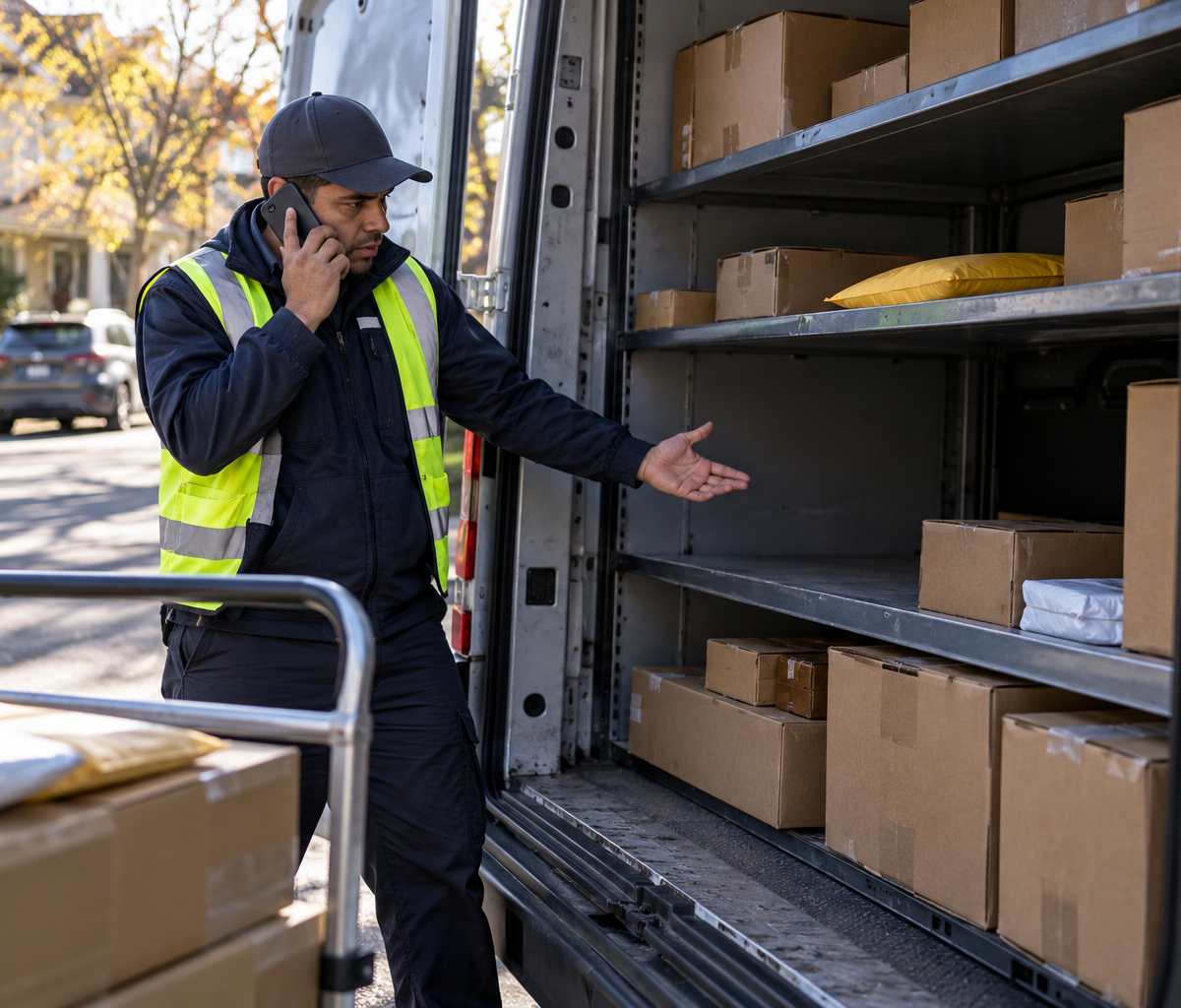
Ask how a driver reports a suspected parcel loss, preserves custody facts, receives safety support and hands investigation to the right team.
A driver opens the van to retrieve parcels at an apartment stop, makes a delivery, and returns to find one item missing from the load. The door was open for part of the stop, but the driver did not see anyone take a parcel. The item might have been taken, misplaced in the van, or scanned into the wrong group. Checking package-theft response policy means knowing how to protect personal safety, preserve what is known, report the suspected loss, and get help with the remaining route without deciding the cause from a guess.
The FBI's cargo-theft guidance tells people to call 911 when they are in immediate danger and describes reporting theft to local or state law enforcement. Its cargo-theft scope is broader than a single missing delivery parcel, and it does not establish Delpack's escalation threshold or assign fault to a driver. A candidate should ask the employer for the actual response policy: who receives the first report, what evidence is needed, who investigates, and what support is available if the route cannot continue as planned.
Start with the first safety response
The first safety response depends on what the driver encounters. If someone is threatening the worker or trying to enter the van, the driver should follow the employer's emergency training, get to safety, and call emergency services when needed. The FBI advises calling 911 if there is immediate danger. A missing parcel discovered after the fact is different: the worker should not chase a person, search private property, or confront a bystander based only on suspicion.
Ask how the employer wants a driver to secure the vehicle and remaining parcels while reporting. The driver may need to move to a safe lawful parking place, close the vehicle, and contact dispatch. They should not leave the van open to photograph a scene or keep searching while other items remain exposed. Safety and custody come before a detailed inventory. The employer's procedure should explain what to do when the driver is alone at a busy stop.
Check the difference between an active theft and an unexplained shortage. A driver who sees a person removing parcels may have a different immediate response from one who notices a missing package during sorting. Both deserve prompt factual reporting, but the first may involve urgent danger or law enforcement. A policy should give drivers a way to describe what they actually observed without forcing the word “theft” into every missing-item report.
Ask what to do if a customer or witness approaches. The driver can record a name or statement through the employer's approved process, but should avoid arguing, promising reimbursement, or asking a bystander to detain anyone. The employer should identify who speaks with customers and law enforcement after the first report. A driver can help preserve facts while another team handles the investigation and claims.
Checking package-theft response policy includes worker support. A driver who has been threatened or shaken by the event may need to stop, get help, or hand off the route. Ask whether dispatch can send another worker, arrange a safe meeting place, or take over customer communication. The response should protect the person as well as the remaining inventory.
Use the internal theft report
The internal theft report should tell the employer what happened while the details are still fresh. Ask whether the first step is a call to dispatch, an app incident button, a safety hotline, or a supervisor message. A normal “package missing” scan may update delivery status without alerting the team that the van may have been accessed. The policy should distinguish those workflows and state when the driver must use each one.
Learn what counts as first notice and whether a detailed form follows. A phone call may let dispatch secure the route, while a later written report records times, location and evidence. Ask how the driver confirms the report was received and who owns it after the dispatcher changes shifts. A report left in a personal text thread may be hard for the investigation team to find.
Describe the event in neutral terms. The driver can say when the parcel was last seen or scanned, when the van door was open, what was discovered, and whether any person was observed near the vehicle. They should say when a fact is unknown. “A parcel is missing after this stop” is different from “a customer stole it.” An unsupported accusation can harm an innocent person and distract the team from checking other explanations.
Ask whether the employer wants a quick inventory before the driver continues. The missing item may be in another tote, under a shelf, or attached to a different stop. The worker should follow the approved search method without opening sealed customer parcels or exposing more items. A route lead may decide whether to check the van at the scene, at a safer nearby location, or back at the depot.
Checking package-theft response policy also means knowing the after-hours contact. A late delivery may occur when the regular supervisor is unavailable. The policy should name a backup who can decide whether to continue, pause, or transfer the route. An unanswered voicemail is a poor substitute for an operational response when the vehicle's security or remaining parcel count is uncertain.
Preserve the parcel custody record
The parcel custody record connects the missing item to its last confirmed point. Ask what the employer expects the driver to preserve: stop ID, scan history, vehicle ID, tote or cage assignment, load count, door-open time, and delivery sequence. The driver may not have access to every system. They should record their own observations and let the responsible team retrieve logs, camera footage, or customer data through authorized channels.
Check the scan states carefully. A parcel marked loaded, out for delivery, attempted, or delivered may have different implications. A scan may show where a device was at a moment, but it may not prove where the physical parcel went afterward. The worker should not change a scan to make the count look correct. If an earlier scan was wrong, the policy should provide a correction method that preserves the original event and explains the update.
Ask how to photograph the scene if the employer requests it. A safe image of a damaged door or disturbed load may help, but the driver should not photograph people or private property beyond the approved need. If there is visible damage, record it before repair or cleanup if that can be done safely. Do not disturb a possible crime scene contrary to law-enforcement instructions. The response owner should tell the driver what can be documented immediately.
Separate a parcel count from a value claim. The driver may know that one package is missing without knowing its contents or retail value. They should not guess the value, promise a refund, or assume that a particular insurance process applies. The employer or shipper has the systems to determine shipment identity, customer contact, and any claim. The driver's job is to provide an accurate custody timeline.
Find out how remaining parcels are secured and transferred if the driver leaves the route. A second worker needs the vehicle or tote identity, current stop status, and a list of items still in custody. The handoff should not mark undelivered parcels as completed. A truthful inventory protects customers, the next driver, and the investigation from confusion created by a hurried route transfer.
Know who manages the investigation support
Available investigation support may involve dispatch, fleet safety, loss prevention, the shipper, a customer-service team, or law enforcement. Ask which team has authority to gather records and decide whether an external report is needed. The driver should know who will contact them for a statement and who will communicate with the customer. A handoff among several teams should have one owner who can answer where the case stands.
The FBI's cargo-theft page lists local or state law-enforcement reports among its reporting options. Whether a single missing parcel calls for police contact depends on the facts and the employer's process, and immediate danger has its own response. Ask who makes that decision and what information the driver must provide. A worker should not be left to infer that every shortage is a crime or that no theft should ever be reported externally.
Ask how the employer distinguishes an employee error, a misload, a misplaced parcel, and suspected theft. The investigation may compare load scans, route events, customer contacts, and vehicle access. The driver should be able to submit a factual account and correct a misunderstanding. A missing item is a finding about inventory; it is not proof that the driver caused or committed the loss.
Find out what happens if the event affected the driver's safety or ability to work. Is there a supervisor check-in, a route reassignment, or help filing a police report if requested? The policy should describe support without promising a particular outcome. A worker may need medical or legal advice in a serious case; the article cannot replace either. It can prompt the candidate to ask whether the employer has a clear contact rather than leaving the driver alone with the aftermath.
Ask how the driver receives closure. A case may end with a parcel found in the wrong tote, a customer correction, or an unresolved loss. The worker should learn whether they need to update a route record or provide another statement. They may not receive private investigative details, but they should not be told to keep changing delivery scans without an explanation of the correct status.
Work through the open-van-stop example
Consider an illustrative driver who opens the van at a multibuilding stop. They retrieve two parcels, deliver them, and return to find a third parcel missing from its expected shelf. The van door was open briefly while the driver moved a cart, but no person was seen taking anything. The example is a test of the response process; it does not describe Delpack equipment or establish that theft occurred.
The driver closes and secures the van, moves to a safe place if needed, and checks the assigned tote and scan history using the employer's procedure. The parcel is still missing. They contact the designated operations number and report the stop ID, last confirmed scan, approximate time, door condition, and what they did or did not observe. They do not mark the parcel delivered or accuse a passerby.
The response owner asks the driver to pause the affected stop while it reviews the load record. It may discover a misload, ask for a controlled second search, or direct a formal loss report. If law enforcement is needed, the employer explains who calls and what facts are shared. The driver receives instructions for the remaining parcels and any customer-service status, without making promises to the recipient.
Change one detail: the driver sees a person carrying parcels away and feels threatened. The priority shifts to personal safety and emergency response. The driver should not chase the person to recover inventory. They report the observed description only from a safe place and follow emergency and employer instructions. The later custody record can be completed after the immediate danger is addressed.
The example is about suspected loss during delivery and support for the driver. A warehouse security coordinator's career centers on facility access controls and investigations. A collision or injury has a different first-report sequence and may involve road-scene duties. Keeping those scopes separate helps the driver use the correct channel for the event they actually face.
Ask for the policy before a loss occurs
A candidate can ask: How is a suspected missing parcel distinguished from theft? Who gets the first report? What scans and observations should the driver preserve? Who decides whether police are contacted? Who handles the customer, the remaining route, and the worker's safety? What happens if the case is later explained by a misload? Ask the employer to walk through a single missing parcel as well as a witnessed theft.
Keep the reporting contact and basic record fields accessible on the route. A usable policy lets the driver get safe, report facts promptly, preserve custody information, and hand the investigation to the right owner. Checking package-theft response policy is complete when the worker knows what support follows a suspected loss without assuming blame or inventing evidence. The driver guide hub has related work guidance, and the Fort Wayne driver careers page lists local openings.
Continue with Delpack
Review the Fort Wayne career overview or contact Delpack with a question about the company.