Checking severe-weather stop rules
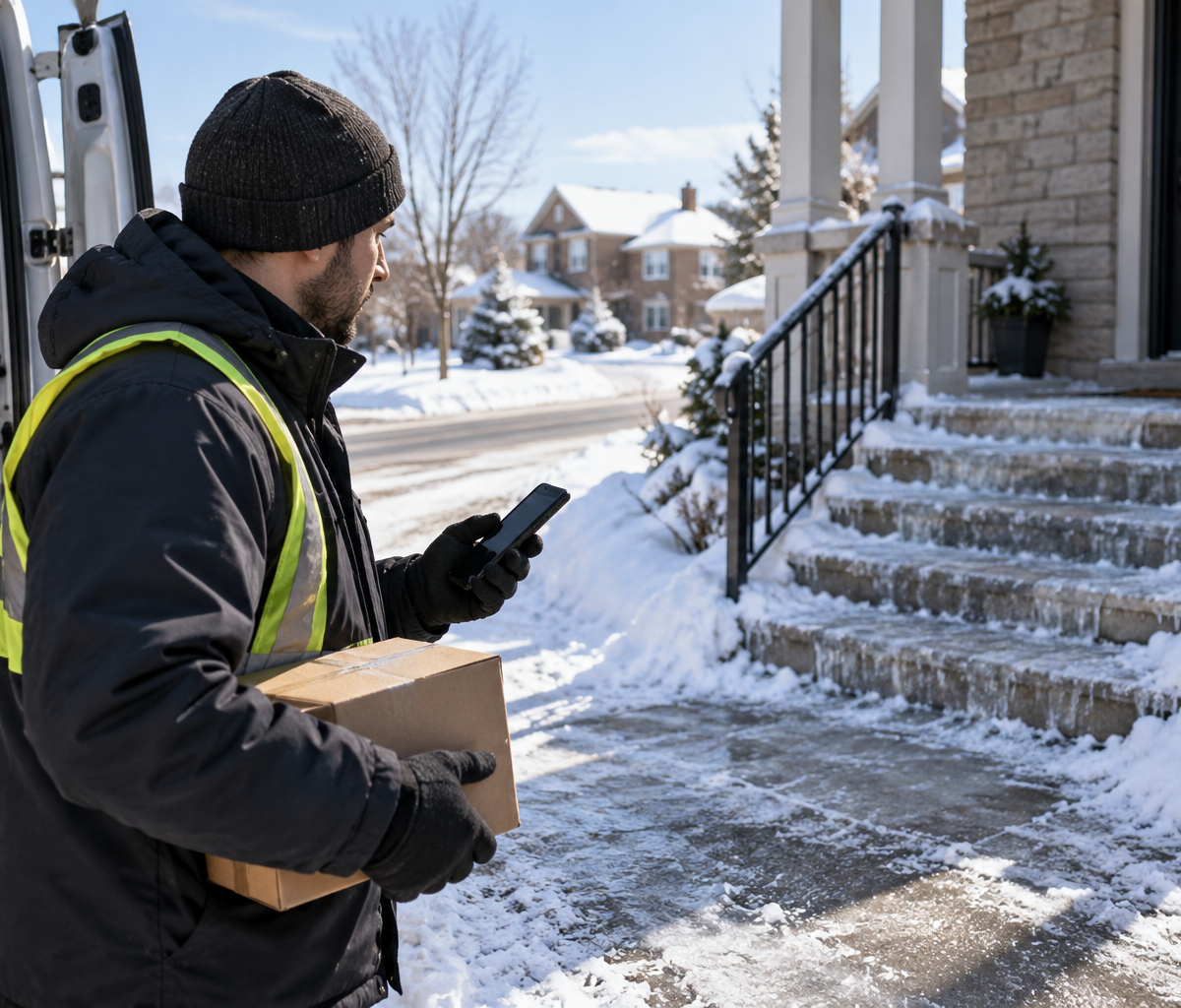
Clarify who may pause a single unsafe weather-affected delivery, how dispatch decides the next step and how the parcel is recorded.
A driver can reach the right address on a winter route, yet the final stairs to the door are coated with ice. Nearby streets remain open and other stops may be deliverable. The question is what happens to this parcel and who may decide that this attempt should pause. Checking severe-weather stop rules means learning how a driver identifies a weather hazard at one stop, contacts dispatch, records the item truthfully, and resumes only when an approved safe method exists.
OSHA's winter-weather guidance recognizes snow and ice as hazards for workers and discusses slip prevention. It does not provide Delpack's rule for a customer's stairs or a universal threshold for skipping a delivery. A candidate should ask the employer to walk through a concrete stop where the road is passable but the approach to the door is not. The answer should distinguish a stop-level decision from a decision to close an entire route.
Recognize the stop-level hazard
A stop-level hazard is a condition on the approach or at the handoff point that makes the specific attempt unsafe. It may be ice on steps, a flooded walkway, a fallen branch, or a blocked entrance after a storm. The driver should describe the actual condition and where it begins. “Bad weather” is too broad if only one property has an unusable path; the support team needs enough detail to assess this address.
Ask how the employer expects drivers to check the approach before carrying a parcel. A path may look clear from the van but become icy at a shaded stair or side entrance. The worker should know whether to stop at a safe observation point, keep the parcel secure, and contact dispatch before attempting the hazardous section. They should not test a slippery stair while holding a box merely to prove it cannot be used.
Find out whether alternate access is part of the procedure. A building may have a cleared front entrance, a receiving desk, or an accessible ground-level handoff. Those options are useful only if the driver is authorized to use them and the customer or site actually accepts that delivery location. Do not leave a parcel at an improvised spot because it is easier to reach. Ask who can approve an alternate handoff and how it is documented.
Weather may change during the shift. Rain can freeze after sunset, a plow can block a driveway, or a storm can clear while the driver is nearby. The rule should account for the condition observed at the time of the attempt rather than assuming a morning forecast describes every stop. A driver can report new facts and request a revised instruction when conditions change.
Checking severe-weather stop rules includes an honest distinction between unsafe access and inconvenience. A longer cleared walkway may be usable even when the closest path is not; a steep icy stair may remain unsafe despite a delivery deadline. The employer should define who assesses those alternatives and how a worker explains the hazard without feeling forced to make a risky attempt to satisfy a scan requirement.
Clarify authority to pause an attempt
The authority to pause an attempt should be explicit. Ask whether the driver may stop before entering an unsafe approach and then notify dispatch, or whether approval is required before any change to the stop. The worker should not be expected to climb icy stairs while waiting for a supervisor to answer. The policy should allow immediate avoidance of a visible hazard and then provide a clear route to an operational decision.
Find out who makes the final service choice. Dispatch may authorize a safer entrance, contact the customer, reschedule, or move the parcel to a qualified team. A driver may know the on-site condition but not the service agreement or customer preferences. A useful procedure combines the worker's observation with the employer's authority rather than treating the route app as the decision maker.
Ask what happens if the first contact cannot be reached. The driver may be on a rural route, in weak service, or working after the regular manager leaves. Is there a backup number, a safe pause status, or an instruction to secure the parcel and continue to another stop while the issue is reviewed? The worker should not have to stay parked at the property indefinitely or invent a delivery outcome.
Check whether the rule applies equally to new and experienced drivers. A new worker may not know which building entrances are normally used. An experienced worker may remember a safe path from last winter that is blocked today. The decision should be based on current observed conditions and approved access, not on a reputation for “getting it done.” Supervisors should explain how they support a driver who reports a genuine hazard.
Ask how a worker records the instruction. If dispatch approves a different door or a deferred attempt, the route system should show who gave that direction and when. A verbal call may resolve the moment, but a written trace helps the next driver or customer-service team understand why the parcel is still in custody. The record should preserve the driver's observation and the employer's decision as separate facts.
Use the weather-stop dispatch contact
The weather-stop dispatch contact should be reachable from a safe location. Ask what information to provide: stop ID, address, exact hazard, vehicle location, parcel status, and whether an approved alternate entrance is visible. A concise report might say, “The only authorized steps to this door are iced over; the parcel remains in the van.” It should not claim the whole neighborhood is unsafe if nearby roads and properties are clear.
Ask whether photos are useful and how to take them safely. A picture of the icy stair may help the operations team, but a driver should not step onto it to get a better angle. They should follow customer privacy and app rules, avoiding unnecessary images of people or interiors. If a photo cannot be obtained safely, a clear verbal description still gives dispatch a basis for action.
Find out whether dispatch can speak to the customer or site contact. A property manager may clear a path, direct the driver to a staffed entrance, or request a later attempt. The driver should not negotiate a new delivery location privately if the employer requires approval. A customer request may be useful information, but the final route instruction should come through the authorized channel.
Check what a driver should do while waiting. They may be able to secure the parcel and move to another stop, or they may need to remain until dispatch resolves the address. The employer should state the rule so a worker does not block a driveway or spend route time repeatedly calling from the same hazardous location. The response can differ by stop, but the decision path should be predictable.
Checking severe-weather stop rules also means asking how repeated hazards reach route planning. If a stair stays icy for days, one driver's note should not disappear after a deferred scan. The employer may need a stop-specific warning or a customer contact before the next attempt. That long-term record is distinct from the immediate decision to keep today's driver off the ice.
Record the parcel status after a paused stop
The parcel status should describe what actually happened. If the driver did not reach the door because of ice, the record should not say “delivered” or “customer refused.” Ask which weather or safety exception code applies and whether a supervisor must approve it. The parcel remains in the worker's custody until an authorized handoff or return. A truthful scan protects the recipient and prevents an unsupported claim of completion.
Ask where the parcel goes next. It may remain on the route for another attempt, return to the depot, or transfer to another driver after the path is cleared. The employer should explain who decides and how the handoff is tracked. An item set aside without a clear status can be lost in the next loading cycle, even though the original problem was only an icy approach.
Find out how a later attempt uses the hazard record. The next driver should know which stairs were unsafe, whether an alternate entrance was approved, and what condition would make a new attempt reasonable. A note that says “weather” without a location may not help. The site may need to be rechecked because conditions can change; an old photo is evidence of the earlier attempt, not proof of today's state.
Ask how customer communication is handled. Dispatch or customer service may need to explain a delay or request that an access path be cleared. The driver should not promise a specific redelivery time or leave the parcel at an unapproved location to avoid a complaint. The person with authority should coordinate the service response while the driver keeps the package secure.
Check whether the route system distinguishes a weather-related safety pause from an address error or a customer absence. Those codes may trigger different notifications and next-day planning. If no suitable code exists, the driver should ask the lead for the approved note and preserve the observed condition. A precise record helps the next team avoid repeating the same unsafe approach while giving the customer an accurate explanation.
A stop-level pause should not automatically cancel the whole route. The driver may continue safely to other addresses under dispatch's direction. Conversely, if conditions across the route have become unsafe, the team may need a broader decision. The article concerns the narrower situation where one property presents a hazard and nearby travel remains possible. Knowing that scope keeps the report precise.
Work through the icy-stair example
Consider an illustrative driver at a small apartment building. The street is clear, but a short stair from the sidewalk to the only marked delivery entrance has a sheet of ice. The parcel is medium-sized and would occupy the driver's hands. There is no visible receiving desk or cleared side door. The example does not describe a Delpack route or set a universal ice threshold.
The driver stays off the stair, keeps the parcel in the locked van, and contacts dispatch from a safe parking place. They identify the stop, describe the ice and lack of an authorized alternate, and send a safe photo if the employer requests one. Dispatch contacts the site or customer and determines whether another entrance is available. The driver waits or continues to another stop according to that instruction.
Suppose the site contact confirms a cleared ground-level receiving entrance and dispatch approves that handoff. The driver uses the approved path and records the actual delivery location. If no safe approved approach exists, the driver records the weather exception and retains or returns the parcel as directed. Neither outcome requires climbing the icy stair to demonstrate effort.
Now change one detail: the road leading to the whole neighborhood becomes impassable. That is no longer just an unsafe doorstep; dispatch may need to adjust a group of stops or the entire route. The first report should still name the observed road condition. A broad route decision is made by the employer with more information than one driver can gather at a single entrance.
This case concerns a discrete delivery attempt. Cold-exposure protections ask whether a winter route provides clothing and warming across the shift. Smoke and air-quality rules may require broader route adjustments even without icy surfaces. Separating those issues helps a candidate find the policy that controls the actual hazard.
Ask for the exact stop rule
A candidate can ask: May a driver pause before entering an icy approach? Who must be contacted, and what happens if the contact is unavailable? Can dispatch approve another entrance? Which parcel status is used when the stop is deferred? Who contacts the customer and when is the address rechecked? Ask the employer to walk through an example where only one doorstep is unsafe but the rest of the route remains open.
The procedure should let the driver report the observed hazard, receive a decision, and keep the parcel record accurate. Checking severe-weather stop rules is complete when the worker knows how to avoid one unsafe attempt without guessing at a new delivery location or falsifying a scan. Related work guidance is in the driver guide hub, and local roles are listed on the Fort Wayne driver careers page.
Continue with Delpack
Review the Fort Wayne career overview or contact Delpack with a question about the company.