Checking smoke and air-quality rules
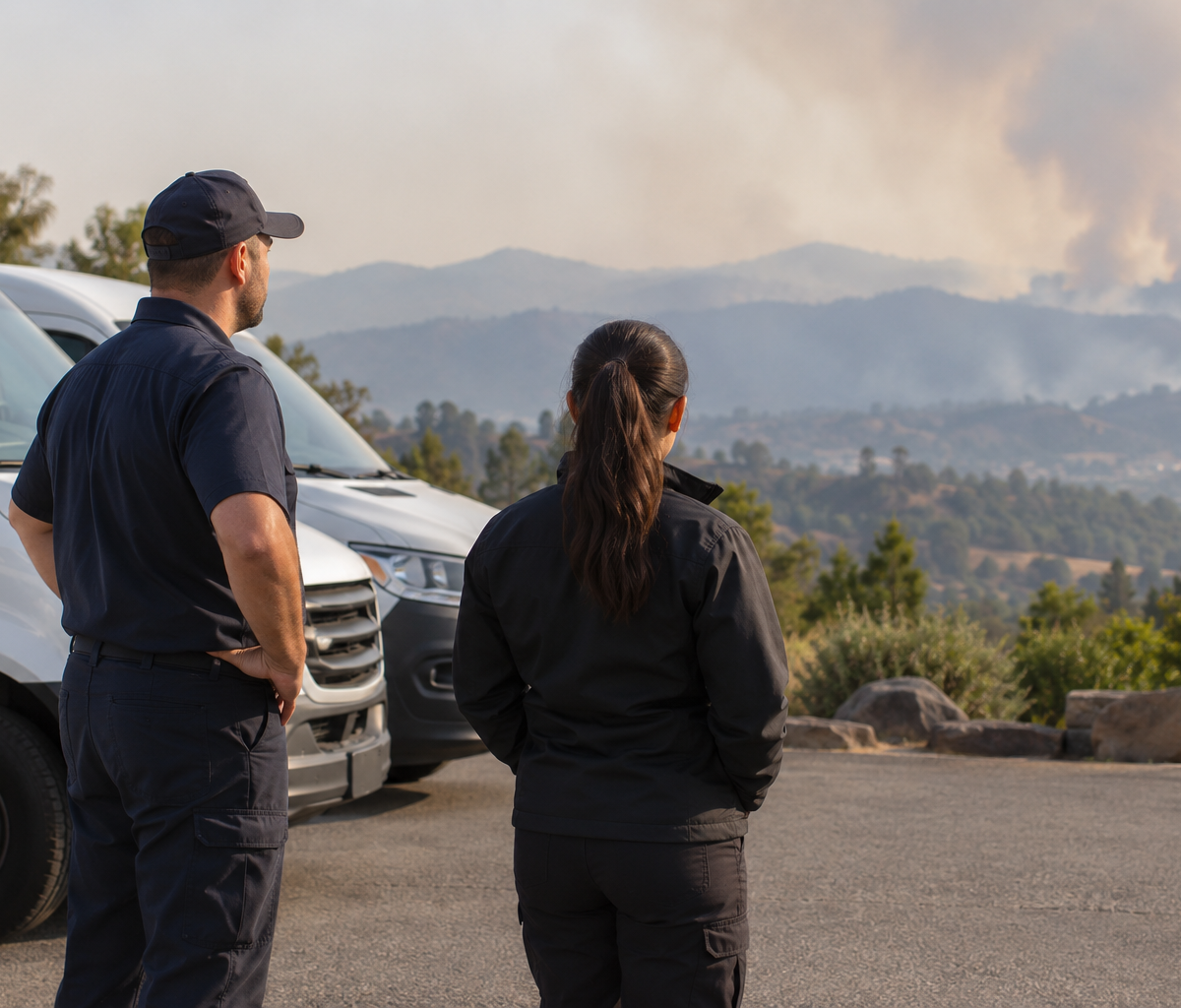
Find out who watches air quality, how drivers report smoke and who can adjust a delivery route when outdoor exposure rises.
A delivery route can look ordinary at dispatch and become smoky by midday. The roads remain open, the addresses are accessible, and the van is moving. Yet each walk from the vehicle to a doorway adds outdoor exposure. Checking smoke and air-quality rules means finding out who monitors changing conditions, how a driver reports them, and who can change the route when continuing as planned would increase exposure.
Wildfire smoke is one reason to ask. NIOSH advises employers and outdoor workers to monitor air quality frequently and consider moving or rescheduling work, reducing strenuous activity, taking breaks away from smoke, and limiting exposure where feasible. Those are general risk-reduction measures. They do not tell a Delpack driver which AQI number pauses a route, what app status to choose, or whether one worker can change the delivery order. Those details depend on the employer's actual procedure.
Find the air-quality monitoring trigger
An air-quality monitoring trigger is the condition that prompts someone to check current information and decide whether a route needs review. Ask whether dispatch watches a public air-quality source, receives local alerts, acts on driver reports, or uses some combination. The answer should identify who is responsible during the shift. A morning forecast alone cannot describe every neighborhood and hour of a long route.
AirNow's Air Quality Index, or AQI, communicates outdoor air quality and health concern in color-coded categories. Its “Unhealthy” category covers 151 through 200; at that level, some of the general public may experience health effects and sensitive groups may experience more serious effects. That public-health label is useful context for a conversation with dispatch. It is not, by itself, a company stop rule or a guarantee that every driver has the same exposure.
Ask which location the team checks. A regional number may differ from conditions along a route that crosses several areas, and a nearby fire can change what a driver sees and smells. NIOSH points workers to the EPA Fire and Smoke Map or a state health department's air-quality website for frequent checks. A driver should know which source the employer uses, how current the reading should be, and who interprets it for operations.
Find out whether a visible smoke plume or symptoms can trigger a review even if the last published reading was lower. Monitoring tools are useful, but the worker still needs a way to report an observed change. A driver might describe a smoky section of the route, the time it began, and whether the next deliveries involve repeated outdoor walking or heavy carrying. That report gives dispatch more to work with than “the air is bad.”
Also ask how the employer handles a formal local advisory. An advisory may cover a wide area, while delivery activity varies by route. The policy should say who reads it, how affected drivers hear about it, and when the decision is revisited. Checking smoke and air-quality rules begins with a dependable monitoring process, because a protective option is hard to use if no one knows when to consider it.
Identify who makes the route adjustment decision
A route adjustment decision can affect customers, parcel custody, shift timing, and several drivers. Ask whether dispatch, a supervisor, or another designated lead may move stops, delay a group of deliveries, change duties, or bring a driver back. The worker should know what they may do immediately when they notice a concern and what requires approval. A clear distinction prevents the route app's suggested order from becoming a safety decision by default.
Ask how quickly the driver can reach that decision maker. Smoke may intensify while the driver is between stops. A useful process gives the worker a primary contact, a backup if the first contact is unavailable, and an instruction for waiting somewhere safe while the issue is assessed. The driver should not have to keep making exposed deliveries simply because a message has not yet been answered.
The route response may be narrower than a full shift cancellation. Dispatch might move work to a less smoky area, reschedule exposed stops, reduce strenuous tasks, or arrange indoor duties if available. NIOSH lists these as possible ways to reduce exposure; whether any is feasible for a particular delivery operation depends on staffing, geography, parcel commitments, and the employer's plan. Ask for examples of changes the team can actually make.
Find out how customer commitments enter the decision. A timed delivery does not erase an exposure concern, but it may require a different customer notification or handoff. A driver should receive an authorized instruction about the item and its status instead of promising a delivery time independently. Dispatch can coordinate service consequences while the driver provides current observations from the route.
Ask whether a route can be reassessed more than once. Smoke can shift with wind, and one neighborhood may improve while another worsens. The employer should explain when a changed route is reviewed again and who tells the driver that normal work may resume. An initial decision should not be treated as a permanent description of conditions for the rest of the day.
Checking smoke and air-quality rules is especially relevant for roles with repeated vehicle exits. A short walk to one door may seem small, but a delivery shift can include many outdoor intervals. The candidate does not need to calculate a personal exposure limit from a map. They need to learn whether the employer considers the pattern of work when choosing a route response.
Ask what protective guidance the driver receives
Useful protective guidance should describe available actions in the work setting. NIOSH suggests reducing strenuous activity where possible, taking breaks in places free from smoke, and limiting outdoor exposure by moving work indoors or to a less smoky location when feasible. Ask which of those options the delivery operation can support. A break in a smoky loading area may not achieve the same purpose as a break in a cleaner indoor space.
Ask whether the employer has identified a place for lower-exposure breaks during a smoky route. A driver may be miles from the depot and unable to enter a customer building. The answer might involve returning to a facility, moving to a different service area, or another approved arrangement. The specific location matters more than a generic instruction to “take a break,” especially if the driver does not know where to go.
Heavy carrying can increase breathing effort. NIOSH notes that physical demands and long schedules may affect smoke exposure and health response. Ask whether dispatch can change assignments that involve repeated long walks or bulky parcels when smoke is a concern. The employer may have few options on a particular day, but it should be able to explain how that constraint is evaluated rather than silently keeping the same workload.
A mask question deserves a careful answer. NIOSH says a NIOSH-approved filtering facepiece respirator such as an N95 can reduce exposure to airborne particles from wildland-fire smoke. It also states that these respirators do not protect against gases such as carbon monoxide, and wearing one during heat or physical activity can add heat-related risk. Required workplace respirator use belongs within the applicable respiratory-protection program. Ask what the employer actually provides and instructs; do not assume a personal N95 makes an otherwise unsafe route acceptable.
Workers differ in how smoke affects them. NIOSH notes that symptoms and risk factors vary, including pre-existing heart or lung conditions. Ask how a driver can report symptoms or a health concern and who receives the report. The process should offer a way to request a change without having to disclose unnecessary medical details to every person on the dispatch channel. The employer should explain its own accommodation and escalation path.
Find out what guidance reaches a newly hired driver. An experienced dispatcher may know where to find the air-quality map, but a new worker needs instructions they can use while away from the depot. A short written procedure with a source, contact, and possible responses is more useful than a rule conveyed only in a morning conversation. Ask whether it is included in onboarding and where it can be found later.
Use an air-quality escalation channel
The air-quality escalation channel should work from the route. Ask whether the worker calls dispatch, uses an app message, or contacts a safety lead. The first report can be simple: current location, observed smoke, current public reading if available, work remaining, and any symptoms or immediate concerns. The worker should distinguish a measured AQI category from a personal observation so the team knows what each piece of information means.
Ask what to do if mobile data is weak or the map will not load. A driver can still describe visible conditions and ask for the employer's reading or instruction. The route policy should not require a worker to obtain a perfect screenshot before raising a concern. Conversely, a reading copied from another city without its location or time may mislead the team. The report should carry enough context to be useful.
Find out how dispatch records its response. If the route is changed, the driver should know which stops remain assigned, which items stay in the vehicle, and which statuses to use. A delivery that has been deferred because of smoke must not be marked delivered. The record should show the operational decision accurately so customer service, the depot, and the next shift can handle those parcels without guessing.
Ask whether the route app can reflect a temporary change while keeping the original plan visible for reference. A driver may be sent toward a clearer neighborhood, then told to return when smoke shifts. If instructions live only in scattered messages, it can be difficult to know which list is current. The employer should explain how the driver confirms the active assignment and who resolves conflicting directions.
A symptom report may require a different response from a route-planning request. A worker with trouble breathing, chest pain, or other concerning symptoms should follow the employer's emergency procedure and seek appropriate medical help. This article does not diagnose the cause. Ask how urgent health concerns are separated from routine scheduling messages, so a driver is not left waiting in a normal dispatch queue when prompt assistance is needed.
Checking smoke and air-quality rules includes the follow-up. After the immediate route decision, ask who reviews whether the change worked. Did the driver reach a less smoky area, obtain a cleaner break location, or return to the depot as directed? The answer can inform the next adjustment without pretending that one map reading settled the entire shift.
Work through an unhealthy-AQI route
Imagine a driver halfway through an afternoon route. Wildfire smoke becomes visible, and the public reading for the area reaches AQI 168. AirNow classifies that number as “Unhealthy.” The driver still has several deliveries involving repeated walks from the van. This is an illustrative scenario, not a Delpack threshold or a report of a real route.
The driver checks the employer-approved air-quality source, notes its location and time, and contacts the designated route lead from a safe place. They describe the smoke, the remaining outdoor work, and any symptoms. They do not decide from the AQI number alone that every stop is prohibited. They ask for a review under the employer's policy, while avoiding an unnecessary exposed task during the conversation if the procedure allows a pause.
The lead checks current conditions across the service area. One possible response is to shift the driver to a less smoky set of stops and defer the exposed group. Another is to return the driver to the depot or assign indoor work if available. A third may be to reduce the physical demands of the remaining route and provide a cleaner break location. The employer chooses among feasible options under its actual policy; none is guaranteed by the public AQI label.
Suppose the lead moves the driver to a different area. The driver confirms the revised stop list, keeps deferred parcels secure, and records the instructed status for each one. Customer service receives an accurate reason for the change. Later, dispatch checks conditions again before deciding whether the original group can be attempted. That recheck matters because smoke can move during the shift.
Change the example slightly: the driver reports a health concern even where the public reading is lower. The team should use its worker-health escalation procedure rather than dismissing the report because a regional map appears better. A map is one input; the worker's condition and the actual work still require attention. The candidate should ask how the employer handles both kinds of information.
This case differs from an icy doorstep. Ice can make one particular approach unsafe while the rest of the route continues. Smoke may affect many stops and the cumulative pattern of outdoor work, so the decision may involve route geography, timing, and duties. Heat-related water and rest support presents a different question again. The distinction helps a worker ask for the right policy instead of applying a one-stop exception to a shifting area-wide condition.
Questions to ask before taking the role
Ask who monitors air quality during a shift and which source is used. What observation or advisory prompts a check? Who decides whether stops move, duties change, or a route pauses? Is there a backup contact if dispatch does not respond? Ask for an example from a smoky day, including how the driver was told about the decision and how parcels were recorded.
Ask where a driver can take a lower-exposure break, whether strenuous deliveries can be rearranged, and how symptoms are reported. If respirators are mentioned, ask exactly what training, fit or program requirements apply to the intended use. A vague assurance that “drivers can wear masks” does not answer whether the employer has addressed route changes or other exposure controls.
Ask how a revised route is checked again as conditions move. A policy should let the worker send new observations, receive an updated assignment, and preserve accurate parcel records. Checking smoke and air-quality rules gives a candidate a practical way to evaluate that decision path before a smoky afternoon forces everyone to improvise. Browse the driver guide hub for related work topics and the Fort Wayne driver careers page for local roles.
Continue with Delpack
Review the Fort Wayne career overview or contact Delpack with a question about the company.