Checking stop-level risk reporting
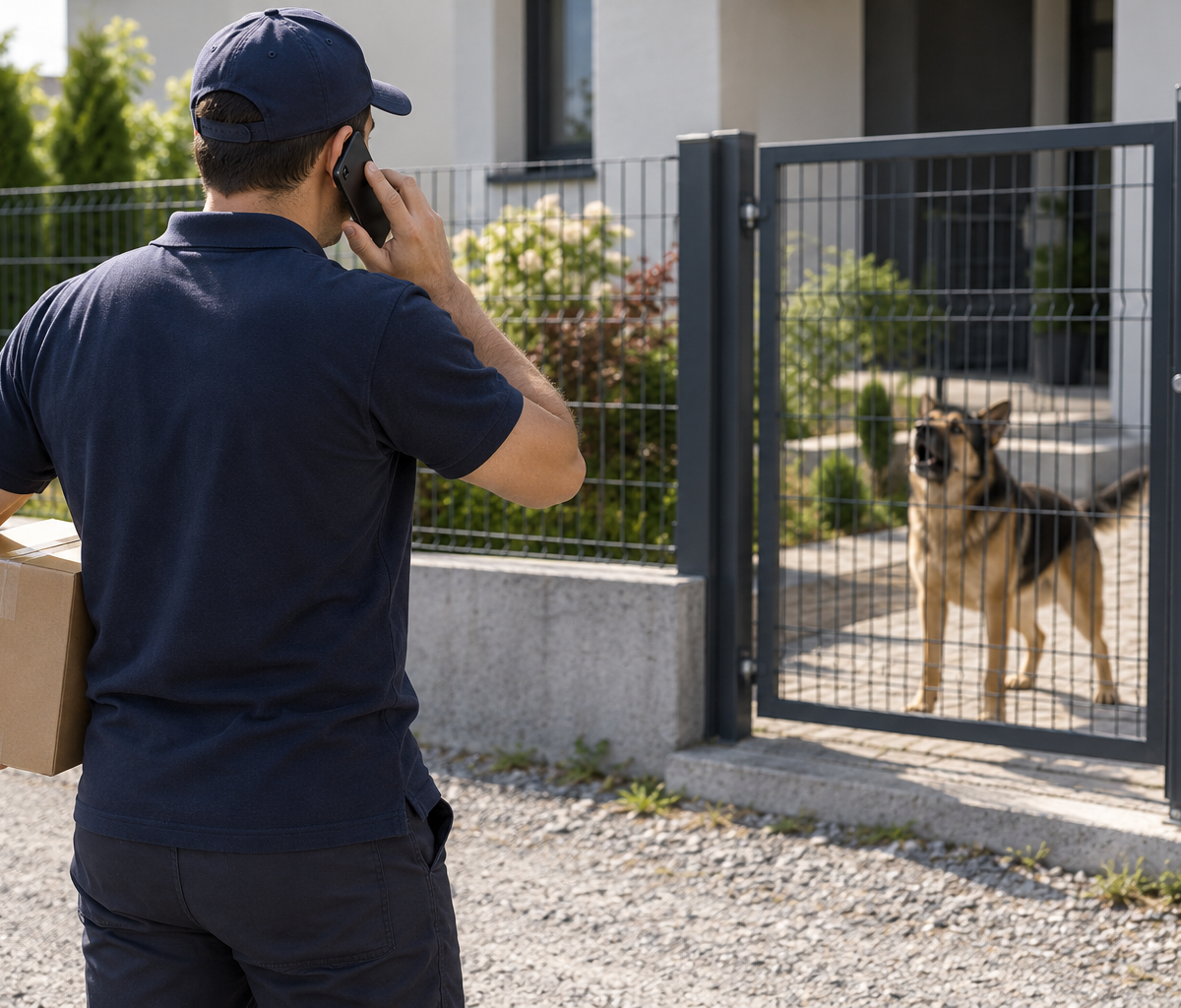
Learn how a driver’s address-specific hazard report becomes a warning that later drivers can see and use.
A driver finishes a route knowing that a loose dog appeared at the same address twice. They may have told dispatch about today's delay, but tomorrow's driver could still arrive without warning. Checking stop-level risk reporting means finding out how a specific address hazard becomes a useful record for later assignments, who checks that record, and how the information reaches the next person approaching the stop.
OSHA's recommended safety-management practices call for workers and employers to identify hazards, review reports and near misses, and respond to concerns. The Postal Service offers a concrete example of address-specific dog warnings: its carriers use warning cards and device alerts to inform other carriers about dogs at particular addresses. Neither source establishes Delpack's technology or its procedure. A candidate should ask how this employer turns a driver's observation into a current route warning.
Capture useful hazard detail
Useful hazard detail identifies the address, the condition, and the part of the delivery approach affected. “Dog problem” is too vague for a driver who needs to know whether the animal was loose on the front walk, behind a gate, or visible only at a neighboring property. The report should say what the first driver actually observed and when. It should avoid guessing at the animal's temperament or assigning blame to a resident without evidence.
Ask what identifying information belongs in the report. A stop ID, address, date, time, and brief description can help operations distinguish two nearby buildings or two entrances at one complex. If a property has several delivery points, name the one affected. A note attached to the wrong address can mislead the next driver, while a note attached to an entire apartment block may be too broad to guide a safe approach.
Find out whether a driver can record a recurring pattern. One incident may be enough to alert the next route, but a second observation can show when and where the hazard tends to appear. A dog may be loose in the driveway in the afternoon but secured at another time. The record should preserve those observations as dated events rather than flattening them into a permanent claim that the address is always unsafe.
Ask whether the reporting form separates firsthand observations from customer statements and secondhand reports. A resident saying “the dog never comes outside” is information, yet it does not erase what a driver saw on the path. A coworker's warning is worth checking, but the current driver should not present it as their own observation. Clear attribution makes the note more useful and fair to everyone involved.
Photos may help when they can be taken safely and the employer permits them. Ask what images are allowed, where they are stored, and whether the driver can submit a report without an image. A worker should not approach an animal to capture proof. The lasting record depends on a clear account, not a risky photograph. It should also avoid unnecessary images of people, homes, or private spaces.
Checking stop-level risk reporting includes the difference between a hazard description and an instruction. “Loose dog seen at front walk at 2 p.m.” describes an observation. “Use the back door” proposes a different delivery method that may be unauthorized or unsafe. Ask who may add an approved instruction to the route note and how a driver can tell it apart from the original report.
Find the address-level reporting channel
An address-level reporting channel should connect a report to the exact stop in the route system or another record used by future drivers. A text to today's dispatcher may solve the immediate scheduling problem, but it can disappear with the shift. Ask where the driver enters a lasting hazard report and whether the entry stays tied to the address when parcels, routes, and assigned drivers change.
Some employers may use a route-app note, a safety form, or a supervisor who enters the warning. The candidate should not assume any one tool exists. Ask who receives the entry, whether a driver gets an acknowledgment, and how they can check that the address was recorded correctly. An acknowledgment could be a reference number, visible note, or direct confirmation from a supervisor.
Ask what to do if the app allows only a generic delivery exception. “Attempted” or “not delivered” records a parcel outcome; it may not capture a hazard for the next shift. The driver may need a second reporting step. The employer should explain both records and who reconciles them so the parcel status remains truthful while the safety note persists beyond that parcel.
Find out how a report is handled after hours or when the usual supervisor is absent. A driver finishing late may be the last person to see the address that day. The process should identify a place to submit the note and a person or team who reviews it before the next assignment. If that review cannot happen immediately, ask what temporary warning reaches an early route.
Ask how the company handles several reports about the same address. Duplicates may contain different observations, such as a dog near a gate one day and loose beside a vehicle another day. A reviewer should be able to connect related reports without deleting the details that explain changing conditions. A single broad label may be convenient for search but insufficient for a driver deciding how to approach the stop.
Reporting should be possible from a safe place. A worker can note the stop ID and observation after moving away from the hazard, according to the employer's procedure. The lasting record does not require the driver to remain near an animal or to use a phone while operating the vehicle. Checking stop-level risk reporting asks whether the process fits the actual route, where signal, time, and safe parking may vary.
Confirm the future-driver warning reaches later drivers
A future-driver warning is useful only if the next driver sees it before reaching the risky part of the stop. Ask where it appears: in route preparation, on the handheld device, with the stop details, or in a supervisor briefing. The Postal Service's dog warning cards and device alerts illustrate two ways to share address-level information. They are examples from another operation, not evidence of a Delpack feature.
Find out whether substitute drivers, new hires, and helpers receive the same warning as the regular route owner. A note stored in one person's memory does not protect someone assigned on a day off. The employer should explain how the warning follows the address into a reassigned route. If a team member without the usual device handles the parcel, ask how the note is conveyed then.
Timing matters. An alert that appears only after the driver has walked to the door is late. Ask whether the worker can review the note before leaving the vehicle or even before loading that route. The right moment depends on the work system, but the person approaching the address needs enough notice to make the employer-approved plan before entering the affected area.
Ask whether the warning includes an action path as well as a description. It might direct the driver to contact dispatch before an attempt, use a verified safe entrance, or follow a specific exception process. Those instructions should come from an authorized reviewer and remain current. The reporting driver should not create a permanent service rule by improvising a note. The next driver should know who can clarify it.
Check how the driver can flag a missing or wrong warning. They may discover that the note names the neighboring address, describes an entrance that no longer exists, or omits a repeated event. A correction path matters because a stale or misplaced note can be as confusing as no note. Ask who verifies the correction and whether the original observation stays available for context.
A useful test question is: “If I report a loose dog tonight, what exactly does tomorrow's replacement driver see before arriving?” Request a walkthrough, not an assurance that information is “in the system.” The answer should identify the record, the reviewer, the display point, and how the company confirms the warning was received. That makes the route handoff observable.
Keep the address-warning review current
An address-warning review keeps the record tied to current conditions. A hazard can recur, move, or be resolved. Ask who decides whether a warning stays active, changes wording, or is removed. A driver report might trigger customer contact, a site check, or another observation, depending on the employer's authority and policy. No worker should assume one uneventful delivery proves the original risk has disappeared.
Find out how a customer-provided update is checked. A resident may say the dog is now kept indoors, yet later drivers still need to know what was previously observed and what instruction currently applies. An updated note can distinguish a reported change from a verified one. The process should allow a driver to add a fresh observation if conditions differ on arrival.
Ask whether the employer reviews the note after a later near miss. OSHA recommends investigating incidents and near misses to identify underlying hazards. If another driver encounters the same loose dog, the team should connect that event to the earlier address record and reconsider whether its warning and response are adequate. An entry that exists but is ignored has not solved the communication problem.
Warnings also need a way to avoid broad, stigmatizing labels. The point is to convey a specific safety condition, not to describe a household or neighborhood as generally dangerous. Ask whether records use factual dates and locations and whether only relevant workers can view sensitive details. Precise wording makes the note easier to update and less likely to encourage unsupported assumptions about the people at the address.
Find out whether drivers can see what happened to their reports. The reporter may be told that an address warning was added, that more detail is needed, or that a proposed note was corrected. OSHA's worker-participation guidance calls for prompt responses and feedback about actions taken. For this topic, the concrete outcome is whether later route assignments carry an accurate warning, not whether a broad safety suggestion reached a committee.
Checking stop-level risk reporting ends with a maintenance question: who owns the note after the first driver leaves? A record with no reviewer can persist long after it is wrong; a report with no permanent home can vanish before the next attempt. Both failures make the next driver reconstruct a known hazard from scratch.
Work through the recurring-dog example
Consider an illustrative address on a residential route. On Monday, a driver sees a loose dog beside the front walk and follows the employer's immediate stop procedure. On Wednesday, the same driver sees the dog again near the vehicle approach. This article concerns the lasting address record after those encounters. The immediate decision about withdrawing from a threatening animal belongs to the separate stop-safety procedure.
From a safe location, the driver submits two dated observations under the exact stop ID. The report says where the dog was seen, whether the customer or another person was present, and which delivery approach was affected. It does not say the dog has bitten anyone unless that was observed or independently established. The driver records the parcel outcome separately under the actual instruction received.
A reviewer checks that the address and entrance are correct, links the two observations, and decides what warning and approved direction should appear for future routes. If the system needs a supervisor to enter the note, the reporter receives confirmation when it is done. A temporary handoff may be needed if another driver is assigned before that review finishes. These are possible elements of a sound process, not claims about Delpack's current system.
The following morning, a replacement driver sees the warning before reaching the front walk. They read the observed details and the current instruction, then assess the actual conditions at the stop. The warning does not guarantee that the dog will be present, nor does an empty yard erase the prior reports. It gives the worker advance context and a route to clarification if the situation differs.
Suppose the next driver finds that the dog now appears behind a secured gate. They report the new observation rather than deleting the older one themselves. The authorized reviewer can decide whether the warning should change and whether the approved delivery method remains appropriate. This preserves the history while preventing an old note from pretending nothing has changed.
The example is narrow: one address, one recurring hazard, and a record handed to a later driver. Several drivers reporting a dangerous depot exit would require a wider management-feedback channel. A driver standing in front of a loose dog needs the immediate animal-stop procedure. Keeping those tasks separate helps a candidate test whether the employer has both a current response and a durable route memory.
Questions to ask about the handoff
Ask where an address hazard is entered, who reviews it, and whether the driver receives confirmation. What details belong in the report? Does it remain linked to the exact stop after parcels and route assignments change? How does the next driver see it before approaching the property? Ask for a nonconfidential example that follows one report through to a later route.
Ask who may turn a report into an approved instruction, how conflicting observations are reconciled, and when a warning is updated or retired. If a hazard recurs, how does the next event connect to the prior record? The answers should show that an address note is reviewed and maintained, rather than copied indefinitely or lost after one shift.
Checking stop-level risk reporting gives a driver a way to judge whether one person's observation becomes usable guidance for the next person assigned to that stop. Related work topics appear in the driver guide hub. Local roles are listed on the Fort Wayne driver careers page.
Continue with Delpack
Review the Fort Wayne career overview or contact Delpack with a question about the company.