Choosing a parcel-handling automation step before buying equipment
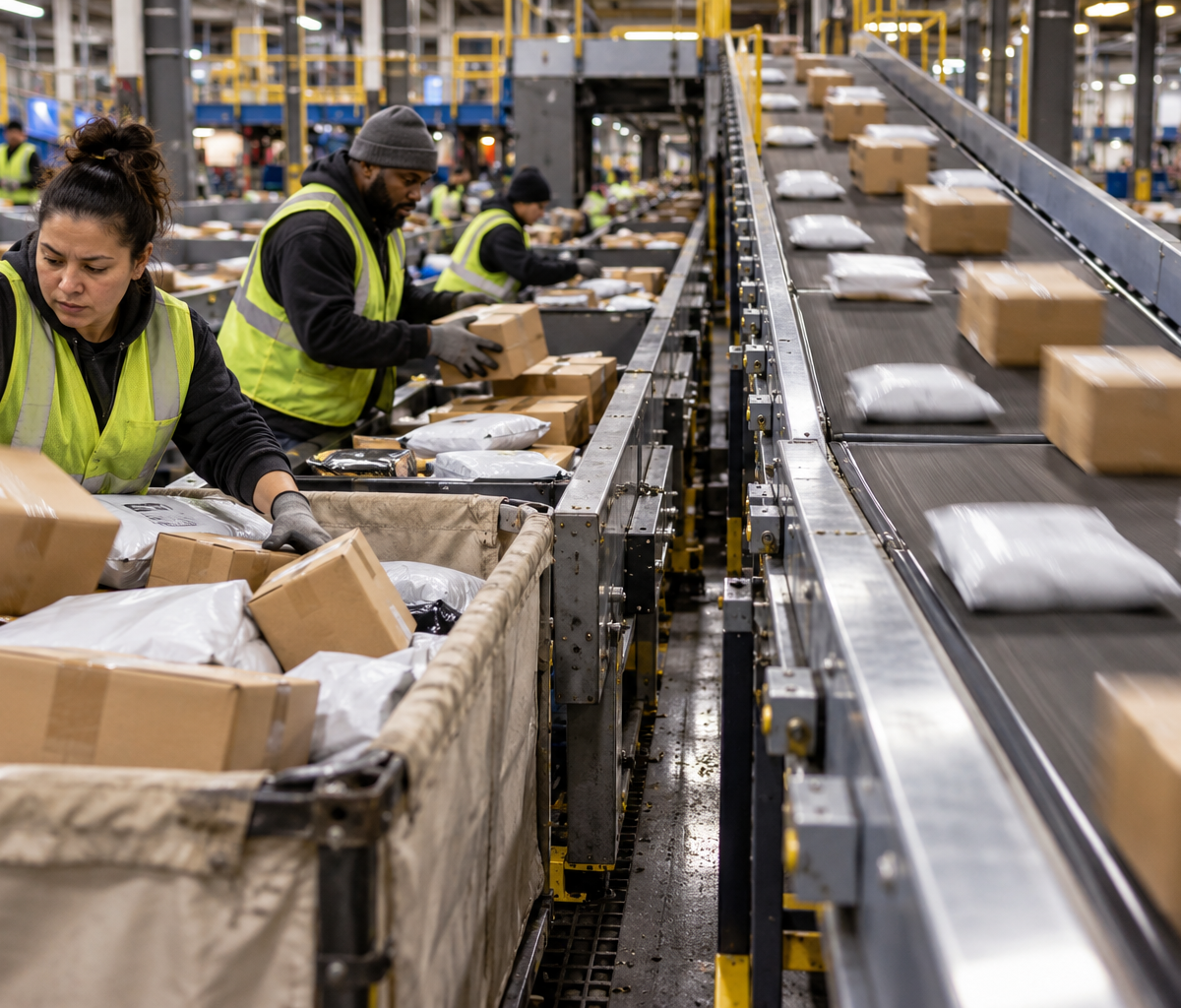
Measure losses in scanning, sorting, conveying and loading to choose the first parcel-process step worth automating.
A parcel facility has a conveyor that moves packages quickly, yet workers spend much of the shift correcting parcels placed in the wrong sort lane. Adding a faster conveyor would move mistakes faster. Choosing a parcel-handling automation step starts by finding where time or accuracy is actually lost: at identification, destination sorting, movement between stations, or the final load into a vehicle.
Automation can assist several different actions. A scanner reads an identifier; a sorter directs a parcel to a destination; a conveyor moves it; a loading check confirms the intended vehicle or container. The four actions connect, but success at one does not prove the next one works. Map the parcel’s path and measure the loss at each handoff before selecting the first step to change.
USPS has described a parcel robotic sortation system in which parcels are placed on a conveyor, scanned, directed using destination information, and dropped into designated containers. Its account also notes that very large items cannot use that particular conveyor path. That example shows how multiple technologies can form one flow; it does not describe Delpack’s facility or prove that the same equipment fits every parcel operation.
Map the parcel scan before the first decision
A parcel scan connects the physical item to its tracking or order record. Check whether labels are readable, whether the right identifier is captured, and whether a failed read is routed to a clear exception point. If workers often hand-key a code or reprint a label, identification may be the first process worth improving. If scans are already reliable, more scanning hardware may not solve later sort errors.
Separate no-read parcels from wrong reads. A no-read item should be held for identification; a wrong read can send a parcel confidently to the wrong place. Review examples and the point where the mismatch is discovered. Ask whether the source is label placement, damaged labels, device positioning, data quality, or a missing verification step. Each cause suggests a different repair.
Do not assume the answer is a fully automated tunnel. A change in label quality, scan position, exception routing, or a guided handheld workflow may address the observed loss with less disruption. The decision is which step to automate first, not a promise that every manual scan should disappear.
Use a clear denominator for scan performance. Count parcels presented to the identification point, parcels read correctly on the first attempt, parcels sent to a no-read lane, and parcels that required a manual correction. If the team reports only successful scans, it may miss items that bypassed the scanner altogether. Follow a sample of failed reads to learn whether the item later entered the correct sort stream and how much extra handling it required.
Locate manual sort errors before adding speed
Count manual sort errors by where they begin: an item sent to the wrong lane, a correct lane whose destination sign is outdated, or a parcel moved from a full container to the wrong overflow point. The error should be traced to its first wrong decision. A later loading problem may actually be a sorting error carried forward.
Suppose a hypothetical shift processes 1,000 parcels and staff correct 40 wrong-lane placements. Observe a sample of those 40. If the labels and destination rules were correct but the manual divert was wrong, a guided or automated sort decision may deserve a pilot. If the lane map was outdated, an automated sorter using the same map could repeat the mistake consistently. Fix the plan before automating it.
Measure correction work as well as the error count. A parcel caught at the next station costs less to repair than one discovered after it reaches the wrong vehicle. Record how far the item traveled before detection, who found it, and whether it delayed departure. Those facts make the sorting step’s burden visible beside other candidate investments.
Separate a bad sort instruction from a bad physical execution. A worker can follow an outdated lane map perfectly and still send the parcel to the wrong destination. A machine would do the same if its data were not corrected. The sort plan and lane assignments must be current before a pilot tests automated diverting. This article chooses where automation may help; the separate sort-plan decision defines the destination rules themselves.
Compare conveyor capacity with real flow
Conveyor capacity is the amount the transport path can move under ordinary conditions, not merely its advertised mechanical speed. Look for queues before and after the conveyor, stops caused by jams, items that cannot fit, and downstream stations that cannot clear the arriving flow. A conveyor that is often idle while sorters correct lanes is unlikely to be the first bottleneck.
In the hypothetical example, assume the conveyor can move 1,200 parcels during the planning period while only 1,000 arrive. That simple comparison suggests nominal transport capacity exceeds volume. Check actual uptime and the timing of arrivals before concluding. A short burst of 300 parcels may overwhelm a station even if the full-shift totals look comfortable.
If workers repeatedly carry parcels around a gap in the conveyor or wait at a transfer point, movement may be the constraint. A conveyor change could then reduce travel. But it should be evaluated with the receiving station: moving parcels faster into a full sort lane creates a queue in a new place. The first automation step should improve completed parcels, not just speed at one machine.
Observe the flow during its busiest interval as well as across the full shift. A conveyor may have sufficient daily capacity yet stop repeatedly when parcels arrive in bursts. Record time spent running, blocked, and waiting for upstream supply. If it is blocked because downstream containers are full, increasing belt speed will not clear the blockage. A change in container handling or downstream staffing might matter more than the transport mechanism itself.
Test loading validation at the final handoff
Loading validation checks that a parcel or container reaches the intended vehicle and that the load record matches what left the facility. Wrong-vehicle corrections can look like sort errors from a distance. Trace the parcel: was it in the correct lane and container before loading? If so, the final handoff may need a scan or confirmation control rather than a new sorter.
Ask whether the vehicle identifier is visible, whether containers are staged in the right order, and where a loader confirms the match. A simple scan that rejects a wrong vehicle may be more useful than faster movement upstream if loading is where errors enter. If the site already verifies every load reliably, another check could add time without improving accuracy.
Keep the destination record and physical item linked. A digital “loaded” status without the parcel in the vehicle is not a completed load. Conversely, a package placed on a vehicle without an updated record can leave the driver with an unexplained item. The candidate automation should close the specific gap the evidence shows.
Use bottleneck evidence across all four steps
Build one table of bottleneck evidence: arrivals, completed parcels, queue length, errors, rework minutes, and exceptions for scanning, sorting, conveying, and loading. Use the same time window for each station. A local maximum speed tells little about the overall flow when downstream work is slower or more error-prone.
In the example, the conveyor has unused capacity and wrong-lane rework dominates. That points toward the sorting decision as the first pilot, provided the lane map and item data are correct. If investigation shows that most “wrong-lane” events begin with unreadable labels, improve identification first. If the item reaches the correct lane but the wrong van, focus on loading. The diagnosis can change after following a few parcels end to end.
Compare the cost of an error with the cost of waiting. A bottleneck can be slow work, poor accuracy, or both. A station that processes quickly but causes costly downstream correction may deserve attention before a visibly crowded station. The decision should use actual completed output and rework, not a single stopwatch reading.
Check whether the evidence points to one parcel class. Large, irregular, or fragile items may account for most exceptions while ordinary parcels flow well. A first automation step can target the group that fits the proposed process and give the rest a deliberate manual path. Averaging all parcels together could make a useful pilot look weak or conceal a group that the equipment cannot handle. Record the size and mix of the tested volume.
Work the manual-sort example through alternatives
Imagine a facility with 1,000 parcels in a shift, ample conveyor capacity, and 40 manual wrong-lane placements. First, confirm the sort plan was current and the recorded destination matched the parcel. If it was not, correct the data and instructions. If it was, test a guided sort display, scan-to-lane confirmation, or a small automated divert for the affected flow. These are alternatives to evaluate, not a product recommendation.
Before changing the whole line, select a bounded parcel group and compare its wrong-lane rate and completed-throughput time with a comparable group still using the current method. Include items the proposed system cannot handle, such as unusually large parcels, in a defined manual path. USPS’s example makes that limitation concrete for its own machinery; a local equipment proposal needs its own size and handling limits.
Try an alternate diagnosis using the same 1,000-parcel shift. Suppose the 40 wrong-lane events disappear after the lane map is corrected, but twelve parcels are still loaded onto the wrong vehicle. A sorter purchase would now target a problem that was fixed without it. The remaining evidence points to the vehicle handoff. A load scan or clearer staging control might be the smaller first change. Repeating the diagnosis after each repair keeps the automation plan tied to current losses.
Choosing a parcel-handling automation step in this case means testing sorting accuracy first because the observed loss is there. Buying a faster conveyor while manual sort errors remain would leave the main rework untouched. If the pilot reduces errors without creating a new queue, expand cautiously and keep tracking the loading outcome.
Write pilot criteria before changing the process
Pilot criteria should name the parcel group, start and end dates, expected improvement, and stop conditions. Decide how many wrong-lane events, no-reads, jams, loading mismatches, and completed parcels will be recorded. Include the labor to run and maintain the proposed step. A pilot that counts only machine speed cannot tell whether the facility improved.
Assign an owner for exceptions. A scanner may fail to read; a sorter may reject a parcel; a conveyor may stop; a load scan may flag a mismatch. Workers need a safe, documented path for each case. If the new system leaves exceptions in an untracked pile, it may improve its own dashboard while making the operation worse.
Check physical fit and worker safety with the site’s qualified team before installing or changing equipment. The article does not specify a machine design or safety procedure. It asks the operations team to choose the step whose measured improvement justifies further engineering, procurement, and training work.
Include integration and upkeep in that decision. A sort machine needs current destination data; a scan step needs labels and records it can read; a conveyor needs space, maintenance, and an exception route; a load check needs an accurate vehicle assignment. Ask who will update rules, respond to faults, and train workers on the new step. These requirements can change which option is practical even when two options promise similar throughput in a demonstration.
Choose the first change the evidence supports
Choosing a parcel-handling automation step ends with a specific process problem, a bounded first change, and a measure of completed output and errors. Improve identification when unreadable or mismatched labels dominate. Improve sorting when the destination decision fails. Improve movement when travel or transfer queues constrain flow. Improve loading verification when correct parcels reach the wrong vehicle.
Delpack’s driver guide hub covers the route side of parcel work, and the Fort Wayne driver careers page lists openings. This facility example is educational; those pages do not claim Delpack uses a conveyor, sorter, or parcel robot.
Continue with Delpack
Review the Fort Wayne career overview or contact Delpack with a question about the company.