Comparing loading duties in two delivery driver offers
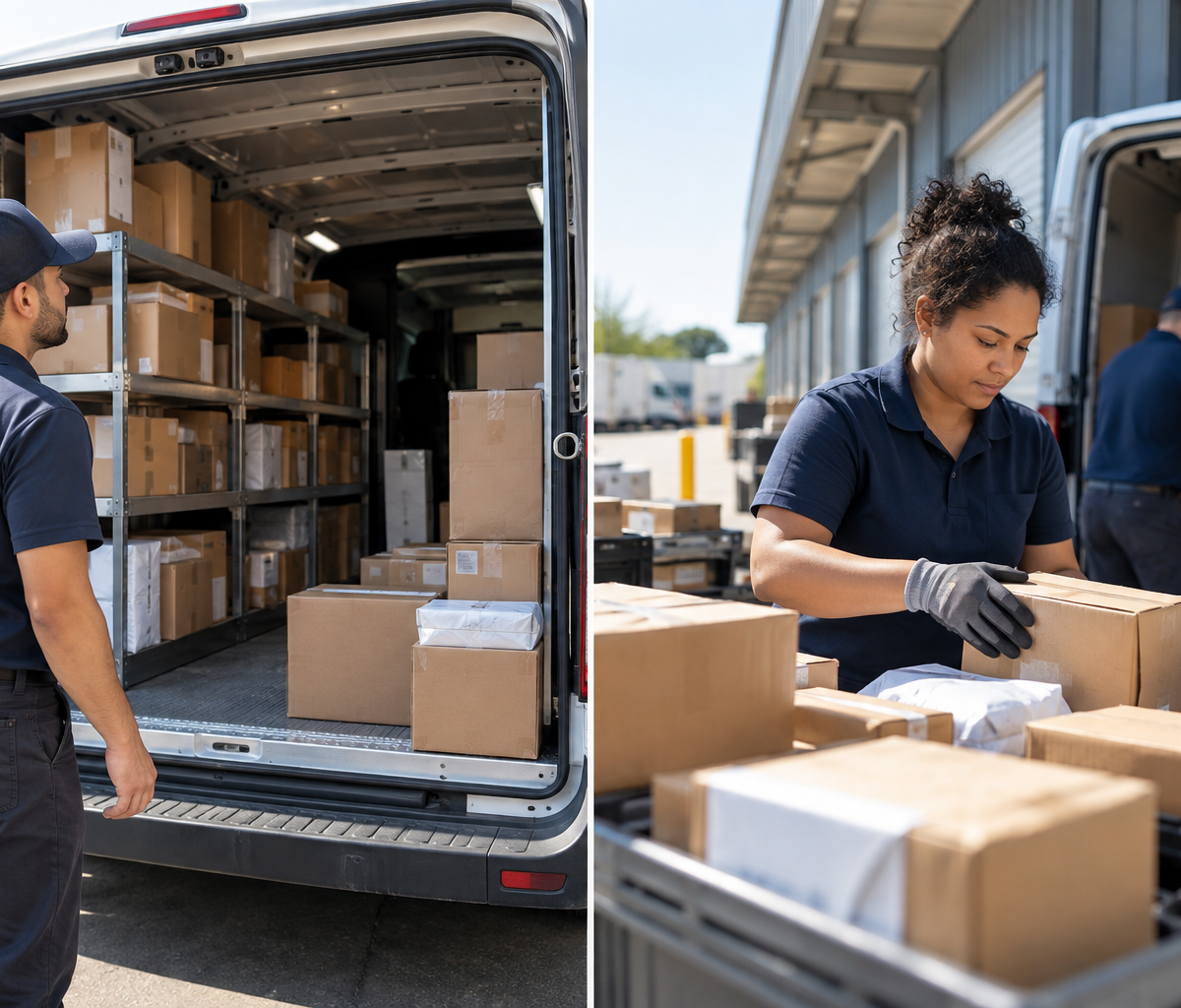
Find out who sorts, scans and loads before departure, how long preparation takes, and when it enters the paid workday.
“Driver” describes the part of a delivery job everyone sees. It does not tell an applicant what happens before the van leaves the depot. One offer may begin with a vehicle already prepared for the route. Another may require the driver to sort packages, scan them into an app, move carts and load the vehicle. Comparing loading duties means identifying each pre-route task and the time, equipment and physical effort it adds to the workday.
Loading is within the broad occupational picture. The Bureau of Labor Statistics describes delivery drivers as loading and unloading packages, along with driving and making deliveries. That description cannot establish the division of labor at a particular employer. At one site, a separate team may stage most freight. At another, the driver may prepare nearly everything. Ask the hiring team about the offered role and worksite, then compare the answer with your own capacity and schedule.
The central question is simple: when you report for work, what is ready, and what must you do before departure? The answer affects the real start of the day, the physical demand before the first stop and the amount of control you have over the route. It can also expose a difference between two offers that advertise similar driving hours.
Identify the loading handoff
The loading handoff is the point where staged freight becomes the driver's responsibility. Ask whether packages arrive already assigned to a route, grouped in carts, sorted by stop or placed in the vehicle. A “preloaded” van could still require the driver to check packages, rearrange items and resolve missing scans. A “driver-loaded” van could involve neatly staged carts that are quick to transfer. The label alone is too loose for a useful comparison.
Ask who physically moves packages from their staging location into the vehicle. If a team does that work, ask when it finishes and what the driver checks before leaving. If the driver does it, ask whether the assigned load is available at reporting time or whether the driver waits for parcels to be released. Waiting, sorting and loading can have different causes and different effects on the departure time.
Find out what happens when a package appears after the van is nearly ready. Does a loader add it, does the driver reopen and reorganize the load, or does dispatch assign it elsewhere? You are trying to understand the ordinary handoff, including common interruptions. An unusual late package should not be treated as the daily standard, but a repeated late-release process is part of the normal job.
Ask to see a typical start-of-shift sequence if the employer offers a job preview. A walkthrough can make an unclear verbal description concrete. It may show where carts are parked, how far the driver moves them and who resolves a route mismatch. If a walkthrough is unavailable, ask the same sequence question in the interview: what is the first task, what comes next and when does the driver leave?
Separate pre-route sorting from moving packages
Pre-route sorting can mean several different tasks. A driver might divide packages by delivery area, check address labels, group items for the same stop or place parcels in the order they expect to reach them. Some employers do part of this work upstream. Ask exactly which decisions the driver makes and which are already reflected in the staged load.
Sorting has a time cost, but it can also change the route later. A driver who chooses a workable arrangement may find items quickly at each stop. A driver asked to load an unsorted pile with little time may spend additional minutes searching during deliveries. The point for an applicant is not to decide the employer's ideal process. It is to learn how much pre-route organization is assigned and whether the schedule allows enough time to do it carefully.
Ask whether package labels or a route app identify stop order. If the system gives a suggested order, ask whether the driver must follow that order while loading or can adapt it to the vehicle layout. A route with bulky or fragile items may need a different placement than a sequence based only on stop number. The employer should be able to explain the expected method and what training a new driver receives.
Keep this inquiry focused on duties. You do not need to debate how many packages should fit in a vehicle to decide whether the offer includes sorting. Record whether you would sort, how much of the sort is complete before arrival and whether someone checks the finished load. Package-count calculations and detailed load optimization belong to a different operating question.
Clarify pre-route scanning and exception work
Pre-route scanning may be a quick verification step or a substantial part of the start. Ask whether every package is scanned into the driver’s device, whether a cart is scanned as a group, and who handles an item that the app rejects. A hiring team may call all of this “loading,” so a task-by-task question is useful.
Ask what the driver must check before departure: package count, visible damage, correct route assignment, address visibility, or required documentation. The exact checks depend on the employer’s process. Avoid assuming the driver can skip a check because another employee staged the freight. Conversely, avoid assuming the driver is responsible for every upstream mistake. Ask who owns corrections and how they are escalated.
A discrepancy can consume more time than the scan itself. If a package is listed in the app but missing from the cart, does the driver search the staging area, contact a supervisor or wait for a loader? If an item belongs to another route, who moves it? These examples reveal whether exception handling is occasional support work or a routine driver duty. Ask for the most common problem and what a new driver is taught to do.
Check what tools are supplied. A handheld scanner, phone mount or route app may be part of the standard setup, while other sites use shared equipment. Ask whether the driver receives the tool at clock-in and whether its battery and connectivity are checked before loading. Equipment trouble should not be silently folded into a promise that loading “takes only a few minutes.”
Measure pre-route time on the same basis
Pre-route time is the period between reporting for work and actually departing for deliveries. Ask each employer for the normal range on a representative day, not the fastest recent example. Include required check-in, vehicle inspection, sorting, scanning and loading if those are in the driver’s sequence. If the employer quotes a start time and an expected first departure, write both down.
Suppose Offer A has the driver report at 8:00 and leave at about 8:20 after checking a preloaded van. Offer B has the driver report at 7:35, sort and load for roughly 45 minutes, then depart at about 8:20. Both drivers may begin deliveries at the same time. Their mornings, however, begin at different hours and involve different work. The example is hypothetical; the numbers illustrate a comparison method, not a typical industry standard.
Ask whether the stated time includes ordinary delays. A 20-minute estimate may describe a fully staged day, while a delayed arrival or missing equipment creates a longer range. Ask what happens on a heavy day and how frequently those days occur. You do not need an exact average to make a sound decision. A credible range with an explanation is better than one precise number with no context.
Record who communicates the departure target and whether the driver can finish loading before leaving. A tight target may make the physical work feel rushed. A later departure may lengthen the whole shift. Ask whether a loading delay changes the assigned route, the expected finish or the help available later in the day. These operational answers matter because the pre-route task does not disappear once the vehicle leaves.
Ask how recorded work time includes preparation
Recorded work time should be clear in the offer discussion. Ask when the driver clocks in or otherwise begins paid work relative to required sorting, scanning and loading. If the employer expects you to arrive early to prepare the van, ask whether that early preparation is part of the scheduled shift and how it is recorded. Get the answer from the actual employer’s policy or offer materials.
Keep the question factual and direct: “If I report at 7:35 to sort and load before an 8:20 departure, what time does my paid shift begin?” Follow with “What happens when the load is late and I cannot start until 7:50?” The purpose is to understand the offered arrangement. This article does not resolve the legal treatment of a particular employer’s pay practice, and a hiring conversation is not a substitute for reviewing the written terms.
Ask whether the loading assignment changes the length of the day or only the start time. A job posting that says “eight-hour shift” may be interpreted differently by different employers. Find out whether the eight hours include pre-route preparation and post-route duties. For this comparison, focus on the start and loading portion. End-of-day closeout pay is a separate subject and should be checked separately if it affects the choice.
When comparing pay rates, do not multiply an advertised hourly rate only by expected driving hours. Include the scheduled work you are actually asked to perform before the route. If either employer’s terms remain unclear, mark the estimate as provisional rather than assuming that preparation is either paid or unpaid. The written offer and timekeeping explanation should settle the question.
Check loading equipment and physical demands
Loading equipment changes how demanding the assignment feels. Ask whether carts, dollies, ramps or other aids are available and who provides them. Also ask where the vehicle is parked relative to the staging area. Moving packages a few steps from a cart differs from making repeated trips across a depot, even when the package list is the same.
Find out whether loading involves lifting from the floor, placing items above shoulder height or moving bulky parcels into a vehicle with limited access. A broad job description may mention lifting without telling you what the morning actually requires. Ask about the range of items handled in the offered role, the usual team support and the training for safe handling. Do not infer a universal weight limit from an occupation profile; get the employer’s actual requirement.
Ask who helps when an item cannot be handled safely by one person. A clear answer might describe a team-lift process, a separate equipment operator or a reassignment. An answer that depends on “drivers figure it out” leaves an important operational question open. The applicant should know what support is available before accepting a role with regular loading.
Consider the timing of the effort. Forty-five minutes of lifting and moving before the first delivery can feel different from intermittent handling across the route. Someone comfortable with driving and ordinary parcel delivery may still prefer an offer with less concentrated pre-route work. Another applicant may prefer to arrange their own load because it makes the route easier to run. The comparison should reflect the actual task and the applicant’s own capacity.
Use the preloaded-van and sorting example
Imagine Offer A starts with a preloaded van. The driver checks the route assignment, scans a short exception list and departs. Offer B requires about 45 minutes of sorting and loading from staged carts. Both roles involve deliveries, and both may advertise the same hourly rate. To compare them, write down the reporting time, paid-time start, tasks, equipment and likely departure for each.
Suppose Offer B gives the driver clear labels, a cart and room to arrange packages. The extra preparation may be a manageable part of the job for someone who likes controlling the vehicle layout. Suppose instead that the employer expects a driver to sort mixed freight rapidly without describing training or assistance. That is a different offer, even if the posting uses the same phrase “load the van.” Ask the employer which picture is accurate.
Now consider Offer A. A preloaded van may save early physical work, but the driver might have little chance to correct a confusing arrangement. Ask whether drivers can make small adjustments before departure and how long that normally takes. The example is not designed to favor one offer. It shows why “preloaded” and “driver-loaded” need details before they can be compared.
Put unresolved items in a third column. If Offer A has not explained who fixes missing items, write that. If Offer B has not explained when paid time begins, write that. Do not fill gaps with what you experienced at a previous employer. Similar operations can assign preparation work differently.
Keep the loading comparison tied to your decision
Comparing loading duties is about the assignment before a route begins. It is distinct from calculating an ideal package count or designing a loading process for the employer. Ask enough about sorting, scanning and movement to understand your duties. Then stop and compare the offers. An applicant can make a good choice without auditing the depot’s entire workflow.
Also keep the morning distinct from the closeout after deliveries. The two may affect total hours, but one answer does not establish the other. If you need a complete shift estimate, request the separate end-of-day sequence and pay treatment. For this topic, use the pre-route information to understand the real start of work and the physical preparation required before departure.
A short follow-up email can resolve much of the uncertainty: “For this role, who sorts the assigned packages, who scans them, who loads the van, when does paid time start, and when do drivers normally depart?” Add a question about equipment or lifting support if it matters to you. Ask both employers in similar language so their replies can be compared directly.
Choose the offer whose loading assignment you understand and can perform on the schedule offered. The better fit may be the preloaded van, the driver-sorted load or a third arrangement, depending on time, physical demands and your preference for organizing the route. Comparing loading duties is complete when you can describe what you will do before the first stop and how that work enters the paid day.
For a broader look at driver work, see the delivery driver realistic job preview guide. The Fort Wayne driver careers page can help you review local opportunities. Confirm the loading process for the specific opening with the hiring team, since general site information cannot establish a particular route’s preparation duties.
Continue with Delpack
Review the Fort Wayne career overview or contact Delpack with a question about the company.