E-commerce fulfillment work: do individual orders fit you?
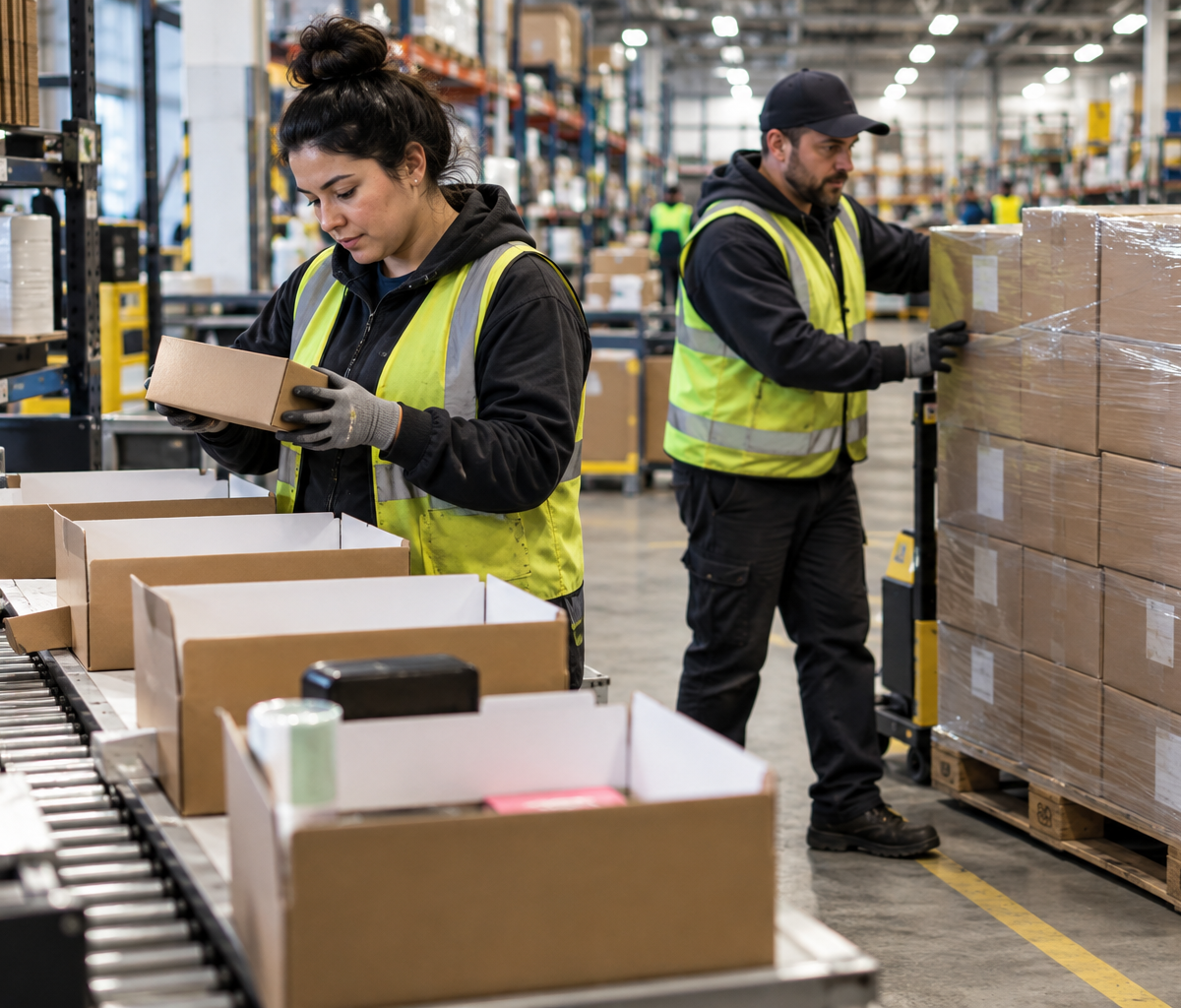
Compare the repeated completion of individual consumer orders with larger-unit store replenishment, using actual role boundaries, handoffs and shift demands.
A candidate is comparing two warehouse openings. One team prepares individual online orders, many containing just one product. The other moves palletized goods to stores. The candidate likes seeing a customer order completed, but wonders whether repeating that cycle throughout a shift would feel satisfying or monotonous. E-commerce fulfillment work centers on taking separate customer orders from available stock through the required picking, packing, and shipping handoffs. The right job choice depends on the actual station duties, order mix, pace, and accuracy checks at the employer.
The label can cover several positions. One person may select items, another may pack them, and a third may stage parcels for carrier pickup. A smaller operation may ask one worker to handle more than one step. Before accepting, the candidate should learn what part of the order journey belongs to the opening. “Fulfillment associate” does not establish that everyone does every task or that all orders contain a single item.
See the flow of consumer orders
Consumer orders are separate requests with their own items, quantities, destinations, and fulfillment status. Even when two customers buy the same product, each order must stay tied to the correct package and shipping record. Shopify’s merchant guidance describes a basic pick, pack, label, and carrier-handoff flow for orders fulfilled by a seller. A large warehouse may divide and automate parts of that flow, so the guidance supplies a general sequence rather than a universal job design.
In the example, ten customers each order one item. The facility has ten small jobs to complete, each with a distinct order identity. A store replenishment order for ten cases of one product is different: it can involve a larger handling unit and one receiving destination. The online-order team may repeat a short sequence many times rather than move one large unit across the building. The candidate should ask which pattern dominates the advertised shift.
Order mix matters. A facility with many one-item orders can feel different from one handling orders with several products, gift notes, special packaging, or returns-related checks. The candidate should ask for a normal day’s range without demanding a fixed number that may change by season. They can also ask whether workers rotate among picking, packing, and staging or remain at one station.
The U.S. Bureau of Labor Statistics describes stockers and order fillers as receiving, tracking, and moving merchandise to fill orders. That broad occupational account supports the existence of order-filling work. It does not tell the candidate whether this specific employer uses a cart, conveyor, scanner, paper list, or automated storage system. The employer’s actual process should fill in those details.
Protect order-level accuracy through handoffs
Order-level accuracy means the right item and quantity reach the right customer order and stay correctly identified through packing and dispatch. A worker may pick the correct product but place it in the wrong tote. A packer may receive the right tote but apply a label for another order. The candidate should understand which checks their position performs and what happens when the system and physical items disagree.
Consider two single-item orders for similar-looking products. A worker cannot rely on a quick glance at the carton if the variants differ. The site may use a scan or another verification step. The employer should explain that method to a candidate who will perform it. For someone evaluating the broader fulfillment role, the important question is how each completed order remains distinct through several people and stations.
An exception can interrupt the cycle. The listed item may not be in its recorded location, packaging may be damaged, or the order may require a different shipping service. Ask what the worker is expected to do in each situation: pause and flag it, move it to an exception queue, ask a lead, or use another approved workflow. A facility that explains the escalation clearly gives the candidate a better picture of the job than one that promises “just scan and go.”
Accuracy is not simply the absence of obvious mistakes at the first station. The order has to leave with the right contents and record. The candidate can ask where errors are found and how feedback reaches the worker. Some problems are discovered at packing, some during an audit, and some only after a customer reports them. The response should help workers learn without asking them to invent fixes outside their authority.
The worker may also have to separate a problem with stock from a problem with the order. If the requested product is missing from its recorded location, another employee may investigate inventory while the order waits. If the product is present but the order information is unclear, the next step may involve customer-service or systems staff. The candidate should ask which exceptions they are expected to flag and whether they continue with another order while the issue is resolved. That answer reveals how much independent judgment the role requires.
Understand the pick-pack handoff
A pick-pack handoff transfers selected goods and their order identity to the packing step. In one operation, a picker may deliver a tote to a station; in another, a conveyor or automated system may carry it. The packer verifies contents and prepares the parcel under the site’s process. Microsoft’s warehouse packing documentation illustrates a software-supported packing station, but it does not define the workflow at every e-commerce facility.
The candidate should ask whether the advertised role owns the whole handoff or only one side. If the position is mainly picking, they may spend much of the shift moving among storage locations. If it is mainly packing, they may work at a station receiving a succession of prepared orders. If it rotates, they need to know how training and performance expectations differ at each point. A broad title can hide those distinctions.
For the one-item orders, the handoff may be quick, but it still matters. A tote for one customer should not be mixed with the next customer’s item. The pack station needs the right order reference before printing or applying a label. The candidate need not design the controls; they should know whether following a precise sequence appeals to them and what the site expects when a tote arrives with a mismatch.
Shipping is another handoff. A packed parcel may need to be sorted to the correct carrier pickup area or service level. That does not make the job a parcel-sorter position by default. The separate parcel-sorting career topic owns the work of sorting parcels after they are ready. Here, the candidate is evaluating the order-completion flow and where their role sits within it.
Test the shift rhythm behind a one-item order
Shift rhythm can be shaped by order releases, carrier cutoffs, station capacity, and replenishment of the products workers need. One-item orders may be fast to complete individually but numerous. The candidate should ask when orders arrive, whether work comes in waves, and whether the station stays busy all day. “Fast-paced” is less useful than a description of the first two hours, the busy period, and how the team closes out a shift.
In the example, the candidate may enjoy finishing many small orders and seeing a clear completed count. Another worker may prefer fewer, larger tasks with a more visible freight unit. Both preferences are reasonable. The candidate should consider whether repeated scanning and verification feel engaging, and whether they are comfortable with the employer’s quality expectations as well as its volume target.
Physical demands cannot be inferred from order size alone. An individual item may be light or heavy. Picking can involve walking, reaching, and repeated handling. Packing can involve standing and repetitive motions. The actual workstation design and rotation matter. OSHA’s warehousing guidance discusses ergonomic risks such as lifting, reaching, and repetition across warehouse tasks. It does not establish the demands of a particular opening.
Ask what a worker handles personally, how often tasks rotate, and what training or aids the employer provides. If the candidate has a limitation or accommodation need, the actual role description and employer process are the right place to discuss it. An article cannot say that all consumer-fulfillment work is physically easier than pallet work, or the reverse. The task details decide.
Compare the consumer order with a store pallet
The store-pallet opening may involve receiving, staging, moving, and verifying larger handling units. The e-commerce opening may involve more separate order identities and shorter completion cycles. The candidate should compare the work they will actually perform, not treat “online” and “bulk” as complete job descriptions. Facilities often handle mixed orders, cases, and pallets under one roof.
One useful question is, “What counts as a finished unit of work for this position?” In consumer fulfillment, it may be a correct pick, a packed parcel, or a shipment handed to the carrier, depending on the role. In bulk distribution, it may be a checked pallet or a store order staged for a trailer. The candidate should know where responsibility begins and ends. That boundary shapes both satisfaction and accountability.
Another question is how often work changes. Online orders can vary item by item, but a worker fixed at one packing station may repeat the same motions. Store replenishment may move larger units, but the route and product mix can change through the day. A realistic shift walk-through reveals more than assumptions about variety. The candidate can ask about ordinary and peak periods separately.
The candidate may be drawn to completing many individual customer orders and keeping each identity intact from release through shipment. That differs from the satisfaction of tracking a larger unit across a warehouse. A role that rotates between both environments could offer variety, but the candidate should verify that rotation rather than assume it comes with a general warehouse title.
Use the interview to see the actual role
Ask the employer to describe one ordinary order through the part of the process this role owns. What information does the worker see? What do they physically handle? Which scan or check confirms completion? Who receives the order next? What happens when the item is missing or the parcel is damaged? The answers reveal the job’s core work without requiring an exact productivity promise.
Then ask about the mix: one-item versus multi-item orders, picking versus packing time, rotation, the busiest cutoff, and how quality is measured. A clear answer may show that the job is a good fit even if the candidate expected a different title. A vague answer leaves room for a follow-up conversation before the candidate commits.
Prior warehouse experience can be described honestly. A person who has moved store pallets may have practiced label checks, destination matching, and exception reporting. Those habits can transfer to consumer orders, but the worker should not claim experience with a specific packing system they have never used. Delpack’s transferable skills for a delivery driver resume guide offers a related method for describing non-driving work accurately when considering delivery roles.
Delpack’s Fort Wayne driver careers page covers its current driver opportunities. It does not establish that Delpack operates the e-commerce facility in this example or has an open fulfillment position. Readers comparing warehouse and driving jobs should use each actual posting and employer conversation for duties, pay, schedule, and work environment.
Choose the order cycle you want to repeat
E-commerce fulfillment work may suit someone who likes finishing many distinct customer orders, following precise identity checks, and seeing how picking, packing, and shipping connect. It may be less appealing to someone who prefers moving larger freight units or dislikes the repeated station work in the particular opening. The label alone cannot decide that fit.
The candidate should leave the interview able to describe a normal order, their own step in it, the handoff before and after, common exceptions, physical demands, and the shift’s busy period. Comparing that real sequence with the store-pallet role will reveal whether they prefer many small order completions or larger-unit movement. The decision belongs to the actual work, not a general ranking of fulfillment against distribution.
Continue with Delpack
Review the Fort Wayne career overview or contact Delpack with a question about the company.