Fulfillment supervisor work: lead the whole shift, not one station
Use a growing packing queue to assess whether coordinating people, safety, quality and output across a fulfillment shift fits your leadership goals.
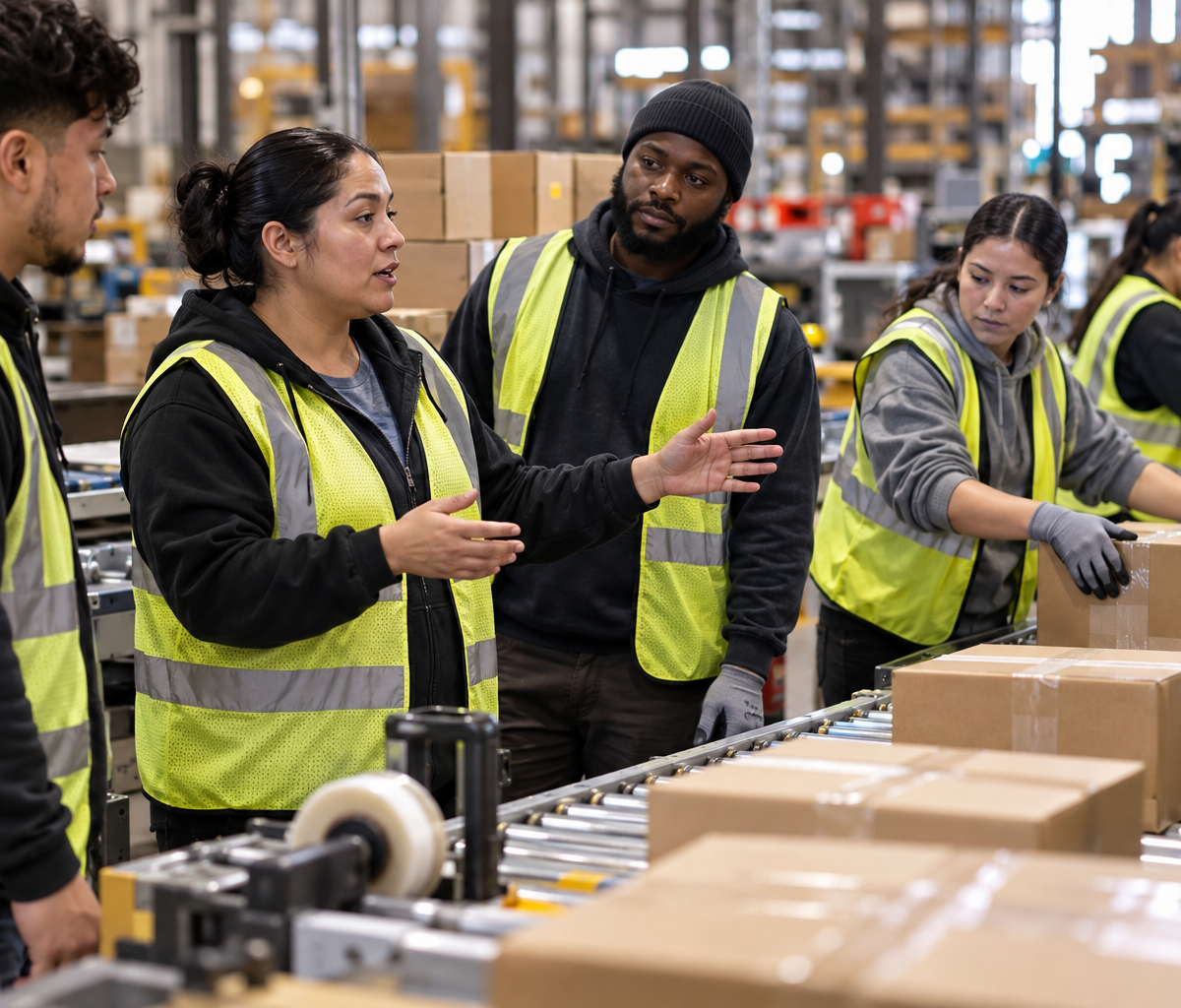
A packing queue grows while several pickers have finished their current wave. Orders still need to reach a carrier cutoff, and the packing team is beginning to rush. A fulfillment supervisor has to understand the queue, the skills available on the shift, the safety of any reassignment, and what the team can realistically finish. Fulfillment supervisor work may fit someone who wants responsibility for people, safe execution, and output across the shift rather than one station’s task alone.
The supervisor’s job is not to move every available person as soon as a chart turns red. Some pickers may be trained to pack; others may not. Picking may resume shortly. A packing station may be waiting on supplies or a system problem rather than labor. The candidate considering leadership should be interested in finding the actual constraint, making an authorized adjustment, explaining it, and checking whether it helped.
Start with a shift handoff that names the work
A shift handoff tells the incoming supervisor what is already in progress, what is due next, and what remains unresolved. It may include open orders, carrier cutoffs, staffing, equipment status, safety concerns, and exceptions. Without that picture, a supervisor can make a change that looks efficient locally but disrupts a commitment another team was already managing.
In the worked example, the supervisor should know which orders are in the packing queue, which are waiting for picking, and which have an earlier departure requirement. A total queue count may hide important differences. Ten orders requiring one item each may not take the same time as ten orders needing several checks or special packaging. The supervisor needs a practical view of work remaining rather than only a number on a screen.
The candidate can ask an interviewer how a shift begins. Does the supervisor receive a written handoff, meet the prior lead, review a dashboard, walk the floor, or combine these? Who reports a broken station or an unresolved order? The answer shows whether the employer gives leaders useful information or expects them to discover problems after the shift is already under pressure.
O*NET’s profile for first-line supervisors of material movers describes coordinating workers, monitoring safe work, addressing problems, and assessing training needs. That occupation is broader than one fulfillment site, but it supports the idea that the role is both operational and people-facing. The posting must still define the actual team size, authority, and duties.
Diagnose the packing queue before moving people
A packing queue is work that has reached a packing step but has not yet been completed. Its growth can have several causes: an unusually large release of picked orders, a station down for maintenance, missing packing materials, a difficult order mix, or too few trained packers. The supervisor should identify which cause is present before deciding that more hands are the answer.
Suppose the queue rises after a large picking wave. Two trained pickers are temporarily free, and the packing stations have supplies and capacity. Moving one or both to pack may help the shift meet its cutoff. But if the queue is growing because the label printer is failing, reassignment can put more people in line for the same blocked device. A leader who checks the flow before acting is more useful than one who reacts only to the largest number.
The candidate should ask how supervisors see queues and bottlenecks. Are there live counts, physical staging lanes, team leads’ updates, or manual reports? How do they distinguish an item waiting for a packer from an item held for a quality or inventory exception? A clear answer shows how the role turns evidence into action. It also reveals whether the supervisor spends time on the floor, at a screen, or both.
If reassignment is appropriate, the supervisor needs to preserve coverage for the next picking wave. The decision may be temporary, with a review point after the packing backlog falls. Longer-term cross-training is a separate planning decision. The candidate’s immediate question is whether they want to coordinate a current shift using people who are already qualified for the work.
Keep safety responsibilities visible under pressure
Safety responsibilities do not disappear when a carrier cutoff approaches. The supervisor should know the site’s procedures for each station, the training and authorization needed for equipment, and the path for reporting hazards or injuries. Moving an untrained worker to a task because the queue is long is not a sound solution. A candidate should ask how the employer expects leaders to handle a missed target when the safe option takes longer.
OSHA’s warehousing guidance describes hazards involving lifting, repetitive movement, powered equipment, docks, and other warehouse activity. It is general guidance, not a finding about this hypothetical facility. It supports asking how supervisors observe the work, correct unsafe conditions, and make sure instructions are understood. The employer’s actual program and tasks determine the practical duties.
In the example, the available pickers may know how to pack ordinary parcels but not fragile or unusually large orders. The supervisor should match the reassignment to their training and the order mix. They may need a trained packer to handle the exception work while another employee completes standard orders. The exact division depends on the site’s rules; the leadership habit is to check capability before changing assignments.
The candidate should also ask what authority the supervisor has to pause work or escalate a hazard. A title can imply responsibility without granting every decision. A good role description explains who can stop an unsafe process, who arranges repair or maintenance, and how the team is told what to do while the problem is open. Those answers matter as much as the output target.
Communicate a change people can carry out
Once the supervisor understands the queue and chooses an adjustment, the team needs a clear instruction. Who moves, to which station, for what work, and for how long? Who watches the original picking area? What should staff do if an order or device blocks them? A vague call for everyone to “help packing” can create duplicate work, leave another area uncovered, or send untrained people to a station.
In the hypothetical shift, the supervisor might ask one qualified picker to help at a defined packing station until the queue reaches a manageable level, while another remains available for the next pick release. The lead at packing confirms what work is ready and which exceptions remain separate. After a short interval, the supervisor checks whether completed orders are actually increasing. This is a leadership example, not a universal staffing ratio.
Communication should travel upward as well. If the carrier cutoff is now at risk, the supervisor may need to inform an operations manager or transportation contact under the employer’s process. If a packing system fails, the appropriate support team may need a precise description of the problem. The candidate should ask what information leaders are expected to report and when. A reliable escalation protects both the shift and the next team that must respond.
Delpack’s delivery driver dispatch escalation support guide addresses a driver’s different situation: reporting a route problem to the right support contact. The common principle is that a useful escalation gives the next decision-maker facts they can act on. The guide does not define warehouse-supervisor authority or promise a Delpack fulfillment-supervisor position.
Use worker feedback without losing accountability
Worker feedback can reveal why a plan is failing. A packer may know that a label device jams after a particular order type; a picker may know that a supposedly available item is missing from its bin. The supervisor should listen and distinguish an observation from an assumption. Workers need a safe way to report problems, and the supervisor still has to decide or escalate according to their authority.
The candidate should ask how the employer handles coaching. Are errors reviewed privately with enough context to learn what happened? Are new workers given task training before their speed is compared with experienced staff? How does the supervisor recognize a process problem that no individual worker can fix? A leader who enjoys teaching and problem-solving may find this part of the role meaningful; someone who wants only to optimize numbers may not.
The job also includes uncomfortable conversations. A repeated quality error may require coaching, documentation, or escalation. A worker may disagree with a temporary reassignment. The supervisor should be able to explain the reason, listen to relevant constraints, and follow the employer’s people policies. The candidate should learn what support HR and senior operations provide rather than assume the first-line leader handles every personnel issue alone.
O*NET lists problem-solving, staff instruction, and coordination among the broader tasks of this supervisory occupation. Those tasks make the career different from being an excellent picker or packer. Skill at an individual station helps a leader understand the work, but supervising asks them to support others’ performance and make decisions for the whole shift.
Measure output with the limits in view
Fulfillment output can be described by orders picked, packed, shipped, held for exception, or still open at shift end. A supervisor should know which measure the site uses and what each status means. Counting only completed parcels can hide a large unresolved exception queue. Counting only picks can make a shift look strong while packing and carrier handoff fall behind.
For the growing packing queue, the supervisor can compare the starting backlog, new arrivals to packing, completed packs, and orders near cutoff. If the queue shrinks only because picking stopped, the problem may return with the next wave. If pack completions rise while quality stays sound, the temporary reassignment may be helping. The candidate need not promise a particular target; they should understand how to read the flow.
Safety and quality belong in that interpretation. A faster line with more mispacked orders or unsafe work is not a successful shift. The supervisor may have to explain why a target was missed and what constraint caused it. A truthful handoff to the next shift is more useful than a polished number that conceals unfinished work. The candidate should ask which outcomes the employer expects leaders to report together.
Staffing forecasts for next week belong to a labor-planning role or higher-level process. A fulfillment supervisor may provide evidence from today’s shift, such as recurring backlog or training gaps, but a future roster forecast is not the core choice here. The candidate is assessing whether they want responsibility for the real-time team, safety, and output under today’s conditions.
Test the leadership path with a real shift story
Ask the interviewer to describe a recent shift when one area fell behind. What did the supervisor see first? Which information changed their diagnosis? Who could be reassigned, and who approved it? What happened to the other work? How did they check safety, quality, and completion afterward? A concrete story reveals the organization’s expectations more clearly than a list of traits such as “leadership” and “multitasking.”
The candidate should also ask about team size, number of leads, shift overlap, training responsibility, authority over schedules, and the balance between floor presence and reporting. A supervisor with ten workers at one site may have a very different day from a supervisor coordinating several work cells. Pay and schedule terms must come from the actual posting or offer; the title alone cannot establish them.
Someone coming from a warehouse associate role can prepare truthful examples: an exception they escalated well, a safe method they helped a colleague learn, or a time they noticed a bottleneck and shared useful evidence. They should not claim formal supervision they did not perform. Delpack’s Fort Wayne driver careers page covers a different career path and does not establish an open fulfillment-supervisor role.
Decide whether you want the whole-shift responsibility
Fulfillment supervisor work may appeal to someone who wants to coordinate people, protect safe work, solve bottlenecks, coach staff, and explain the shift’s results. The packing-queue example shows the difference between doing one task well and deciding how several tasks fit together. The leader needs evidence, authority, and communication, not just urgency.
Before pursuing the role, the candidate should know how the employer defines a normal shift, what decisions a supervisor can make, how training and safety are supported, and which outcomes are reviewed. If that whole-shift responsibility sounds energizing, the position may be a good next step. If they prefer direct fulfillment work without people leadership, an associate or specialist role may fit better.
Continue with Delpack
Review the Fort Wayne career overview or contact Delpack with a question about the company.