How barcodes identify logistics items without proving where they are
Understand barcode identity, parent-container contents, and the event context needed to infer where a logistics unit was observed.
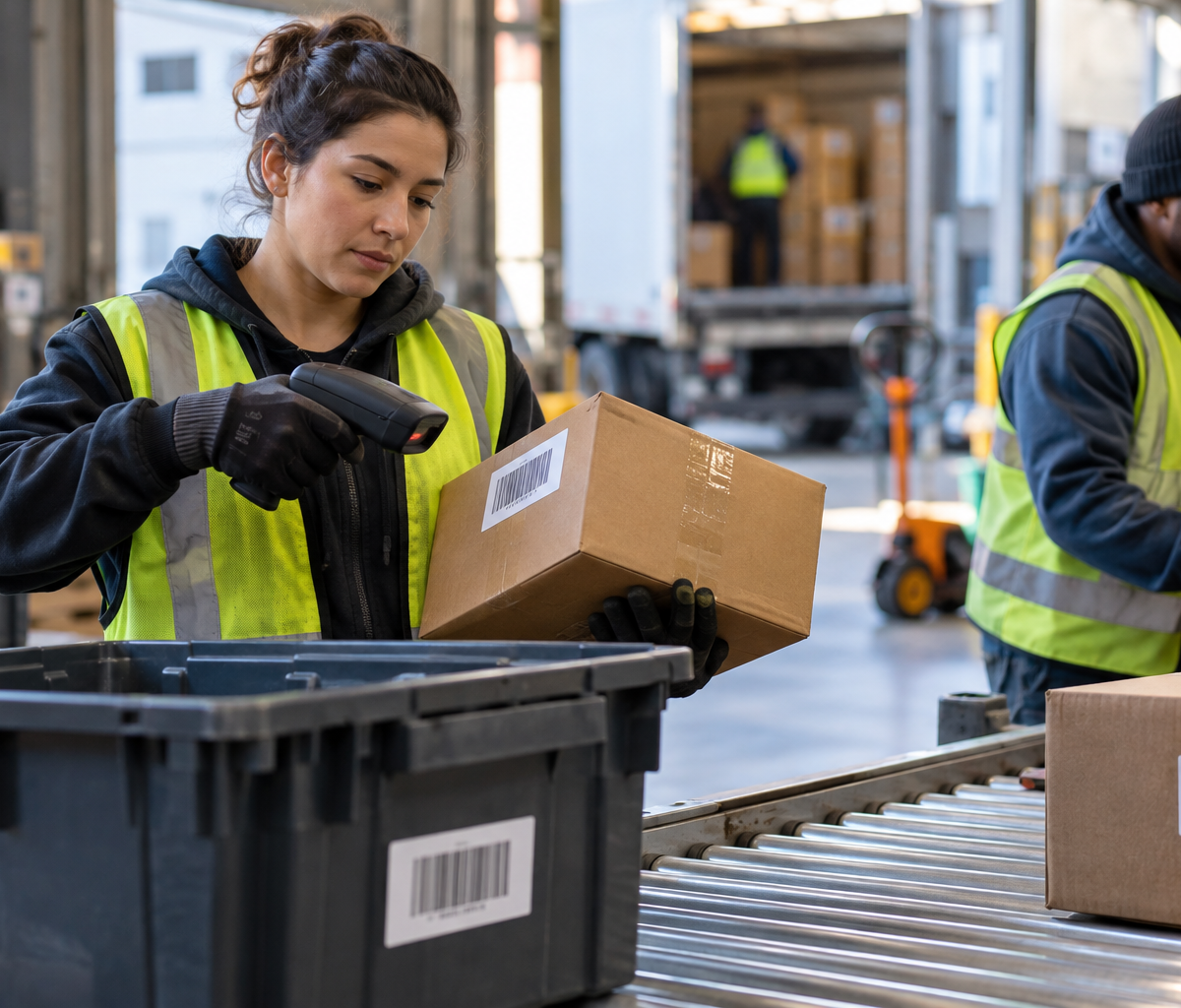
A worker scans the barcode on a tote. The system recognizes the tote ID, but a parcel inside carries a different tracking number. That is not automatically a contradiction. The tote and parcel are different units with different identities; the system needs a record connecting them. Understanding how barcodes identify logistics items begins with this distinction between the code printed on an object, the object it identifies, and the event recorded when someone scans it.
A barcode is a machine-readable way to carry data. The data may identify a product type, an individual handling unit, a location, or another object depending on the system and standard used. It does not contain a live GPS position or prove that the right contents are still inside a container. A scan can become evidence of a location or handoff only when the surrounding system records the reader, time, place, action, and correct physical unit.
GS1 explains that a logistics unit such as a pallet can be individually identified with a Serial Shipping Container Code. Its logistics-unit guidance and GS1 US’s SSCC explanation illustrate one widely used standards approach. A particular delivery employer may use other proprietary identifiers. The key concept applies across systems: the printed code identifies what its issuer assigned it to identify; the surrounding records determine what else can be inferred.
Read the barcode identifier at the right level
A barcode identifier should be interpreted at the level assigned by its system. A product barcode may identify a type of item sold many times. A serialized code may identify one physical logistics unit. A shelf or door code may identify a location. Scanning each can produce a string of characters, but the meaning comes from the numbering scheme and database, not from the black bars alone.
Ask what unit the label belongs to before drawing a conclusion. A pallet label can identify the palletized load as a logistics unit. A carton label may identify a carton. A parcel tracking label identifies a shipment under the carrier’s system. The presence of a pallet code does not make every carton on it share that code as its own identity.
Some labels carry more than one field or barcode. A worker may scan a product code when the workflow expected a handling-unit code. The scanner may read successfully while the wrong kind of identifier enters the transaction. The system should know which field or application identifier it expects at that step. A successful beep means data were read, not that the intended business action was correct.
Human-readable text helps verify the scan but is not a substitute for knowing the code’s purpose. Two labels can show similar customer names and still refer to different shipments. A damaged label can be misread or replaced. The worker should follow the employer’s procedure for an unclear code rather than typing a plausible value from memory.
The issuer and namespace also matter. An internal tote number may be unique within one warehouse, while a standardized logistics-unit identifier is designed for exchange across organizations. Two systems may use the same-looking digits for different purposes. A data connection should preserve which system assigned the code and which object it names.
GS1’s SSCC example illustrates a specific logistics-unit identifier, not a rule that every barcode on every delivery item is an SSCC. A candidate or new logistics worker should ask which codes their operation uses and where the system shows their definitions. This article explains the mental model, not a universal decoding chart.
Keep the unit-to-contents link explicit
A unit-to-contents link records which smaller items are associated with a larger handling unit. A tote can contain several parcels. A pallet can contain cartons. A trailer can carry pallets. Each level can have its own identity, and the relationship can change when work is packed, split, transferred, or unloaded. Scanning the parent unit is useful only if the contents association is current and accurate.
Imagine a tote label scanned at a sort station. The system may show ten parcels assigned to it. That assignment can guide handling, but it does not prove the ten parcels are physically inside at that moment. One may have been left on a table or removed for an exception after the association was made. Physical verification and event records determine how much confidence the worker can place in the list.
Parent-child links should have a creation and change process. Who records a parcel entering the tote? What happens when it is removed? Does the system require an item-level scan, a batch confirmation, or a manual correction? The answers tell you whether a tote scan is a strong proxy for its contents or only an approximate planning signal.
A mismatch should be described at the correct level. If the tote code is valid but one parcel has a different tracking identity from what the tote record expects, the tote barcode itself may be working perfectly. The issue is the association between the tote and parcel records, or the physical contents. This article does not provide the step-by-step repair for a specific mismatch; that separate operational decision has its own topic.
Do not erase an old association to make a new one look clean. If a parcel moved from one tote to another, the system should retain the transfer event where the workflow requires it. The history helps explain why a prior scan showed the parcel under the first tote. It also lets an analyst distinguish a genuine physical transfer from a delayed data correction, two events that may look similar in a simplified tracking view. A current contents list and a movement history answer different questions.
Mixed loads make the distinction especially important. A pallet may hold cartons for several orders. Its logistics-unit code can identify the pallet as a whole while the order system maintains item-level detail elsewhere. A receiving team should know whether accepting the pallet means it has checked every carton or only taken custody of the labeled unit under the agreed process.
Use scan event context to infer movement carefully
A scan event context includes the code read, when and where it was read, the action selected, the device or user, and the system that stored the event. Without that context, a barcode number is static. It can identify an assigned unit but cannot tell a reader whether the unit is currently at the dock, on a vehicle, or with a recipient.
Even with context, a scan is an observation, not omniscience. A worker could scan a label detached from its package. A device may upload the event later than it occurred. A location setting may be stale. Those possibilities do not make scans useless; they define what should be checked when an event conflicts with other evidence.
Event names can be broader than the physical action. “Arrived” may mean a container was scanned at a facility entrance, not that every parcel inside was individually counted. “Loaded” may be recorded against a parent unit rather than each child. Ask the employer what the workflow requires before treating one event as proof of every downstream item’s state.
A current location is often an inference from the latest reliable event, planned movement, and absence of a later conflicting event. If the last scan was at Facility A yesterday, the item may still be there, may be in transit without another scan, or may be in an exception area. A system can display the last known event accurately while the present physical location remains uncertain.
The proof-of-delivery responsibilities guide concerns a driver’s evidence at a final handoff. Barcode identity and scan events are part of that evidence chain, but a readable code alone is not a delivery confirmation. The handoff action, recipient or location context, and employer workflow give the event its meaning.
When investigating a surprising scan, keep the original event. Correcting a bad association or device setting should not rewrite history to pretend the scan never occurred. A later reviewer needs to see what the system recorded and why the interpretation changed. That is especially important when several units share a parent container.
Work through the tote and parcel example
Imagine a tote with its own barcode. A sorter scans it, and the system displays a list of parcels expected inside. One physical parcel has a tracking label that is not on that list. The worker now has three distinct pieces of information: the tote ID scanned successfully, the system’s expected contents list, and the parcel’s separate tracking identity.
The successful tote scan confirms that the scanner read a code assigned to that tote in the system. It does not prove the unexpected parcel belongs there. The parcel code identifies the parcel under its own tracking system. The worker should follow the operation’s exception procedure to compare the parcel identity with the current association and physical contents before the tote continues. This example does not prescribe the repair steps for a real facility.
Suppose the parcel had been reassigned to the tote but the association update has not reached the scanner yet. The discrepancy may be a timing issue. Suppose instead the parcel was placed in the wrong tote. The same visible mismatch would have a different cause. A careful worker does not choose between those explanations from the barcode alone.
After the proper owner resolves the association, the system may record an item-level correction or a physical transfer. The tote’s ID remains the same; the contents record changes. Later scans of the tote can be interpreted against the corrected list and the event history. This is why identity, contents, and movement should remain separate concepts.
The example is hypothetical and does not state how Delpack labels totes or parcels. It shows why a barcode can be correct even when the surrounding operational record needs attention.
Recognize what a scan cannot prove
A barcode scan does not by itself prove condition. A carton can have an intact label while its contents are damaged. It does not prove quantity if a parent unit was scanned but its contents were never counted. It does not prove current location after the item leaves the scan point. Those conclusions require additional observations and the rules of the workflow.
This limit is useful, not a reason to abandon scanning. A good identifier allows systems to connect events to the right unit. The operation becomes more reliable when workers know which conclusions are supported and which need another check. Overclaiming a scan’s meaning can create a false sense of certainty in claims, inventory, or customer updates.
Ask which errors the system catches automatically. It may reject a parcel code when a tote code is expected, flag a duplicate scan, or show that a unit belongs to another destination. It may also accept a syntactically valid code whose physical label was attached to the wrong item. People still need a way to report a mismatch that software cannot infer.
Do not confuse scan cadence with identity. Scanning a unit more often can improve visibility, but repeated scans of the wrong label or stale association do not fix the underlying mismatch. Another Delpack topic covers how often events should be reconciled. Here the focus is the meaning of a code and the evidence created when it is read.
Use the identifier model in logistics work
How barcodes identify logistics items is a useful concept for sorters, drivers, dispatchers, analysts, and customer-support workers. Before answering “Where is it?” or “What is in this tote?”, ask which unit the code identifies and which event supports the answer. That small pause can prevent a product code, container code, and parcel tracking number from being treated as interchangeable.
In a new role, ask which identifier types appear on labels, which system assigns them, and what a successful scan records. Ask how parent containers are linked to their contents and who can correct an association. A good training process explains those rules through real examples instead of relying on scanner sounds and color-coded screens.
For Delpack’s first-party driver opportunities, see the Fort Wayne driver careers page. It does not establish Delpack’s barcode system or tote process. Use the conceptual questions here when learning any logistics employer’s actual labels and scan workflow.
Continue with Delpack
Review the Fort Wayne career overview or contact Delpack with a question about the company.