How drivers close a route with unresolved exceptions
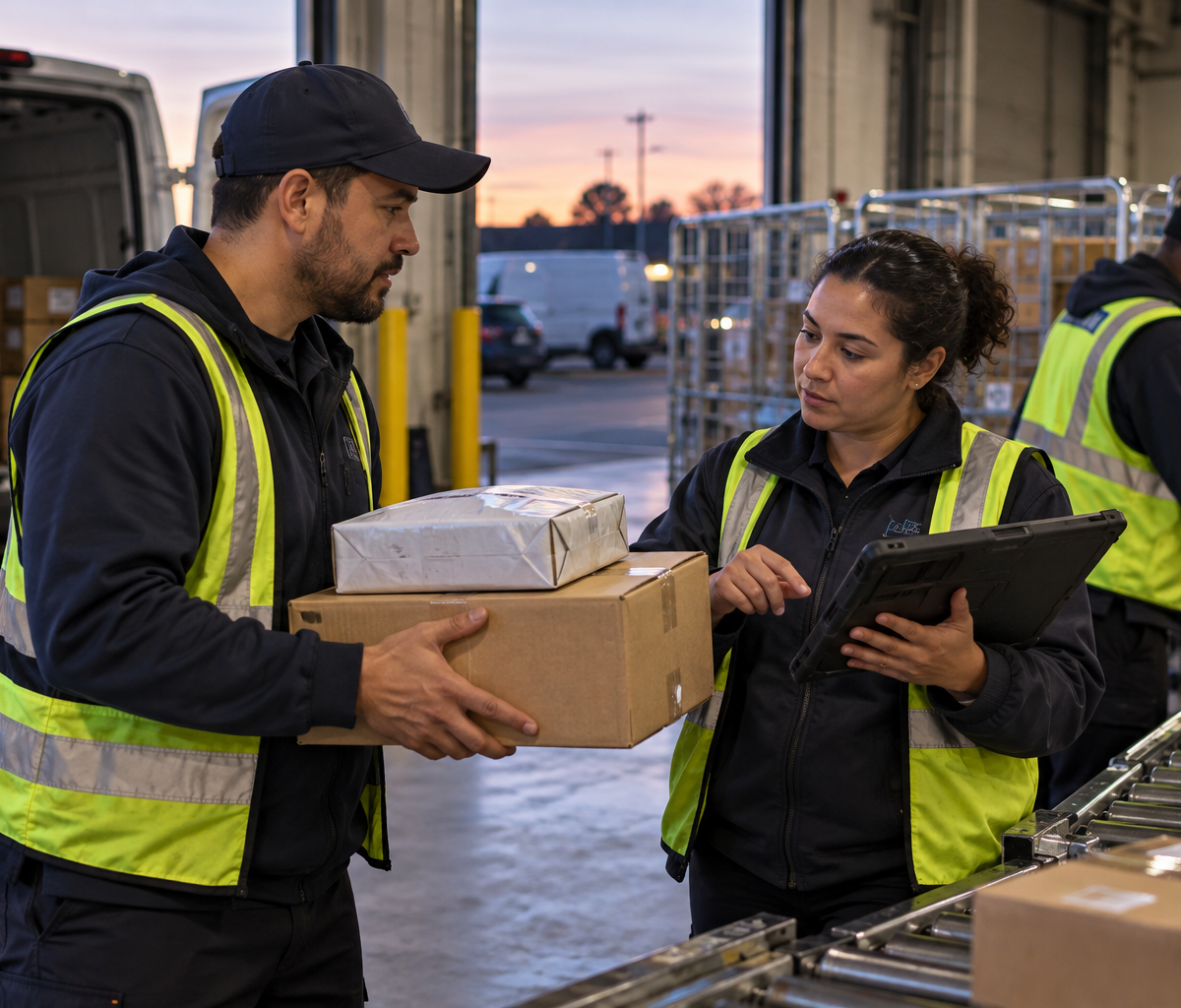
Close a route with two held parcels and an uncertain app event by recording truthful statuses, physical custody, supervisor ownership and work time.
A driver returns to the depot with two undelivered parcels. One address could not be verified; the other parcel's label is damaged. The delivery app also shows an open exception that has not received a final response. Ending the route without a clear handoff can leave the parcels physically present while their digital status or next owner is uncertain. How drivers close a route with unresolved exceptions depends on naming each remaining issue, recording the last supported event and confirming who takes responsibility after the driver’s shift.
This guide covers final route closeout across several unresolved items. It does not choose one undeliverable reason code or perform a detailed count of every parcel returning to the depot. Those decisions have their own workflows. Here, the driver needs a concise, truthful exception list and a supervisor or authorized return owner who accepts the next action. Clocking out should follow the employer's process after that handoff, with the time record reflecting work actually performed.
List every open exception before clearing the route screen
An open exception is a delivery, pickup or app event whose final operational state is still unresolved. Review the route view for failed stops, pending scans, unsubmitted notes and records that appear complete on one screen but open on another. Record the exact stop and parcel IDs. A red badge count of three is not enough when one entry may concern a package already returned and another a customer contact still awaiting a decision.
Separate physical issues from system issues. The driver can have a parcel in the van with a valid failed-delivery scan, or a parcel physically handed to an authorized depot worker while the app still shows it assigned to the route. The two cases require different next actions. A status error should not be "fixed" by inventing a delivery event, and a physically held parcel should not be ignored because its app line disappeared.
For the worked example, note parcel P1 at the address that could not be verified, parcel P2 with the unreadable label, and app case E3 whose submission is still pending. Determine whether E3 belongs to P1, P2 or another stop; do not count the same issue as three separate physical packages. Link the app case to its parcel or stop identity before closing the manifest.
Use a short working list: item identity, last confirmed physical location, last reliable scan or status, reason unresolved, person contacted and next action. That list travels into the supervisor handoff. How drivers close a route with unresolved exceptions begins by making unresolved work explicit rather than hiding it behind a completed route badge.
Keep the two held parcels under known custody
The held parcels remain the driver's responsibility until they pass to the designated depot or supervisor process. Place them in the authorized return area and follow the employer's scan or acknowledgment procedure. The driver should not leave P1 and P2 on an unattended shelf merely because the route is over. Physical transfer and digital recording should refer to the same parcel identities.
Check labels and package condition without improvising a new destination. P1's address problem needs the authorized verification or return path. P2's unreadable label may still have another unique identifier or manifest reference, but the driver should not guess its tracking number from a similar box. Preserve damaged-label evidence according to the site's process and let the trained owner decide whether relabeling or identity repair is needed.
Record who received the parcels and when. If a depot worker scans both, the driver can note the receipt under the route closeout. If only one is accepted because P2 needs a special exception desk, keep P2 under known custody until that owner takes it. A two-package count is helpful, but the named identities and different next paths matter more for this closeout decision.
Do not confuse a return instruction with a completed return. An app may tell the driver to bring a parcel back while its physical location remains the van. Closeout should reflect the actual handoff. The detailed depot reconciliation of all returned inventory belongs to the return workflow; this route record should show that these two exceptional parcels reached their next authorized owner.
Choose a final scan state that matches the facts
The final scan state should describe the supported delivery attempt or custody event. USPS and UPS tracking guidance distinguish delivered, attempted, held and other exception states. Those are carrier-specific examples; the driver must use the codes and definitions in the employer's own system. A package that was never handed to a customer should not be marked delivered to make the route close.
For P1, record the actual address-verification issue using the approved exception path. If the driver did not make a safe, valid delivery attempt because the location was ambiguous, do not choose a code that falsely says a recipient refused the parcel. For P2, record the damaged-label or identity issue according to the employer's available workflow. If no code fits, tell the supervisor and preserve the facts rather than selecting a convenient but wrong reason.
Check scan timestamps and upload status. A device may show an event locally while the server has not accepted it. If a submission times out, determine whether it reached the system before sending the same write again. Record the uncertain attempt and obtain help through the authorized support path. An unchanged retry can duplicate or alter an event after it succeeded out of view; a missing response is not proof of no write.
Review the route's delivered count only after exceptions are accounted for. A final total that matches the number of stops can still hide a parcel marked delivered at the wrong address or a two-piece stop where one piece remains in the van. Match the exceptional parcel IDs against the actual statuses. How drivers close a route with unresolved exceptions requires a truthful state for each affected unit, even if some remain open with a named next step.
Give the supervisor handoff a specific next action
A supervisor handoff should include P1, P2 and E3 by identity, their last reliable states and what decision remains. "Two problems returned" forces the next shift to reconstruct the route. A useful handoff says P1 awaits verified-address review, P2 awaits label or parcel-identity repair, and E3 needs system-state reconciliation before any further scan. Name who accepted each item or case and when.
Use the employer's required channel, whether an in-person exchange, route app, depot log or dispatch contact. If the usual supervisor is unavailable, follow the designated escalation path. Leaving a voicemail without confirmation may be insufficient when physical parcels are still in a van. The driver needs an accepted custody and issue owner before the shift ends under the local process.
Keep the next action concrete. P1 may need a verified address or customer instruction. P2 may need an authorized inspection of label and manifest identifiers. E3 may need a system check to learn whether the timed-out event already posted. Assign a person or team and a time for review. Do not close E3 as "resolved" simply because the driver has handed the phone to a supervisor.
Where a customer deadline is affected, the supervisor should know which communication is pending. The driver should not tell the customer P1 was delivered or that P2 is lost when the evidence shows only an unresolved return. The communication can state the supported facts and next update time. Closeout is a transfer of owned work, not a way to erase the customer's unresolved delivery.
Reconcile the clock-out record with remaining work
The clock-out record should reflect the route, return and exception-handoff work actually done under the employer's timekeeping process. A driver may have reached the depot at 5:00 but spent another twenty minutes returning P1 and P2 and explaining E3. Those tasks belong in the recorded work period where applicable. Do not clock out early in an app merely to make a route screen appear clean while still handling parcels.
Check the route close and timekeeping systems separately. The delivery app may allow the route to close while the employee remains on duty completing depot work. Conversely, the time clock may show a shift end while an app exception remains assigned. The supervisor should know both states and the next owner for the open case. The article does not prescribe an employer's payroll settings or a pay rate; it asks for accurate reporting through the applicable procedure.
Before leaving, verify the driver has no remaining physical parcels or assigned action under the completed shift. If P2 remains in the vehicle because the exception desk closed, the supervisor needs to decide an approved secure holding and custody plan. The driver should not silently leave the box in the van overnight or mark the route complete without telling anyone. A proper closeout can include an open issue when its owner and location are explicit.
Keep a record of the handoff confirmation. The next shift may need to ask who last had P1, what the device showed for E3 and whether P2 was ever scanned into the exception area. An exact time and named receiving person make that investigation possible. If the system later corrects an uncertain event, preserve the original attempt and the reconciliation result rather than rewriting the route history as though no ambiguity occurred.
Work through the two-parcel closeout
At 5:05, the driver reaches the depot with P1 and P2. The route app lists P1 as an address exception and P2 as unresolved because its barcode was unreadable. A separate submission for E3 appears to be spinning. The driver first identifies whether E3 refers to P2; it does. The physical count is two parcels, while the digital issue list has three entries, one of which is a pending event for the second parcel.
The driver gives P1 to the authorized returns worker with its identity and verified-address question. P2 goes to the exception owner, who records its alternate manifest identity and damaged-label condition. The driver does not resubmit E3 until support or the supervisor checks whether the first event reached the destination. Each physical parcel now has a recorded receiving owner, and the app uncertainty has a named reconciliation owner.
Suppose the system check shows E3 posted successfully after the device timed out. The route owner preserves that original event and does not create a duplicate. If it did not post, an authorized corrected action can be taken with the preserved failed evidence. The resulting status must still match P2's physical custody. Neither outcome changes the fact that P2 was not delivered to a customer.
At 5:25, the supervisor accepts the remaining address review and system reconciliation. The driver checks that the route no longer falsely assigns P1 or P2 for delivery, completes the required time entry and ends the shift. This is a truthful closeout even if P1's corrected address and P2's next shipping plan will be decided tomorrow. Those open decisions have owners and evidence.
Check the next shift’s view before calling the case settled
The next owner should be able to find P1 and P2 at their recorded locations and see E3's reconciliation state. If the receiving worker cannot locate one parcel, the prior handoff needs investigation; a scan receipt alone should not be treated as proof the physical unit is in the expected bin. If the app still assigns a parcel to the driver who clocked out, correct the assignment through the authorized process before new delivery work starts.
Review patterns of closeout exceptions. Repeated unreadable labels may need a packaging or print-quality repair. Repeated timed-out scans may need a device or network fix. A single address ambiguity may point to a customer data issue. Preserve each incident's facts and repair the shared cause for later routes rather than asking drivers to choose an inaccurate status at the end of every day.
Readers can use the driver guide hub or the Fort Wayne driver careers page for adjacent delivery information. For the two held parcels and E3, the route closes cleanly when physical custody, last supported scan, unresolved decision, supervisor owner and work-time record all agree with what actually happened.
Continue with Delpack
Review the Fort Wayne career overview or contact Delpack with a question about the company.