How drivers return undelivered parcels
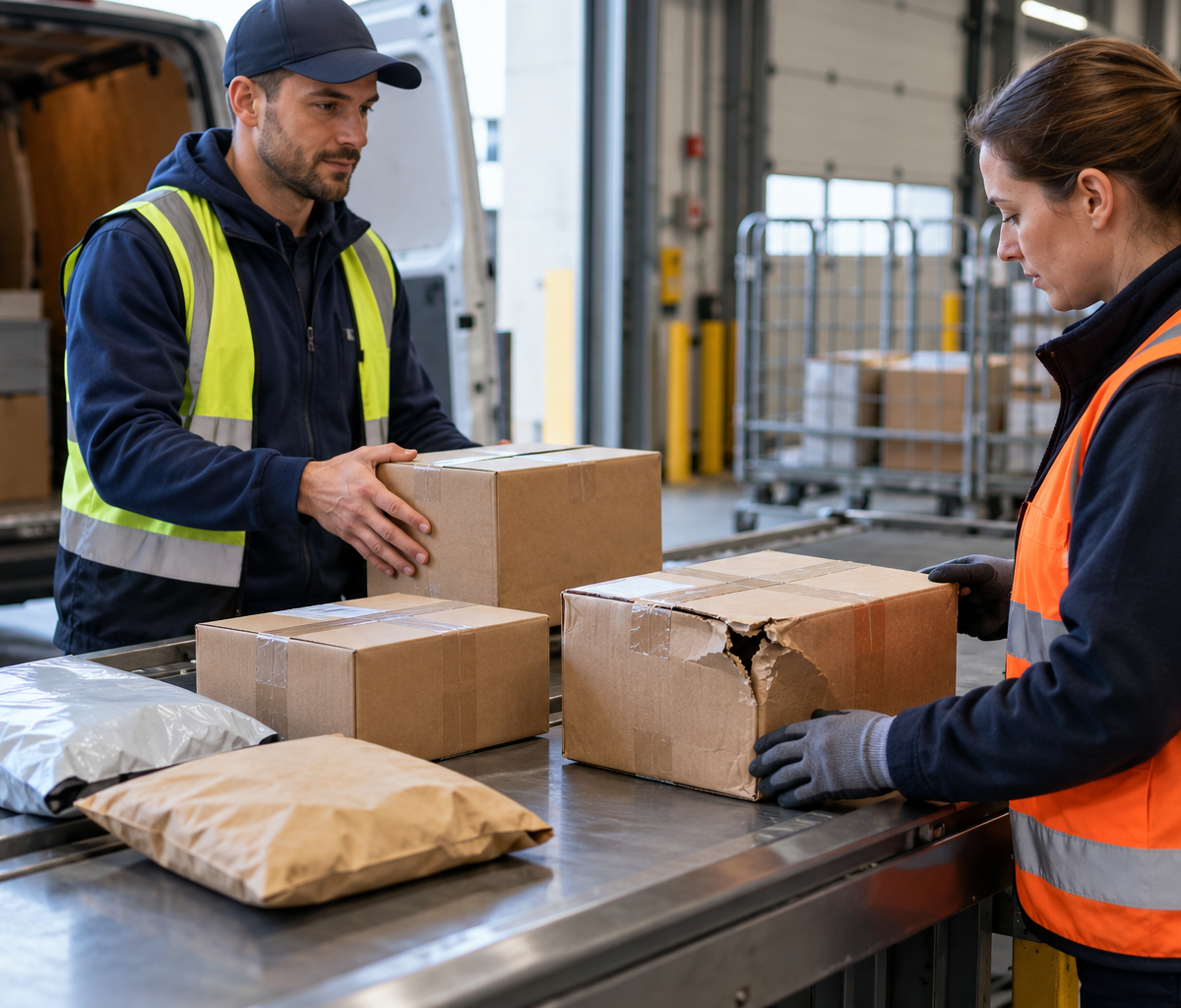
Count undelivered parcels at the depot, match each to its exception record, and verify the receiving scan that transfers custody.
A driver ends a delivery shift with four parcels from failed stops and one carton set aside for damage review. All five are still in the van. The route app may show the reasons they were not delivered, but those entries do not place the boxes in the depot's hands. How drivers return undelivered parcels is the physical and recorded handoff: count the items, match them to their identifiers and exceptions, present them at the approved receiving point, and confirm that another authorized owner accepted them. The driver should be able to account for each package before leaving the station.
This is not a guide to deciding why a recipient refused a parcel or why a delivery attempt failed. Those decisions belong at the stop. It is also narrower than closing every route status before clocking out. The concern here is the five physical items brought back to the depot. A failed-delivery scan, a return instruction, and a receiving acknowledgment are different events. The last event closes the driver's custody only when it corresponds to the parcels actually handed over.
Make a return count before unloading
The return count is the number of physical parcels in the van that must leave the driver's custody at the depot. Count by individual package, not by stop or tote. One failed stop can have two parcels. A damaged package may be separate from the four ordinary undelivered items even if all five return together. Note each tracking ID or other employer-approved identifier so the count can be checked against the route record.
Do the count while the items are still under the driver's control. A quick look at the app's "undelivered" total may miss a package with a pending status, a damaged item handled under a different workflow, or a box accidentally left in the vehicle. Conversely, a digital exception may refer to an item already transferred to support during the shift. Compare the physical inventory with the records instead of assuming they will match.
Keep categories visible without treating them as separate owners. A refused parcel, an inaccessible-stop parcel, and a damaged carton can all be in the driver's van, but the depot may send them to different receiving areas. The driver should ask where each belongs under the actual operation's process. Do not place the damaged carton among ordinary redelivery stock if it needs a quality or safety hold. Preserve its label and the condition evidence already recorded.
How drivers return undelivered parcels begins with a count the receiving person can reproduce. "Five packages" is a useful starting total; a list of five IDs and their physical locations is stronger. The list helps when one parcel is under a seat or in a separate exception bin. It also prevents a broad five-item receipt from concealing a substituted or missing package.
Verify the exception match for each parcel
An exception match connects each physical package to the route event that explains its return. Check the identifier on the box against the app or approved manifest. Confirm that the record says it was not delivered and that the reason entered at the stop reflects what happened. The driver should not change a valid reason just because the depot uses a different receiving lane. If the reason is wrong, report the correction need through the authorized route rather than inventing a new event at check-in.
A parcel may have no exception because the device did not save the attempt, the app had no fitting category, or the item was discovered after the stop. That is a discrepancy to resolve before the handoff is treated as complete. The driver can give the receiving owner the actual history: package ID, last known route event, physical condition, and why it is back. Avoid assigning "customer unavailable" to a box that never reached a door merely to make the return screen accept it.
Look for the reverse mismatch too: a package marked undelivered in the app that is not physically in the return group. It may have been transferred earlier, delivered under a corrected event, or left in the van. Check the event trail and vehicle before signing off. If no physical location is known, keep the incident open with a named support owner. A digital list alone cannot establish that the depot received an absent box.
The damaged fifth carton may have both a failed-delivery status and a damage record. Both histories should remain traceable. A return scan does not erase the damage observation, and the damage note does not replace the receiving event. The receiving team needs to know which package arrived, what condition was observed, and whether the item is held for inspection. Preserve the actual sequence rather than collapsing every reason into a generic "returned" label.
Use the receiving scan for the physical handoff
A receiving scan or equivalent acknowledgment records that the depot accepted a specific parcel from the driver. Follow the employer's designated process: the receiver may scan each package, the driver may scan into a return area under supervision, or a controlled handoff sheet may be used. The exact method is local. The important check is that the record identifies the parcel and the new custody owner after the physical transfer.
Do not treat an arrival at the depot as a handoff. Parking the van, ending the route in the app, or leaving boxes on a shelf does not show that a receiving person accepted them. If the designated area is closed, use the approved secure-hold or after-hours procedure and record who now controls the items. A driver should not mark the five parcels received while they remain in an unattended vehicle.
Watch the scan result. A beep may mean the barcode was read, but the app could still reject a parcel because of route status, duplicate entry, or a missing exception. Check the confirmation shown by the receiving workflow. If one of five IDs fails, keep that item under an explicit custody arrangement while the issue is resolved. Do not count a rejected scan as accepted merely because the other four went through.
Record the actual time of receipt. The delivery failure may have happened hours earlier, but the depot took custody at return time. Backdating a receiving scan to match an attempt can distort the chain of custody. A separate system upload delay may also exist; retain the distinction between the physical handoff and when the central system displayed it. If the receipt is uncertain, ask the receiving owner to reconcile it before leaving.
Confirm the custody transfer and next owner
The custody transfer closes the driver's responsibility for the physical parcel and starts another owner's. Identify the person, team, secure station, or system queue that accepted each item. A depot may separate ordinary redelivery freight from damaged or restricted items. The driver should know where the fifth carton went, not merely that it was unloaded with the others.
Ask for the receipt or status view the employer uses to confirm acceptance. It may show five package IDs and one or more receiving locations. Compare it with the count made at the van. If the screen shows four of five, locate the remaining item and resolve its handoff. If it shows six, check for a duplicate scan or an item from another route. The mismatch matters even if the total looks close; the identities determine which customer packages are accounted for.
Do not infer a shipper return from a depot return. A parcel brought back to the station may be held, redelivered, inspected, reassigned, or eventually sent to the sender. FedEx's public tracking guide distinguishes "returning to shipper" from other delivery statuses within its own network. The driver should use the employer's actual return-to-depot record unless a separate authorized instruction sends the parcel back to its shipper.
If a receiving worker asks the driver to leave before scanning, clarify the approved deferred-receipt process. Some operations may permit a secure drop with a later scan; if so, the driver needs the named handoff point and evidence that custody changed. An informal "I'll get to it" beside an open shelf is not a reliable transfer. The physical items and the record should have the same owner at the end of the interaction.
Work the five-parcel depot return
Consider an illustrative route returning at 18:20. The driver has four undelivered parcels, F11 through F14, and damaged carton D15. The app lists F11 and F12 as access failures, F13 as an unavailable required recipient, and F14 as an approved hold after an address question. D15 has a separate on-route damage report. The driver counts five physical boxes in the van before unloading. These example statuses do not claim to be Delpack's actual code names.
The driver compares the five label IDs with the route and incident records. F11 through F14 have the expected undelivered entries; D15 has the damage case and a direction to return it for inspection. The receiving desk accepts the four ordinary returns one by one. Each scan shows the corresponding ID and a successful depot receipt. The driver then takes D15 to the designated damage area, where the receiving worker acknowledges that exact carton and its condition case.
Suppose F14's scan fails because the app still shows it assigned to the driver. The other four receipts do not make F14 disappear. The driver keeps F14 at the staffed desk, gives the receiver its tracking ID and earlier hold instruction, and asks the support owner to reconcile the status. The final record should show who accepted F14 and when. If a system correction is needed, it should refer to the real physical handoff rather than a guessed earlier time.
After correction, the driver checks the five-ID receipt against the physical return list. The van is empty of these packages, and each has a named receiving location. If D15 is held for inspection, that is the depot's next workflow. The driver has completed the return without deciding whether a customer will receive a replacement, whether F13 gets another attempt, or whether any item goes back to the shipper.
This case also shows why the total is necessary but insufficient. Five packages counted at the van and five scans at the desk could still conceal one duplicate scan and one missing carton. The identity-level comparison closes that gap. It also gives the next owner a workable queue rather than an unexplained pile.
Resolve a return discrepancy before ending the handoff
A return discrepancy is any difference between the physical parcels, route records, and receiving receipt. It could be a missing item, an extra box, a rejected scan, a wrong status, or a carton routed to the wrong depot area. Describe the exact ID and the two states that disagree. "F14 is physically at the desk; app still assigns it to my route" is actionable. "The returns are wrong" is too broad.
Do not solve a discrepancy by changing a delivery reason to fit the receiving screen unless the original reason was actually false and an authorized correction is made. A parcel can be returned with a valid failed-attempt reason while a separate transfer step is broken. Preserve both records. If the physical handoff is certain but the electronic receipt is not, note the receiving person, location, time, and unresolved system state through the approved fallback. The supervisor can then reconcile the system without pretending the parcel remained in the van.
Check the vehicle one last time for parcels in side pockets, under shelves, or in a damage bin. Then compare the receiving receipt with the driver return list. If an item truly remains unaccounted for, keep the incident with a named owner and the last known physical point. Clock-out or route closure should follow the employer's process; this guide's custody check does not replace the separate route-closeout review of open digital exceptions.
How drivers return undelivered parcels is complete when the count, identities, receiving records, and physical locations agree. The driver guide hub covers other route decisions, and the Fort Wayne driver careers page lists local opportunities.
Continue with Delpack
Review the Fort Wayne career overview or contact Delpack with a question about the company.