How package counts become vehicle loads
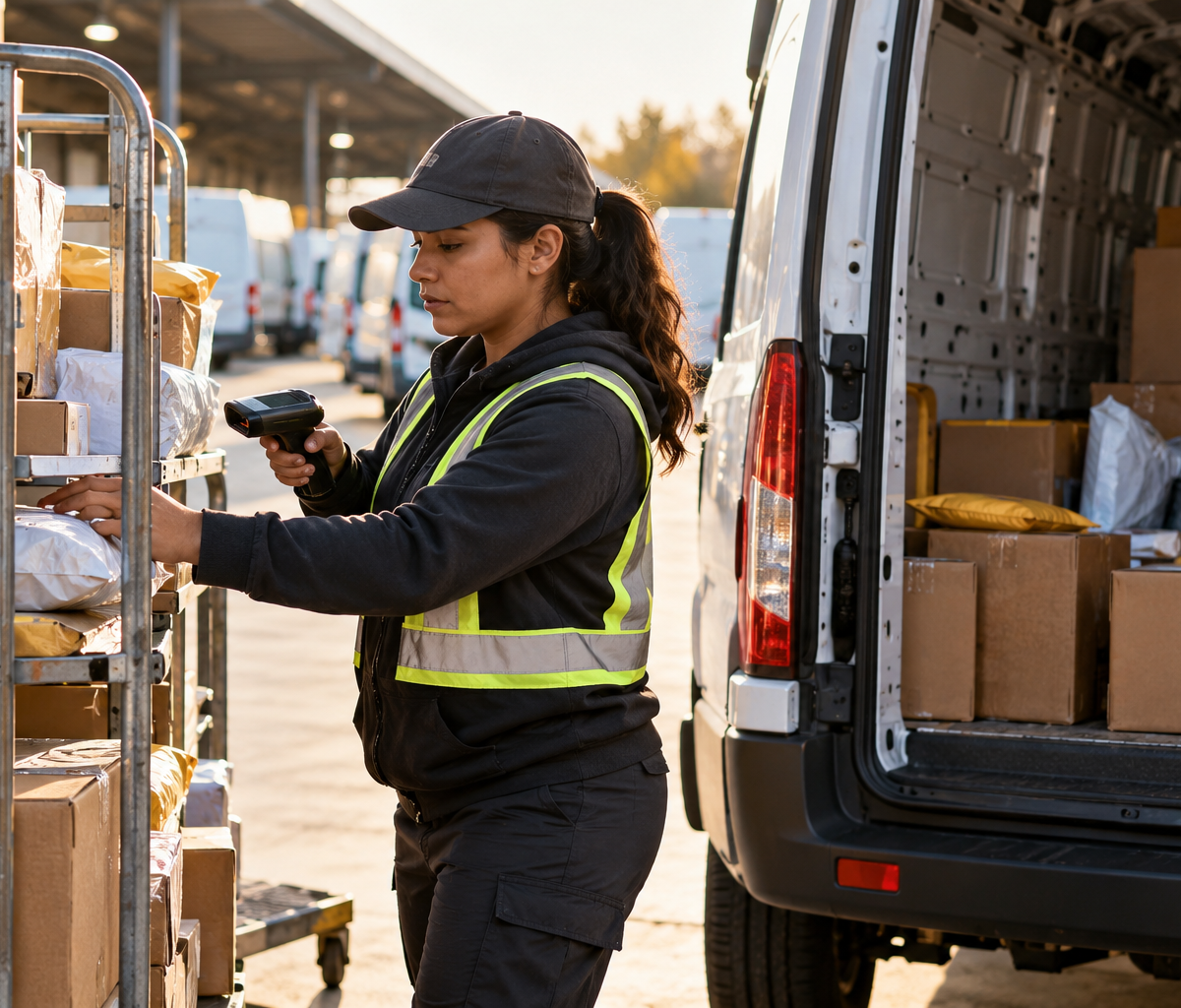
Understand who sorts, scans, and loads the assigned parcels, then verify that the departure record matches the van.
A new delivery driver sees "78 packages" beside a route assignment and wonders what happens next. Will depot staff build the load, or must the driver sort, scan, and place all 78 items in the van? The number alone cannot answer. How package counts become vehicle loads depends on who owns each step between the manifest and departure: identifying the assigned freight, sorting it to the right route, recording the load, arranging it in the vehicle, and confirming that the physical packages match the accepted route. An applicant should understand those duties before the first shift.
Light-truck driving jobs vary. O*NET describes drivers who may load and unload vehicles and lists verification of load contents against shipping papers among common tasks. The Bureau of Labor Statistics also includes loading and unloading cargo in its description of delivery driver duties. Those occupation sources establish that loading can be part of the job; they do not say how Delpack divides work between drivers and depot staff. The useful question is which exact task the role assigns to the person taking this route.
Read the assigned package count correctly
The assigned package count is a starting expectation, not proof that every item is already in the van. Clarify what the number includes. It may count individual parcels, bags, totes, oversized items, pickups, or some combination depending on the system. A stop count is different: one address can have several parcels. A route showing 50 stops and 78 packages can be consistent, but the driver still needs the package-level manifest or approved load record.
Ask when the count becomes final. A preliminary plan may change as late freight arrives, a parcel is held, or a route is reassigned. A displayed total without a timestamp or accepted status can be misleading. The driver should know which route version and package IDs are expected at departure, and who updates the count when freight moves between routes.
Look for separate counts for physical loading and planned collections. A pickup scheduled later in the day is work on the route but is not an outbound parcel in the van at departure. An undeliverable item from a previous shift should not be silently mixed with today's 78. The operation may maintain distinct counts for these categories; if it does, the driver needs to know which one to reconcile against the vehicle.
How package counts become vehicle loads begins with a defined unit of work. "78" should lead to an identifiable set of packages, not an assumption that the nearest cart belongs to the route. Once the identifiers are known, the next question is who moves them through sorting, scanning, and loading.
Clarify the sorting responsibility
The sorting responsibility is deciding which route, zone, cart, or van a package belongs to under the employer's process. In one operation, depot staff may finish sorting before drivers arrive. In another, drivers may sort their own packages from a shared staging area. A mixed arrangement is also possible: staff assign the route, and the driver arranges the assigned freight inside the van. The applicant should ask which part is included in the job.
Identify the physical handoff point. Is the driver given sealed route totes, a cart of loose parcels, or packages at a belt? Who checks items that are missing a readable route marker? Who removes a parcel that belongs to another route? These questions define the work that turns a digital list into a controlled load. They also reveal whether the driver is expected to correct sort errors or report them to a depot lead.
Do not treat a route sticker as the only identity check. A parcel's tracking ID and destination may need to be compared with the manifest when a label or cart appears inconsistent. If a box lacks a valid assignment, do not quietly add it to the van because there is space. The operation should resolve its owner. A separate guide covers an extra unassigned parcel discovered later inside a vehicle; here the issue is building the correct starting load.
Ask whether sorting time is part of the scheduled shift and what equipment is available. The answer affects the actual workday, though this article does not compare two offers or calculate which pays better. The immediate concern is role clarity: a candidate who expects a preloaded van should know if the first task is instead to spend time at a parcel wall sorting the route.
Find out who performs load scans
A load scan records that a specific item or container moved into an assigned stage of the route, according to the employer's system. It might be performed by a depot worker at the belt, by a driver at the van, or by both at separate handoffs. Ask what each scan means and who is responsible for checking its result. A scanner beep can confirm a barcode read without proving the central system accepted the item under the right route.
Clarify whether individual parcels, totes, or both are scanned. A tote-level scan can identify a container, while a parcel-level record can identify its contents. The employer should explain which method is authoritative for the job. A driver should not assume that scanning a tote proves every listed package is inside it if the local process requires a separate contents check.
Find out what happens when a scan rejects. The package may be assigned to a different route, held for an address question, already scanned elsewhere, or affected by a device problem. The driver should know whether to set it aside, call a sorter, or request support. Repeating the scan without understanding the message can obscure the original issue. Preserve the package identity and the observed result until the responsible person decides its disposition.
Ask when the driver accepts custody. Is it when depot staff stage a cart, when the driver scans it, or when the van door closes after a joint count? The answer must come from the employer's process. A digital scan and a physical handoff should describe the same event. If the app says the driver accepted 78 packages but only 77 are physically present, the mismatch needs resolution before departure.
Plan vehicle placement for the assigned load
The vehicle placement step puts assigned packages into the van so they remain identifiable and can be accessed safely during the route. Clarify whether depot staff load the vehicle, whether the driver does it, or whether staff stage freight while the driver arranges it. A preloaded van still calls for a check that its assigned route and package set match the driver's record.
The arrangement may use stop order, zones, package size, special handling, or a combination. The employer should teach its method and any restrictions for heavy, fragile, or damaged items. A driver should not block a door or bury a package that needs early access simply to fit the count. If the planned load will not fit safely, report the capacity mismatch through the separate pre-departure process; this guide is about understanding the normal load-building duty, not deciding an overloaded-vehicle exception.
Loading can include more than lifting boxes. The driver may need to confirm package identifiers, secure loose freight, keep special-service items separate, and maintain a path to equipment. Ask which of those tasks are assigned and what tools or training are provided. A role described as "delivery only" can still involve a meaningful loading check, while a role with depot staff may leave most physical arrangement to them. The actual handoff matters more than a broad job label.
Do not assume a neatly packed van has been reconciled. It can contain a parcel for another route or lack one listed package. The last loading step should connect physical contents to the route record. A visually full vehicle and a correct numeric total can still hide one missing item and one extra item. Package-level identity checks are what distinguish a matched load from a balanced count.
Verify the departure record
The departure record should show which route, driver, vehicle, and package set left the depot, according to the employer's system. Before accepting the load as ready, check the route ID, current manifest count, any required scan completion, and unresolved exceptions. The driver should know whether the physical cartons in the van agree with that record.
If a package is missing from the staging cart, identify its ID and ask the depot owner whether it is being found, held, or removed from the route. Do not reduce the count by hand without a corresponding assignment change. If an extra carton is present, keep it controlled while the operation establishes its route. The goal is a departure record that matches the freight actually carried, not a dashboard that merely displays a green check.
Note any special handoff to another driver or vehicle. A package scanned for route A and physically loaded into van B creates a mismatch even if both routes have the same total. The driver should request correction while the people and packages are still at the depot. Once the van leaves, a later search may have to reconstruct which person last held the item.
The departure check should sit alongside the required vehicle inspection. OSHA's driver guidance calls for pre-trip vehicle inspections, which are a separate safety responsibility. The package count does not certify brakes, tires, lights, or other vehicle conditions. Likewise, a completed inspection does not prove the load is correct. Both checks serve the start of a safe, traceable route.
Work the new driver's loading question
Consider an illustrative new driver assigned route K4 with 78 parcels. The app shows the count, but the driver does not know who scans freight into the van. At the depot, a lead explains that staff sort parcels to route carts and scan each item onto the cart. Drivers then check the cart's route ID, scan the cart at the vehicle, arrange the parcels inside, and report any package-level mismatch before departure. That is this example's process, not a claim about Delpack's actual workflow.
The driver finds a K4 cart with 78 items in the staff record. While arranging the load, they count 77 physical parcels and see one empty space where a tote tag indicates another item. They do not assume the total is wrong or drive away hoping the parcel is elsewhere in the van. The lead checks the staging area and finds the missing parcel on a neighboring cart. Its tracking ID matches K4's manifest. The item is transferred through the approved scan and loaded to the correct van.
The driver then notices a package with a route K5 marker among the K4 parcels. The physical total is back to 78, but the set is not correct: K4 still has 77 of its own items and one K5 item. The driver reports the extra carton, and the lead returns it to K5 while locating the final K4 parcel. Only after the identities, count, and scans agree does the driver accept the departure record.
Change the employer process in the example: suppose depot staff load and scan the entire van before the driver arrives. The driver's question becomes what verification they must perform before accepting that load. They may need to check the sealed totes, route ID, manifest, and visible exception items rather than scan each parcel themselves. The task division changes, while the need for a clear handoff remains.
The new driver can now describe the actual job: staff sort and perform initial scans; the driver verifies the assigned cart, places freight in the van, and checks departure. That description is more useful than "the route has 78 packages" because it names the work the person will perform and the point at which they accept custody.
Ask about the full load-building duty
A load-building duty is any assigned step that turns route data into physical freight in a vehicle. Before accepting a role or beginning a shift, ask who sorts packages, who scans them, who loads the van, who resolves mismatches, and who signs off on departure. Ask whether the count includes containers, individual parcels, or later pickups. Those answers prevent the driver from discovering an unspoken task only after the route clock starts.
Use the answers to prepare for the right training. Someone who scans each parcel needs to learn the scanner's accepted and rejected states. Someone who arranges a pre-sorted cart needs to learn load zones and safe placement. Someone who receives a preloaded van needs to know what they are expected to verify without unpacking the whole vehicle. Each model can work if the handoff and exception owner are clear.
How package counts become vehicle loads is a chain of assigned work: define the count, sort the right parcels, record their movement, load the van, and verify departure. A reader can find related route guidance in the driver guide hub and local roles on the Fort Wayne driver careers page.
Continue with Delpack
Review the Fort Wayne career overview or contact Delpack with a question about the company.