Materials-handling equipment roles: choose the machine and the work
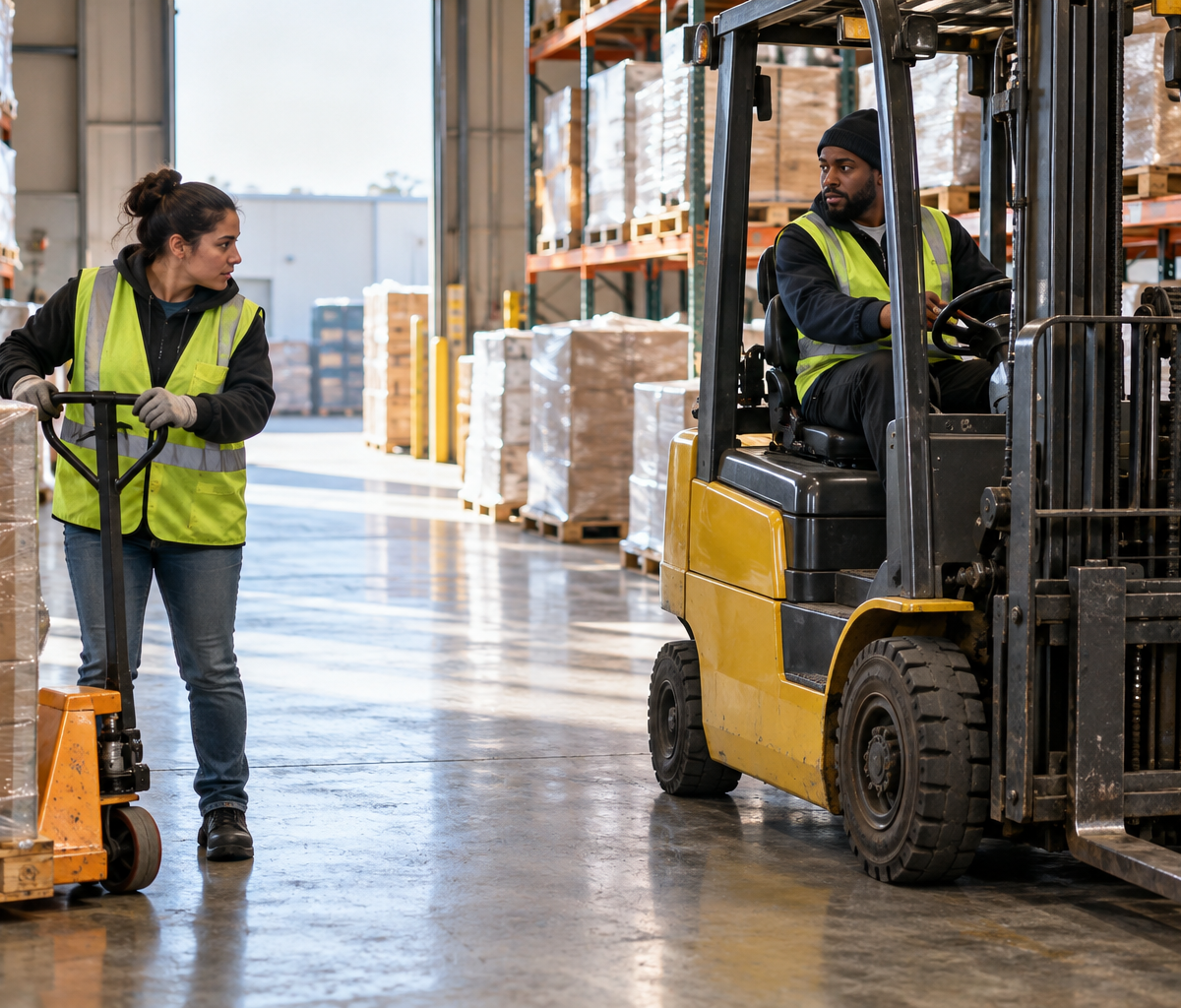
Compare a manual pallet-jack assignment with a forklift opening by machine, training, authorization, and workplace conditions.
A warehouse posting says the worker will move pallets. One shift might involve a hand-operated pallet jack on a level floor; another position might require a powered lift truck in narrow aisles. Both move materials, but the equipment, training, working conditions, and responsibilities can differ. Materials-handling equipment roles make more sense when you identify the actual machine and task before deciding whether a job fits.
A candidate comparing two openings should avoid treating “forklift,” “pallet jack,” and “material handler” as interchangeable labels. The posting may name the equipment precisely, use a broad term, or combine operating time with picking and loading work. The next step is to ask what the worker will operate, where it will be used, and how the employer trains and authorizes people for that assignment.
Identify the equipment type before the title
The equipment type is the specific vehicle or machine used to move a load. A manual pallet jack is pushed or pulled by a worker. A powered pallet jack uses a motor, and a forklift or reach truck can bring different lifting and travel tasks. Exact machine categories and site names vary. A job title rarely tells you enough about controls, load height, aisles, or whether the worker rides or walks with the equipment.
Consider a candidate choosing between two ads. The first calls for moving wrapped pallets from a receiving area to nearby floor locations with a manual jack. The second calls for placing loads on racks using a powered industrial truck. The first may demand sustained walking and careful maneuvering around people. The second requires training and evaluation appropriate to the powered truck and workplace. Neither description establishes the whole job; the candidate should ask what other tasks fill the shift.
The Bureau of Labor Statistics describes material-moving machine operators as using machinery to move objects. Its occupational overview covers several kinds of machines and notes that training varies by machine. It is broad career context, not an instruction that every warehouse operator follows the same route into a job. Employers define actual openings and the equipment they use.
A useful interview question is, “Which make or type of equipment would I operate during a normal week?” Follow it with where the machine works, what loads it handles, and how much time is spent operating it. A candidate who wants a forklift-focused path may be disappointed by a role that uses a manual jack occasionally while most of the day is spent picking. Someone who prefers walking work may feel differently about a ride-on assignment.
Read operator training and authorization separately
Operator training is instruction and practice for the equipment and workplace. Operator authorization is the employer’s decision to permit a worker to operate its equipment after the required process. A course completion card or past experience can be useful evidence of preparation, but it does not by itself tell a candidate whether a new employer will authorize them on a particular truck at a particular site.
OSHA’s powered industrial truck rule requires employers to ensure that operators are competent through training and evaluation. Its training guidance covers truck-related and workplace-related subjects. An employer may evaluate previous training and experience when deciding what additional training is needed. The candidate should ask how the employer handles its own equipment, site conditions, evaluation, and records rather than assume one general “forklift certification” settles every assignment.
For the manual-jack opening, the candidate should still ask about safe-use instruction and workplace rules. For the powered-truck opening, ask when training occurs, whether a trainee is supervised, how performance is evaluated, and which equipment types the resulting authorization covers. Do not operate a machine on the strength of a familiar-looking control panel or a casual “you’ve done this before” from another worker.
Some postings say prior experience is required; others say training is provided. If a requirement is vague, ask whether experience with a similar but different truck counts and whether the employer will evaluate it. The answer affects whether the candidate can start in the role and whether they will spend time in other duties while training. It also helps distinguish a genuine entry path from a posting that expects a ready operator.
A candidate considering paid training outside an employer should first verify what local postings actually request. Ask whether the course teaches the machine types of interest and whether prospective employers still conduct site-specific training and evaluation. Spending money on a card that does not match the intended work may not improve access to the job. Avoid promises of universal authorization from a course description.
Check workplace conditions where the machine moves
Training for powered industrial trucks addresses workplace conditions as well as the truck. OSHA names pedestrian traffic, narrow aisles, ramps, surfaces, and load stability among relevant topics. Those details determine what the work feels like. A broad “forklift operator” label can hide a calm storage area, a busy loading dock, or a mixed aisle where people and vehicles share space.
Ask the employer to describe its routes through the facility. Are operators moving between trailers and storage, replenishing pick faces, or staging outbound loads? How often do they travel near pedestrians? What happens at blind corners or congested doors? These are concrete questions about the job environment. The employer’s procedures, training, and supervision should explain how the operation manages those conditions.
Loads matter too. A stable wrapped pallet on a standard route presents different handling questions from an awkward, irregular item. The candidate should ask what units are commonly moved and whether they are lifted to height, loaded into trailers, or carried over uneven surfaces. They should not infer from the product category alone that the work is easy or difficult. Equipment capacity and load handling depend on the machine and the employer’s instructions.
Pedestrian interaction is especially important for someone coming from a non-operator role. A walking worker may be used to watching for vehicles; an operator has a different view and responsibility while controlling a load. OSHA’s powered industrial truck resources emphasize awareness of pedestrian traffic and visibility. Ask how the site marks travel areas, handles crossings, and trains both operators and walkers to communicate.
The shift pattern can also change the experience. Some equipment assignments concentrate movement around receiving or dispatch windows. Others support replenishment throughout the day. Ask when the machine is busiest, whether the operator also scans or records moves, and how work is handed off between shifts. The candidate is choosing a daily rhythm, not merely a machine.
Compare a pallet-jack assignment with a forklift opening
Return to the two ads. The pallet-jack assignment is a close-range floor movement job in this hypothetical comparison. The forklift role involves powered lifting and placement at height. The candidate should compare how each employer describes training, physical demands, load types, travel paths, and the share of the shift spent on equipment. That comparison gives more information than counting how many times “warehouse” appears in either posting.
A pallet-jack assignment can still require judgment about clear paths, secure loads, and people nearby. A forklift role may include non-driving tasks such as checking records, staging, and reporting an equipment issue. Neither job is defined by a single motion. Ask for a normal sequence: how an assignment is received, how the load is identified, where it goes, and what record confirms the movement.
If the first ad simply says “pallet jack,” clarify whether it means manual or powered equipment. That distinction affects which training and evaluation questions to ask. OSHA’s powered industrial truck rules and guidance apply to powered trucks, including relevant powered pallet trucks; a manual jack is not automatically the same regulated equipment. The employer should identify its actual machine and the procedures used at its site.
Ask what happens when the regular machine is unavailable. Would the worker wait, switch to another authorized truck, or perform other tasks? A candidate should not assume they can use a different model just because the assignment is urgent. The answer also reveals whether the employer has a clear way to manage interruptions rather than expecting improvised substitutions.
See how movement is recorded
Moving a load physically and recording its location are related tasks. A machine operator may scan a pallet, confirm a slot, or hand information to a different worker. If the record points to the wrong place, the next team may spend time searching even when the load was moved safely. Ask how the position confirms completed movement and who resolves an item or location mismatch.
The candidate should understand what the equipment operator is expected to do when a label will not scan, the assigned slot is occupied, or the load looks unstable. The site may have a pause-and-escalate process. A strong answer from an employer explains the next action and who can authorize a change. A weak one leaves the worker to make a record and physical placement agree by guesswork.
These record duties do not turn every operator into an inventory analyst. The operator’s immediate responsibility is to move and confirm the assigned load under the site’s procedures. A separate team may investigate recurring record differences. Candidates interested in data analysis should ask whether this equipment role offers that work, or whether they would prefer an inventory-control position.
Ask what performance measures the employer uses. Trips completed, loads moved, scan accuracy, and safe operation can pull in different directions if targets are unclear. A candidate should know whether training and supervisors support the required checks at the expected pace. A high target alone does not reveal how the facility treats blocked aisles, questionable loads, or incomplete records.
Decide whether the operating conditions fit you
Some people like controlling a machine, learning its limits, and moving larger units with care. Others prefer the hands-on walking and picking side of warehouse work. Either preference is useful if it is grounded in the actual opening. The candidate should ask about standing or seated time, walking between tasks, load handling, noise, temperature, and shift timing. Those operating conditions vary by facility and role.
Previous warehouse work can help an applicant explain how they identify loads, follow location instructions, and work around others. It should be described accurately. Experience using a manual jack does not prove competence on a powered lift truck, and a past powered-truck assignment does not automatically establish current authorization at a new site. Tell the employer what equipment you operated, where, and under what training.
If the posting requires a credential, ask what it means: a prior employer’s training record, a specific course, demonstrated experience, or a condition the employer will verify. Regulatory requirements and employer preferences should be read distinctly. An interview can clarify whether the applicant meets the screen now or can complete the employer’s process after hire.
A candidate can also ask to see the work area during a permitted interview tour. Without entering restricted space or touching equipment, observe aisle width, pedestrian crossings, types of loads, and where operators pause or hand off work. The tour cannot substitute for formal training, but it helps turn a generic job description into a more informed choice.
Choose the equipment path deliberately
Before applying, write down the machine named in each posting, what it moves, where it operates, how the employer trains and evaluates operators, and whether previous experience is required. If an ad leaves those points out, ask. Two “material handler” roles may lead to very different workdays. Materials-handling equipment roles are best compared by the actual operating assignment and the conditions around it.
Delpack’s transferable skills for a delivery driver resume guide offers a related way to describe work experience precisely. Someone moving from warehouse equipment to driving can explain accurate load handling and route-area awareness without claiming a new employer’s authorization. Delpack’s Fort Wayne driver careers page lists driver opportunities; it does not advertise a warehouse-equipment opening.
If the manual-jack assignment offers the movement and pace you want, pursue it on those terms. If the forklift role attracts you, confirm the specific truck, site training, evaluation, and daily conditions before investing in a course or accepting an offer. The machine is only one part of the decision. The job is the machine in a particular workplace, with particular loads and people around it.
Continue with Delpack
Review the Fort Wayne career overview or contact Delpack with a question about the company.