Packing as a logistics career: do you like finishing the order?
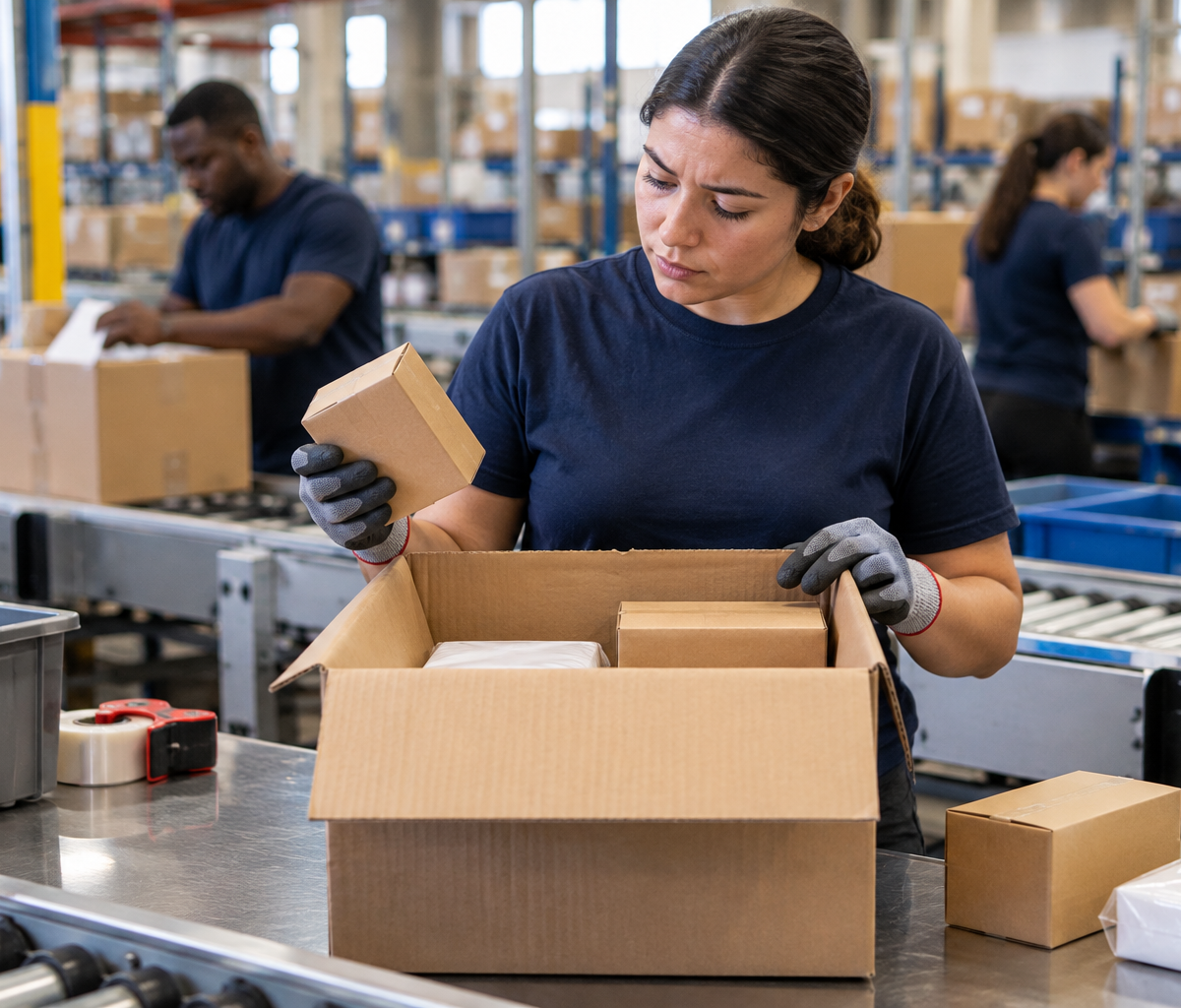
Decide whether checking assembled orders, protecting goods, sealing and labeling parcels, and handling missing items suit you.
A tote arrives at a packing station with three items listed on the order. The packer finds only two. Sealing the parcel would send an incomplete order toward the customer. Packing as a logistics career appeals to people who want to make that last careful check, protect the contents, and leave a parcel ready for its next shipping step.
A packer generally receives goods selected earlier, verifies what is present under the employer’s process, uses the specified materials, closes the package, and applies or confirms the correct label. The exact handoff and authority differ by facility. Some jobs combine picking and packing; others keep them separate. Read the posting for the daily task mix instead of assuming every “packer” does the same work.
Confirm the order item set before sealing
The order item set is the group of products and quantities that should be in the outbound package. A packer may see it on a screen, a pick ticket, or a packing slip. The site may require scans or manual checks. In the three-item example, the packer should establish which item is missing and follow the exception route rather than mark the order complete to keep the line moving.
A check is more than counting objects. Two products can look alike while differing in size, model, or pack quantity. The packer should use the identifiers and instructions supplied by the employer. A scan may confirm a code, but a damaged label or wrong item inside a bag still needs attention. Ask how the facility trains workers on near matches and what evidence they must record when something disagrees.
The picker may have selected the wrong item, a product may have fallen out of a tote, or the order record may have changed. The packer does not need to solve the entire cause before reporting the exception. They do need to keep the parcel open and the state truthful while the appropriate person decides what happens next. A later investigation of where a mis-pick arose belongs to a separate process.
O*NET’s profile for hand packers and packagers includes inspecting products and containers against packing specifications and marking or labeling containers. It describes a broad occupation, not every employer’s exact workflow. The candidate should ask whether this opening expects item verification, package preparation, labeling, or all of them, and whether a packer has authority to hold an incomplete order.
Ask what happens if a required item is unavailable. Does the packer set the tote aside, request a repick, split an order under an approved rule, or alert a lead? The employer decides that procedure. The candidate should be able to identify the exception route before working under a deadline, when guessing or quietly omitting an item would be tempting.
Use the specified protective packaging
Protective packaging is the material and arrangement chosen under the site’s rules to keep goods suitable for transport. A packer may use a box, mailer, cushioning, separator, tape, or other material. The job is to follow product and shipping instructions, not invent a packaging design for every parcel. Ask what instructions appear at the station and who decides when a different material is permitted.
The missing-item example shows why sequence matters. Selecting a box and adding cushioning before confirming the order can waste materials if the parcel must be held. Some facilities may stage materials earlier for speed, but the packer should know when the item check is considered complete. The worker should not seal a parcel while an unresolved item difference remains.
Goods can require different handling. A fragile item may need separation from a heavier item; a product with a specified orientation or seal may have a distinct instruction. The candidate should ask how these requirements are communicated and whether the employer provides examples during training. This article does not prescribe a universal material choice, because products, shipping methods, and employer rules differ.
The packer may also need to avoid excess empty space or overfilled cartons according to site standards. That is a practical packing decision within an approved process. Designing a carton assortment or optimizing box sizes for an entire operation is a different job. For a packer candidate, the key question is whether the station gives clear options and a way to escalate when the recommended package does not fit.
Ask what to do if a box is damaged, a mailer will not close properly, or the contents shift after cushioning. A good process lets the worker replace the material or request help before the parcel leaves. A high output target should not require them to treat an obviously unsuitable package as finished.
Match the shipping label to the actual parcel
The shipping label connects a physical parcel with an order and routing information under the employer’s system. A packer may print and apply it, or confirm a label applied by another station. The worker should check the site’s required match between the parcel, order identifier, and label before release. A correctly packed box with the wrong label can still go to the wrong place.
In a station handling several orders, keep each parcel’s contents and label paired. If the three-item order is held for a missing product, its label should not be attached to the next completed parcel. Ask whether the system prints labels one at a time, requires a final scan, or uses another control. The candidate should understand that sequence rather than rely on visual memory during a busy wave.
Sealing also has a standard. The employer may specify tape placement, closure checks, or special handling marks. A packer should follow those instructions and report when a parcel cannot be closed as specified. The job does not end when tape touches cardboard; it ends when the employer’s completion record and physical package agree.
Ask where finished parcels go. They may be placed on a conveyor, in a carrier-specific area, or in a staging location. A worker should know whether the completion scan occurs before or after that move and what to do if the destination area is blocked. A clear handoff prevents a parcel from being marked shipped while still sitting at the wrong station.
Work at a packing station without losing accuracy
A packing station may combine screens, scanners, tape dispensers, cartons, cushioning, and space for several orders. Its layout affects how quickly a worker can check and finish each parcel. Ask whether the employer trains new packers on the station setup, item verification, and exceptions before measuring normal output. A tidy workspace can help prevent a label or small item from drifting into another order.
Packing can involve long periods of standing, repeated hand motions, reaching for materials, lifting goods, or moving filled cartons. OSHA’s warehouse guidance identifies repetitive work and awkward postures among ergonomic risk factors in warehouse operations. Actual exposure depends on products, station design, and task rotation. Ask about typical package weights, workstation adjustment, breaks, and how the employer handles heavy or awkward items.
The rhythm may be steady or wave-based. Orders may arrive in bursts after picking, and a carrier cutoff can add pressure. A candidate should ask how unfinished orders are queued and how a missing item is handled when the line is busy. A usable exception lane matters more than a promise that the station is “fast paced.” It allows the worker to keep accurate parcels moving without hiding a problem.
Performance measures vary. An employer might count parcels per hour, error reports, damage claims, or completed lines. Ask which measures apply and whether complex orders receive different expectations from single-item parcels. The candidate should know how the team handles a careful hold for an incomplete order. Otherwise, the metric can appear to reward sealing first and asking questions later.
Some packers enjoy the repeated sequence: check, protect, close, label, hand off. Others find station work too repetitive and prefer moving through storage locations. The candidate can ask whether the role rotates through tasks and how often. A job that combines packing with picking may suit someone who wants variety, while a dedicated station may suit someone who likes focused finishing work.
Keep an incomplete order visible
An incomplete order is an order whose required goods are not all ready for the intended parcel under the site’s process. In the example, the packer finds two items where the record calls for three. The worker should preserve that observation and use the approved hold or escalation step. They should not add an unrelated item, erase the missing line, or close the package as though all three were present.
The next person needs to know what happened. A clear exception record may identify the order, the expected item, what was physically present, and where the tote or parcel was placed. The employer determines the exact fields. The candidate should ask how a held order is found later, especially if the shift ends before the missing product arrives.
The packer’s observation can help a supervisor, picker, or inventory team resolve the issue. It is not automatically proof that the picker made a mistake. Stock records, tote handling, or a late order change may be involved. A good packer records the immediate facts and avoids assigning blame from an incomplete view of the process.
If the missing item arrives later, the packer may resume the order under a new instruction or another worker may take it over. Ask how the site prevents an old label or stale packing slip from being used after a hold. That detail matters because the order state can change while the parcel waits.
Compare packing with picking and package design
A picker retrieves assigned items from storage; a packer turns an assembled set into a protected, labeled outbound parcel. A packaging engineer may design materials and standards used by many orders. In a small operation one worker can touch more than one step, but the decisions are different. The candidate should identify which step occupies most of the advertised shift.
If you like moving through aisles and locating exact products, picking may suit you better. If you like checking an assembled order and completing a clear physical product at a station, packing may fit. If you want to test packaging materials and redesign a process, ask about specialist roles rather than assume an entry-level packer job includes that authority.
Use the three-item example in an interview. Ask what a worker does when one item is absent at the packing station. The employer’s answer should identify the hold process, the record, and who decides whether the order can proceed. A concrete response tells you more about the role than a generic claim that quality matters.
Delpack’s transferable skills for a delivery driver resume guide can help a candidate describe real packing work when applying elsewhere. Accurate order checks and truthful handoffs are useful examples if they are tasks you performed. Avoid claiming package engineering or shipping-system authority from a packer title alone.
Choose whether order finalization fits you
Before accepting, ask which item checks are required, how packaging choices are supplied, who handles missing goods, when labels are printed, and where finished parcels go. Confirm physical demands, pace measures, training, and whether the job includes picking. Those answers show whether the daily work is the careful order-finalization role you want.
Packing as a logistics career can suit a person who notices the missing third item and is comfortable pausing that parcel while other complete orders move forward. The work rewards a repeatable sequence and accurate records. The final sealed box should reflect what was actually checked and packed.
Delpack’s Fort Wayne driver careers page lists current driver opportunities, not an advertised packing position. Compare any warehouse offer with actual driver openings for schedule, pay, physical demands, and the work repeated each day. The right role depends on whether you prefer finishing parcels at a station or taking responsibility for a different stage of delivery.
Continue with Delpack
Review the Fort Wayne career overview or contact Delpack with a question about the company.