Prioritizing conveyor repair during a fulfillment shift
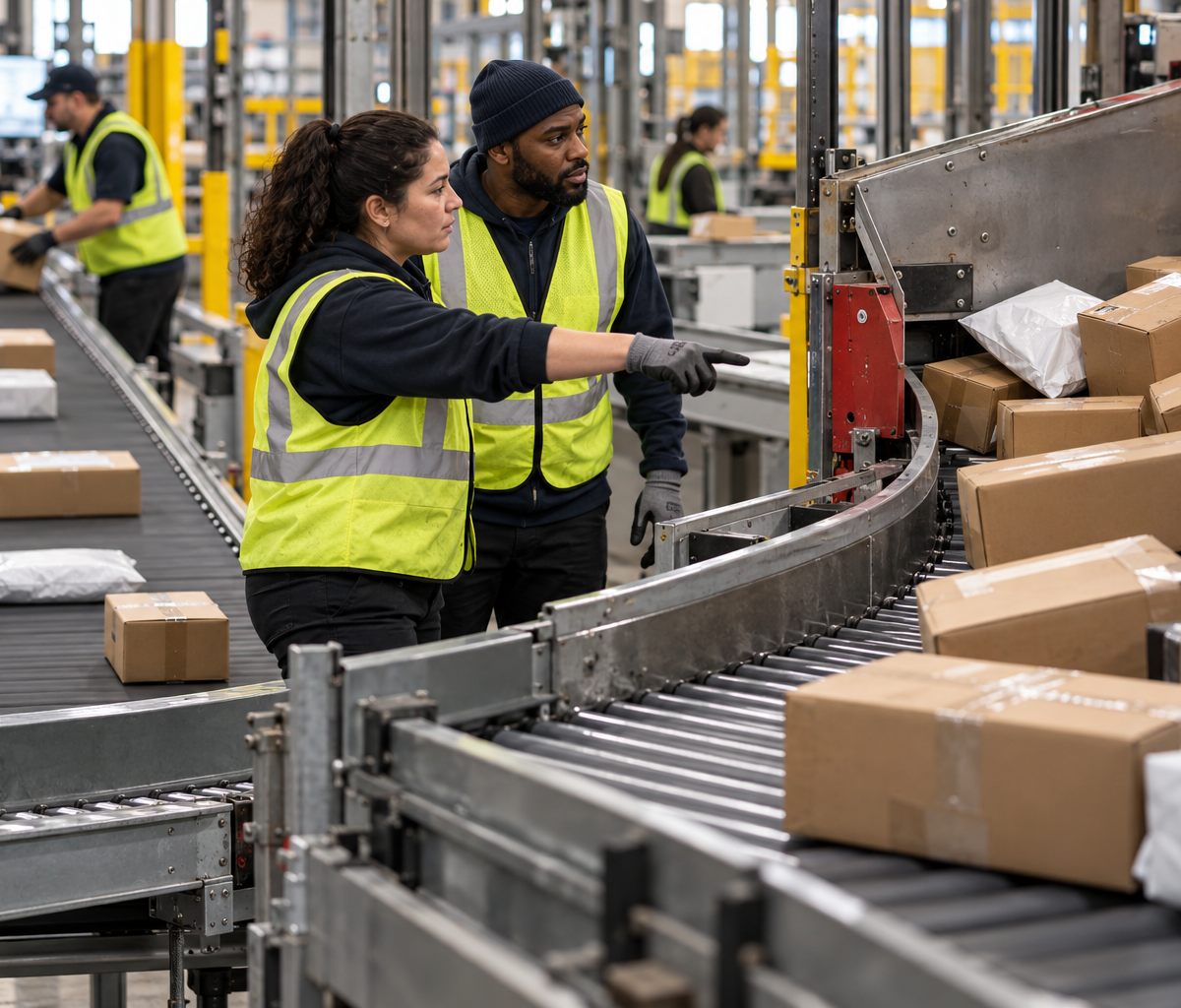
Use safe isolation, affected-flow mapping and approved alternate capacity to prioritize a failed conveyor diverter during a fulfillment shift.
A diverter fails during a fulfillment shift. Parcels begin backing up at one transfer point while a separate belt continues to run. The supervisor has several immediate choices: stop the affected equipment, protect workers and parcels, determine which flow paths remain usable, and decide whether an authorized repair or an approved alternate process will restore order flow sooner. Prioritizing conveyor repair during a fulfillment shift starts with a safe boundary around the fault and a clear picture of which orders cannot move.
There is no universal rule that the loudest fault or longest queue gets repaired first. A jam can hide hazardous energy, and one failed segment can affect several downstream lanes. The facility's equipment-specific procedures, trained maintenance staff, and current order commitments control the response. This article is a decision framework for a shift lead. It does not give instructions for opening guards, clearing a jam, bypassing a safety device, or restarting equipment.
Set the safety boundary first
When a conveyor behaves unexpectedly, stop the affected operation under the site's emergency and escalation procedures. Keep workers out of the hazard area and tell the relevant leads which section is unavailable. A parcel backlog can be moved later; an energized moving part or stored energy can injure someone immediately. Do not ask an untrained worker to reach into a belt, diverter, or transfer point to “keep the line moving.”
The Occupational Safety and Health Administration's warehousing guidance says warehouse operations need a lockout/tagout program for servicing and maintenance, with energy-control procedures, training, and periodic inspections. OSHA's hazardous-energy standard addresses unexpected energization, startup, and release of stored energy during covered service or maintenance. The exact isolation and repair steps belong to the employer's authorized personnel and equipment-specific procedure.
Confirm whether the adjacent belt can remain in service without feeding the failed diverter or creating a new exposure. A running belt beside a stopped segment is not automatically a safe alternate path. Ask the site safety and maintenance leads to verify the boundary before continuing any nearby flow. Record the time, segment, and person who took the section out of service so later operational decisions are based on the same status.
Trace the affected segments
Once the unsafe section is controlled, map the material path. Which upstream belts feed the failed diverter? Which downstream lanes depend on it? Where are parcels already accumulating? The answer may reveal that a visible jam is a symptom of a failed downstream gate, sensor, or destination lane. A shift lead should gather observations from the line and route them to authorized maintenance without diagnosing beyond their training.
Use the facility's equipment map and live status, if available. A label such as “belt three down” may be too broad: a motor may run while the diverter fails, or the belt may be operational but unable to discharge to its destination. Specify the segment and the function lost. This helps maintenance prepare the right response and helps operations avoid sending more parcels into the blocked path.
Count parcels already on the affected conveyor separately from parcels waiting upstream. The first group may require a controlled recovery plan; the second can be held before entering the faulted area. A reliable count or estimate supports labor and order planning, but no one should climb, reach across, or enter a guarded area merely to improve the number. Use the site's approved observation and inventory methods.
Measure the order-flow impact
Ask which outbound orders are blocked and which can continue on the independent belt. A failure that stops only one destination may be less disruptive than one that backs up the common feed for the whole building. Compare current queue growth with the time remaining before dispatch cutoffs. The priority should reflect the safe flow-critical function, not the physical size of the broken component.
Identify the earliest point where the backlog will affect other work. If parcels accumulate at a merge, upstream pick or pack stations may have to slow. If they remain contained in a single lane, other orders may continue. The shift lead can decide whether to pause feeding the affected path, hold work at an earlier stage, or redirect only those orders that the site's approved process can handle. Avoid moving parcels without maintaining their identity and destination record.
Ask whether the continuing belt handles a different product, size, or destination. It may be physically running but unsuitable for the blocked parcels. Operations should not infer capacity from motion alone. A valid alternate path needs a documented route, enough capacity, trained staffing, and a way to preserve scans or other order controls.
Compare an approved bypass with repair
A bypass may mean an existing alternate conveyor path, a manual sort station, or holding parcels until the section is restored. It does not mean defeating guards, interlocks, or controls. Ask the engineering and safety owners which alternate workflows are approved for the affected parcel type and volume. If none exists, the responsible choice may be to stop that flow and protect the queue while maintenance repairs the section.
Estimate the time to activate an approved alternate process, its hourly capacity, and the labor it requires. Then compare those figures with the maintenance team's repair estimate and restart checks. The estimates will be uncertain at first. A shift lead can state assumptions openly: “The alternate lane can accept this destination after a scan change and a staffing move, if maintenance confirms the isolation boundary.” That is more useful than announcing a bypass before its prerequisites are met.
Consider the return from the bypass. A temporary manual sort may keep urgent orders moving but leave a reconciliation task. Ask where parcels will be tracked and who will confirm that every diverted unit returns to the correct outbound flow. A fast workaround that loses package identity may create more delay than waiting for a short, safe repair.
Work through the failed-diverter example
Imagine a diverter sending parcels to two destination lanes. It stops moving correctly at 2:00 p.m. Parcels for lane A back up at the transfer, while lane B's independent belt still moves its own work. Maintenance is called, and operations stops feeding the affected section. This is an illustrative facility, not a Delpack equipment map or a repair instruction.
The shift lead asks maintenance which components must be isolated and whether lane B can remain active without exposure to the fault. The lead asks operations how many lane A orders are due at the next dispatch cutoff, how quickly the queue is growing, and whether an approved manual-sort route exists for those parcels. If lane B shares an upstream feed that will soon block, the impact is broader than the first visible queue suggests.
Suppose maintenance expects a short repair after isolation and inspection, while activating the manual route would take longer and tie up staff needed for other departures. The lead may hold lane A and preserve lane B's safe flow until repair is verified. Suppose the estimate lengthens and an approved alternate path can process urgent lane A orders with reliable scans. The lead may shift those orders while maintenance retains the faulted section. The decision changes with verified safety status and realistic capacity, not with a fixed rule to “always bypass” or “always repair.”
Keep maintenance ownership clear
The maintenance lead owns diagnosis, isolation, repair, and the technical decision that equipment can return to service under the site's procedures. Operations owns the order queue, staffing, and communication of revised cutoffs. A shift supervisor can coordinate both without telling an unqualified worker to perform a technical step. Name one contact for each lane of work so conflicting instructions do not reach the floor.
Ask maintenance for a status that operations can act on: affected section, safe operating boundary, current estimate, and conditions for restart. Avoid demanding an exact time before diagnosis is complete. A range with the next update time is more useful than an unsupported five-minute promise. Operations can plan a hold or approved alternate path while that estimate matures.
If the fault recurs after a tentative fix, stop the affected path and return it to the maintenance and safety process. Do not treat a brief restart as proof that the problem is solved. The facility should record the recurrence and any affected orders, then decide again whether the alternate process remains necessary.
Protect order identity during the interruption
A stalled conveyor can leave parcels between scans or in an unexpected sequence. Ask where the last reliable scan occurred and where the next confirmation will happen. If parcels are held, label the holding area and maintain the system status required by the site. The goal is to know which orders remain blocked, which were safely redirected, and which have reached outbound staging.
When an approved alternate process moves parcels, assign a person to reconcile counts at the entry and exit. That person should report mismatches before the shift closes. A workaround that moves a pile out of sight without a record can make the dashboard look better while creating later delivery failures. The repair priority should consider this quality cost alongside speed.
Do not ask maintenance staff to resolve individual order identities while they are controlling hazardous energy. Operations can hold and trace parcels outside the hazard boundary. Keeping the two responsibilities separate lets each team work from accurate information without pulling the wrong person into a risky task.
Use cutoffs to rank the remaining work
Once the equipment response is safe, rank blocked work by actual departure or service commitments. An urgent order set with a nearby cutoff may justify using an approved alternate lane first. Another set may tolerate a short hold while maintenance completes repair. Ask which orders have a firm cutoff, how many are affected, and what capacity exists after restoration. A queue length without a deadline can mislead the triage.
Compare the expected recovery curve. A repaired conveyor may clear a backlog quickly once verified, while a manual process may start sooner but handle fewer units per hour. The shift lead can estimate when each option would finish the affected orders. Update the estimate when maintenance or operations learns more. A decision made at 2:05 may need revision at 2:30, but the safety boundary does not loosen just because the cutoff approaches.
If no option can meet a deadline, communicate the shortfall early through the site's escalation channel. Customer-facing or carrier teams may need a revised expectation. An honest missed cutoff is preferable to a rushed restart or an untracked parcel move that hides the problem until later.
Verify a controlled return to flow
After authorized personnel complete repair, follow the site's restart procedure. Operations should know which section has been released for use, who authorized it, and whether initial flow is limited for observation. Do not restart adjacent equipment based on a casual message that “the belt looks fine.” The technical release and the operational plan should be explicit.
Run the site's approved checks for parcel routing and scan integrity. The first parcels after restoration should reach the intended lanes with the expected records. If a diverter was the fault, a moving belt alone does not prove sorting is correct. Keep the temporary hold or alternate process available until the team has evidence that the normal path is working as intended.
Reconcile the parcels held during the outage, the parcels sent by the alternate path, and the parcels processed after restart. Record any still missing or delayed orders for the next shift. Confirm safe equipment release and order-flow reconciliation before treating the repair as operationally complete.
Review the decision after the shift
Capture the fault time, isolation decision, affected segments, maintenance response, alternate-path use, missed cutoffs, and final reconciliation. The record should show which assumptions changed. If the team spent longer finding an approved bypass than repairing the diverter, update the site playbook. If the repair took longer than expected because a part was unavailable, identify that dependency for future shifts. The review is about improving the next decision, not assigning blame from hindsight.
Keep this operational decision distinct from a maintenance career description. A technician needs training, tools, and equipment-specific authority to diagnose and repair a conveyor. The shift lead needs to know when to stop, whom to call, which orders are blocked, and which approved path can carry them. A dock-door fault has different physical and flow boundaries; it should not be treated as the same repair problem.
The driver guide hub covers related logistics work, and the Fort Wayne driver careers page identifies local opportunities. Prioritizing conveyor repair during a fulfillment shift gives an operations lead a sequence: protect people, identify the faulted flow, compare safe capacity and repair time, and verify both equipment and order records before calling the shift recovered.
Continue with Delpack
Review the Fort Wayne career overview or contact Delpack with a question about the company.