Quarantining damaged inbound goods before they enter saleable stock
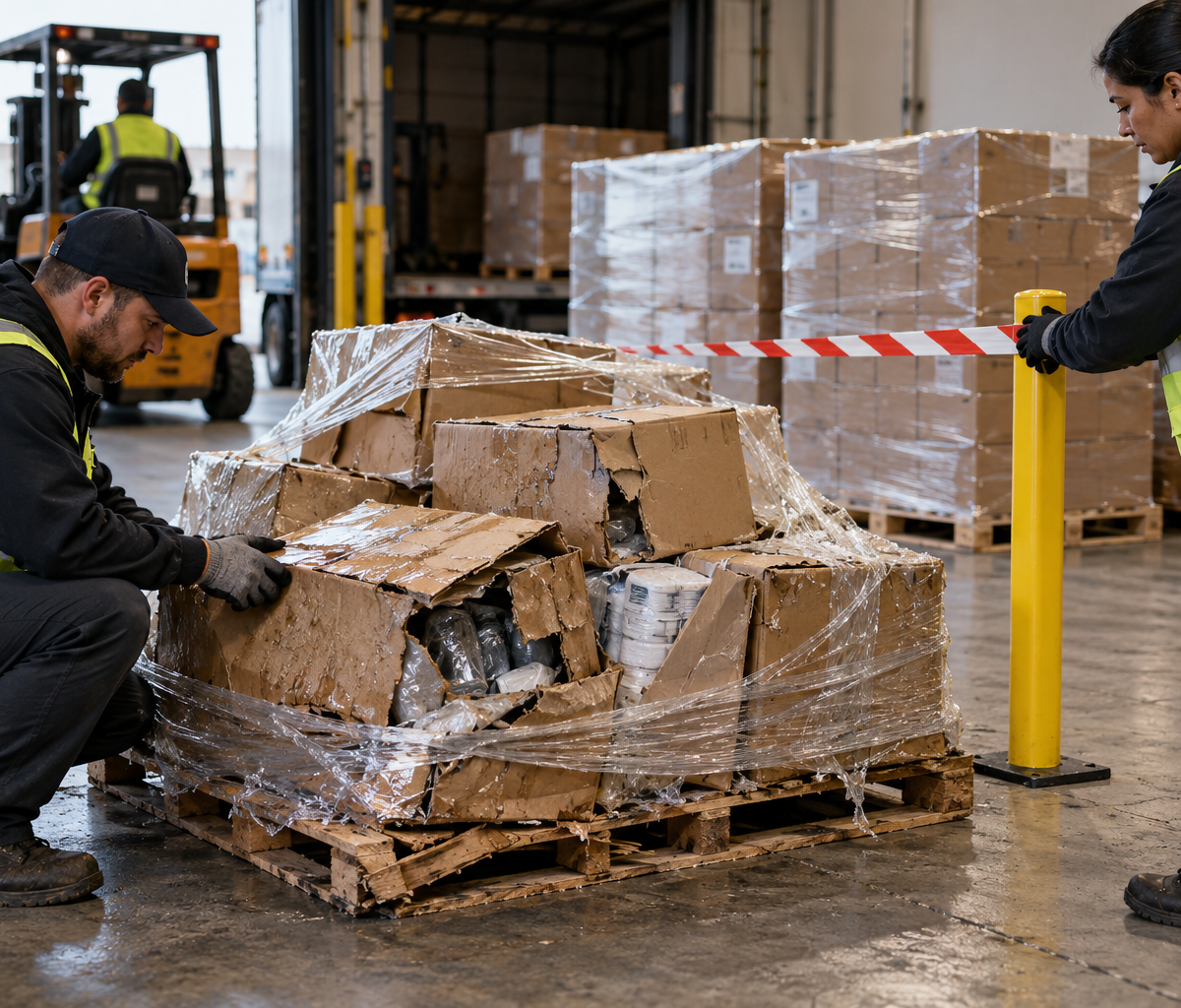
Hold a crushed inbound pallet apart, record condition, split affected units, and release only what inspection and authority support.
A pallet arrives with a crushed corner. Several cartons along that edge are visibly distorted; cartons on the opposite side look sound from the outside. The receiving team wants to keep the dock clear, but ordinary putaway would make the entire pallet available to fulfillment before anyone has established which units are usable or who owns the damage decision. Quarantining damaged inbound goods means holding the affected inbound stock apart, physically and in the inventory record, until condition and ownership are resolved.
The immediate decision is whether these units may enter saleable flow now. It is not the final decision to resell, repair, return or dispose of a customer return, and it is not an article about reporting a workplace safety incident. A damaged pallet may also pose a handling hazard; workers should follow the site’s separate safety procedure if it does. The inventory question remains: which units require controlled inspection, what evidence must be preserved, and who can release them?
Record damage evidence before moving the pallet
Damage evidence should identify the shipment, pallet or handling unit, affected cartons, and observed condition at receipt. Record the purchase or inbound reference, carrier handoff identity, time, visible crush area, torn wrap, wet marks or other relevant signs. Photograph the pallet from enough angles to show the affected area and labels under the facility’s policy. Do not describe hidden product damage as a fact before inspection; “carton crushed” is an observation, while “product broken” needs evidence.
Preserve the received configuration when safe and practical. A photograph taken after a worker restacks the pallet may not show how the damage appeared at handoff. If the pallet must be stabilized or moved for safety, document that change and the reason. Count the handling units and note any discrepancy separately from condition. A carrier receipt, warehouse receiving scan, and purchase-order record may refer to different units of measure; reconcile them before claiming exactly how many products were affected.
Use a condition record that allows more than one result. The crushed corner might involve five cartons with visible damage, ten that need closer inspection, and twenty that appear sound externally. Do not label the entire pallet “good” from the sound side, or “scrap” from the crushed side. The hold can cover all units initially while inspection separates them. Quarantining damaged inbound goods begins with evidence that makes this separation defensible.
Use physical segregation that matches the risk
Physical segregation prevents a held unit from being picked, replenished or mixed with accepted stock while its condition is unresolved. Place the pallet or affected cartons in an approved hold area with a visible identifier and controlled access. If the whole pallet cannot be moved safely, secure the current location and block ordinary movement under the site’s process. The physical boundary should match the inventory boundary; a system hold on stock sitting in a saleable pick face is easy to defeat by mistake.
Keep identities attached. If cartons are removed for inspection, mark which came from the damaged edge and which from the apparently sound side. A single pallet label may be insufficient once cartons are separated. Track serial or lot information where the product requires it. If units are unmarked, create a traceable temporary handling identity before breaking down the pallet. Otherwise, a later “passed inspection” result may not be tied to the cartons actually released.
Check that the hold area is appropriate for the product. Temperature, cleanliness, security, and stacking requirements do not disappear because inventory is under review. A damaged carton may need protection from further handling. Do not place fragile contents beneath heavy goods or block an aisle while waiting for a quality decision. These are storage and safety constraints to follow under local rules, not reasons to bypass the hold.
The team can move visibly unaffected cartons to a separate held sub-group if that improves inspection, but appearance alone does not make them saleable. Until the authorized decision is recorded, they should remain unavailable for ordinary fulfillment. The purpose of segregation is to preserve a meaningful choice, not to assign a final loss to every carton on the pallet.
Set an inventory status that blocks ordinary sale
The inventory status should make held stock unavailable to outbound allocation under the actual warehouse system. Confirm the status applies at the correct item, lot, license plate or location level. A note in a receiving comment is not enough if order allocation can still draw from those units. Microsoft’s Dynamics 365 documentation describes inventory statuses used to categorize stock and make some inventory unavailable for sales or other outbound transactions. That is a software example of the control; the facility must verify its own configuration.
Check the transition from inbound receipt to held inventory. Some systems record goods as received before a quality result, while others use an inspection location or status. If an automated putaway task has already been generated, cancel, change or hold it through the authorized workflow. Do not rely on a verbal instruction to “leave that pallet alone” while the mobile device directs a worker to move it into saleable racks.
Reconcile quantity and status after physical separation. If the receiving record says forty cartons and twenty-five remain on the main pallet after fifteen are moved to inspection, the system should reflect the two controlled groups. A release of the sound group should not also release the damaged group through a shared parent ID. Test with an allocation query or equivalent check that held units cannot be selected. Do not place a test customer order just to discover whether the hold works if a safer system check exists.
Keep the original inbound identity and receipt. A new quarantine identifier can point back to it, but should not erase supplier, carrier or purchase details needed for ownership review. Quarantining damaged inbound goods is both a physical hold and a data control; either one alone leaves a path for accidental sale.
Define the inspection boundary for sound-looking cartons
Inspection should be proportional to the product and the observed damage. A crushed outer corner can conceal broken contents, but an apparently sound carton may also be unaffected. The quality owner should decide which units need external inspection, opening, functional checks or another test under the product’s procedure. Receiving staff should not substitute a quick glance for a required acceptance test.
Microsoft’s quality-order documentation describes inspection and test records tied to inventory, purchase orders and quarantine references. That supports keeping the inspection result tied to specific stock identities. Its exact quality-order workflow is product-specific; a facility using another system can still record the sample, method, finding and decision against the held cartons.
For the pallet example, map damage by position. Inspect the crushed-edge cartons first, then determine whether adjacent cartons need sampling or full review. If a carton passes an approved check, record what was checked and what the result does not establish. An undamaged exterior may not prove a sensitive product is functional; a functional test may not prove packaging is suitable for resale. The acceptance criterion should come from the product and supplier rules, not from pressure to clear the dock.
Do not combine units with different findings into one release. If some cartons are sound and others remain uncertain, split the held identity or otherwise make their status separable. Keep unresolved units under control until a qualified reviewer decides. A partial release is legitimate when the evidence supports it and the system can prevent the rest from following.
Resolve the ownership decision before changing disposition
The ownership decision identifies who can accept, reject, return, repair or otherwise direct the inbound goods under the purchase and freight terms. A damaged carton may be a supplier quality issue, a transport claim, or an internal handling issue; the receiving observation alone may not establish which. Preserve the relevant documents and notify the authorized purchasing, quality, supplier or carrier contact through the local process.
Do not promise a credit or decide that a carrier owes a claim simply because damage was visible at delivery. Terms, notice requirements and evidence vary by agreement and carrier. The local owner should determine deadlines and communications. The warehouse’s immediate authority may be limited to holding and documenting the stock. Keep that boundary clear so an urgent dock decision does not become an unauthorized financial settlement.
Record who makes the product disposition and who handles the commercial outcome. Those can be different people. Quality may approve a sound carton for sale while purchasing still resolves a freight claim for the damaged ones. Conversely, a supplier may authorize return of a group that remains physically held until pickup. Do not let an anticipated credit make stock available for fulfillment.
For the crushed pallet, assign a review owner and deadline. If the supplier needs photographs of the received pallet, send the preserved evidence through the authorized channel. If the carrier’s handoff record has a damage notation, retain it. If no one can establish ownership immediately, the hold remains; uncertainty is not a release criterion.
Walk the crushed-pallet decision through one shift
Assume forty cartons arrive on the pallet. Six at the crushed corner show visible package damage; eight adjacent cartons have no obvious tear but may have taken pressure; the remaining twenty-six look sound externally. These counts are hypothetical. At receipt, hold all forty under the inbound identity and photograph the pallet before breaking it down. Move it to a permitted inspection area or secure the dock position, then split the units into traceable groups as they are examined. The six visibly damaged cartons are not automatically scrap, and the twenty-six sound-looking cartons are not automatically saleable.
Quality might require opening all six damaged cartons, examining the adjacent eight, and checking a defined sample from the rest. The method depends on the item; the example does not set a universal sample size. If inspection accepts twenty-six, finds eight needing more work, and rejects six, record three identities and three statuses. Purchasing can pursue the commercial question without releasing the fourteen held units. If a later finding changes the scope, link it to the original receipt and update the affected group only.
At the shift handoff, the next team should be able to find every group, understand why it is held or released, and see the named decision owner. A neat stack of cartons with no system hold is not a controlled quarantine. Nor is an electronic block useful if a worker cannot distinguish accepted units from those still under review.
Apply release control only to verified units
Release control closes the hold for a specific quantity and identity after an authorized decision. The record should show the inspection result, decision maker, disposition, destination location, and any required approval. Update the system status and physical label together. A carton cannot be treated as saleable while it still carries a quarantine tag, nor should a released carton remain blocked indefinitely because the system change was missed.
Check the result with a controlled inventory query and a physical count. If ten cartons were accepted and five rejected, the two quantities should appear in appropriate states and locations. Do not release a parent pallet ID that still includes rejected cartons. If packaging was damaged but contents passed, verify whether repacking or relabeling is needed under the product’s sales standard before moving those units to fulfillment.
Keep a record of items returned to supplier, sent for repair, or disposed of under the authorized process, but do not treat this immediate hold decision as a guide to every final route. The point here is that no uncertain inbound unit enters ordinary sale while condition and authority are unresolved. Review the case afterward for a shared receiving defect, such as a scanner path that ignored hold status, and repair it for future receipts.
Readers exploring adjacent logistics topics can browse the driver guide hub, and people considering field work can visit the Fort Wayne driver careers page. For the crushed pallet, the sound-looking cartons are not released by appearance alone. They leave the hold only after their own condition and authority are supported, while the damaged and uncertain cartons stay controlled.
Continue with Delpack
Review the Fort Wayne career overview or contact Delpack with a question about the company.