Resolving a shipment identity mismatch before a parcel moves
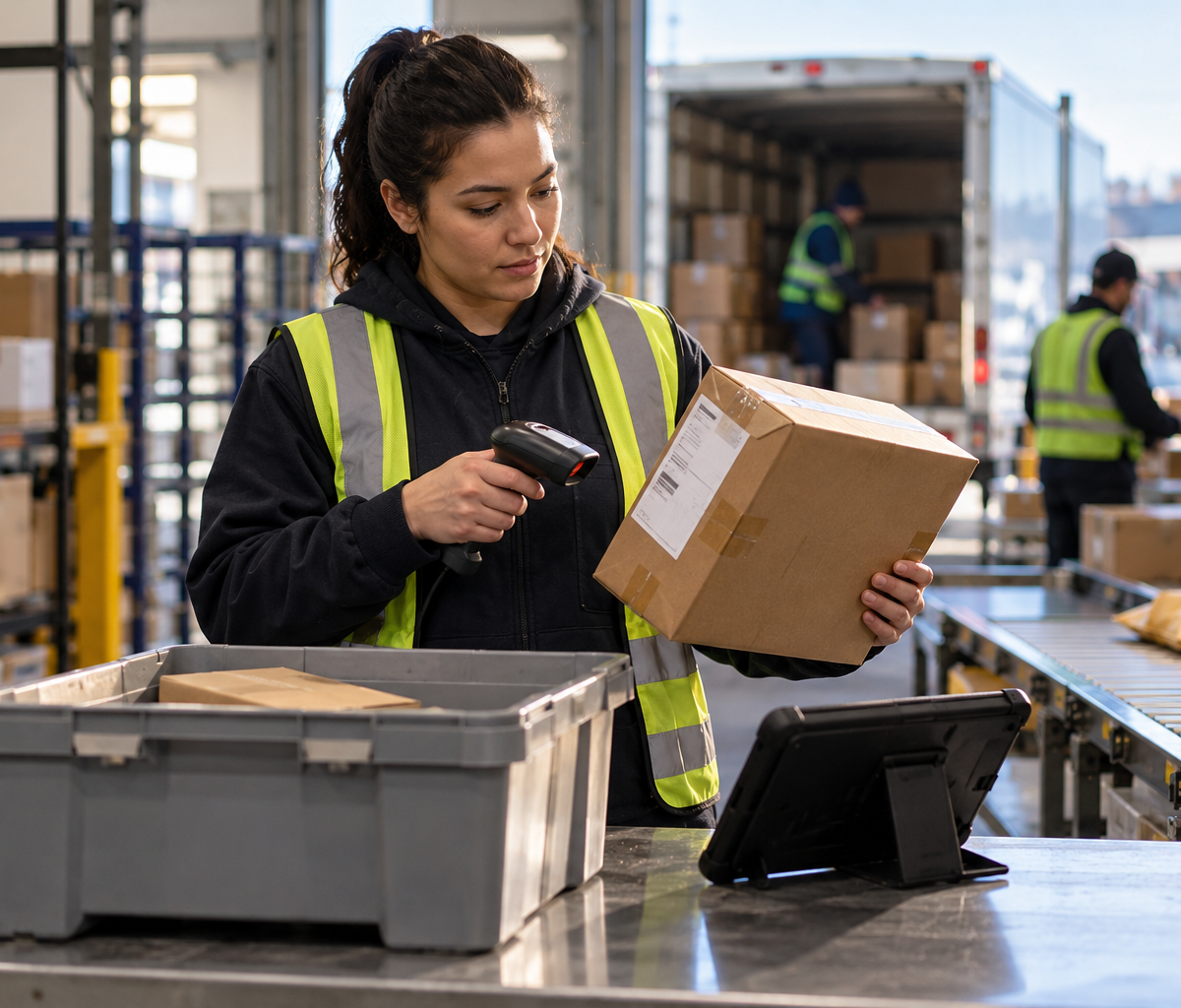
Hold an ambiguously labeled parcel, compare its order and shipping records, then release it only when physical and recorded identity agree.
A parcel reaches a sort station with tracking label T482 on the outside. The order reference in its authorized packing paperwork points to a different order than the shipping record associated with T482. Sending the box onward under the visible label may carry the wrong goods to the wrong customer; changing the label on a guess may create a second error. Resolving a shipment identity mismatch means establishing which physical parcel, order and shipment record belong together before releasing the unit to the next custody step.
This is an upstream identification decision at a warehouse or shipping handoff. It is different from explaining what a barcode represents in general, and from a driver's response to a package addressed to another street. The reader already has a live conflict: one physical box and two inconsistent references. The work is to preserve the evidence, isolate the box, trace the conflicting records and make a supported correction or hold decision.
Stop the unidentified parcel at its current handoff
Place the unit in the facility's controlled exception location and record who has custody. Do not send it into the next sort, load or carrier pickup while its identity is unresolved. That hold should refer to the specific physical parcel and visible label, not to every parcel from the same customer. A narrow hold prevents the ambiguity from spreading through later scans without unnecessarily stopping unrelated work.
Keep the label and paperwork as found. Note the exact tracking number, order reference, package ID if one exists, last reliable scan, station, time and condition of the label. Photographing a label or package may be permitted under a site's privacy and evidence rules; use the authorized process. A handwritten correction on the original label can erase the evidence needed to discover whether it was misapplied or whether the order paperwork is wrong.
Separate physical possession from electronic status. A system may show T482 as ready for carrier pickup even though the parcel is now on an exception shelf. Update the operational hold through the authorized workflow so another worker does not load it based on a stale release state. Preserve the prior event trail. Deleting a scan to make the current status look tidy hides how the conflict arose.
Assign an owner and a time to revisit the exception. An item left in a miscellaneous bin with no case identity can miss both the original service promise and the next investigation shift. The immediate decision is a controlled hold; the final decision follows the identity evidence. Resolving a shipment identity mismatch begins by making that distinction visible.
Read the tracking label as one identity claim
The tracking label identifies a carrier shipment or parcel record under that carrier's process. FedEx's label guidance describes a scannable barcode and tracking number used for delivery updates. Documents found with the box need their own identity check against that record. The outside label is evidence from an earlier workflow that could have been misprinted, duplicated, or applied to the wrong carton.
Read every visible field without merging different identifiers. A carrier tracking number, seller order number, warehouse parcel ID, return authorization and customer reference can point to related records while serving different purposes. Record the exact values, including leading zeros and suffixes. Check whether the label is an outbound label, a return label or an old label partly covered by a new one. If two live barcodes are exposed, prevent an automatic scan from choosing one without a deliberate identity decision.
GS1 describes the Serial Shipping Container Code as a unique identifier for a logistic unit and explains that scanning the code can connect physical movement to electronic messages. That is a standard example of why the unit being identified matters. This case concerns an individual parcel's order and tracking link; an SSCC on a pallet or tote would identify the larger handling unit and would not, by itself, settle which customer order is inside this box.
Query the shipping record for T482. Capture its creation time, linked order, parcel dimensions or weight if recorded, service, destination, label-print event and subsequent scans. Treat measurements as clues, not a unique fingerprint: many parcels share a weight and box size. If the carrier record already has a physical acceptance scan, determine whether that scan refers to this held box or another parcel carrying the same number. A database match alone is not enough when physical custody is disputed.
Compare the order reference with the physical unit
The order reference in the permitted packing paperwork points to the sale or fulfillment instruction. FedEx describes customer references as information a shipper may provide separately from the carrier tracking number. In this case, the inside paperwork names order O917, while T482 is linked to O914 in the shipping system. The difference is a reason to investigate; it is not automatic proof that the outer label is wrong. Packing paperwork can also be inserted into the wrong box.
Retrieve both order records through authorized systems. Check their item lists, quantities, fulfillment locations, recipients, shipment allocations and status histories. If an order has multiple parcels, identify which package number the record expects. If O914 and O917 are separate shipments for one customer, do not collapse them merely because the address matches. If the orders belong to different customers, limit access to the necessary details and handle the exception under the facility's privacy rules.
Examine the physical contents only through the site's approved inspection procedure. In some operations a sealed parcel cannot be opened by a sort worker; route it to the authorized quality or security owner. If an authorized inspection occurs, record the item identifiers, quantities, condition and resealing steps. A generic product name on a packing slip may still fit several orders. The stronger match joins unique item or serial details, the fulfillment record and the actual contents.
Check whether the paperwork is itself a duplicate or an outdated insert. A reprint may show a prior order allocation, while the shipping system may have split the order after a substitution. Conversely, a correct document may expose a carton swapped after packing. The investigator should ask which process created each artifact and when it could have changed. That chronology is more informative than choosing whichever reference appears on the most visible surface.
Reconstruct the scan event trail
The scan event trail ties the physical parcel to recorded handling steps. Start at pick and pack, then review carton creation, label printing, verification scans, sortation, staging and any carrier transfer. Use event time and device or station identity where available. A server upload that arrived later may still describe an earlier scan; do not assume display order is physical order. Keep an unedited copy of the original event sequence with the exception case.
Look for the first point at which O914, O917 and T482 diverge. Did the pack station verify O917's items and then print T482 for O914? Did a worker place O917's packing slip inside an O914 carton? Did a label reprint produce two copies of T482? These are hypotheses, not findings. Test each against print logs, carton scans, work assignments and the location of the other expected parcel. A nearby box with label T483 may provide useful context, but its identity must be established independently.
Record which events are direct observations and which are inferred. A scan of a carton ID at a conveyor proves that identifier was read at the station; it does not necessarily prove the correct items were inside. A pack verification can support contents if the verification process actually checked each item. A carrier tracking event may confirm that a unit with T482 entered its network, yet it may not confirm that the box on the exception shelf is that same unit if duplicate labels exist.
Where records are missing, say so. A gap between packing and staging can leave two explanations open. Do not fill it with a confident narrative because one sequence sounds likely. The outcome may be an extended hold, a search for the second carton, or a request for carrier information. Resolving a shipment identity mismatch depends on a traceable chain from order allocation to the physical parcel now in hand.
Test the two plausible identities against the evidence
Build a short comparison for O914 and O917. For each candidate, show the expected items, recipient, shipment record, packing station, carton or parcel ID, label-print event and last physical observation. Put contradictory facts side by side so the owner can see which claim needs investigation. A candidate with a matching address but mismatched item-level verification remains uncertain. A candidate with matching contents, pack record and carton ID has a stronger basis for action.
In the worked example, suppose the authorized inspection finds a serialized item allocated only to O917. The pack log shows that same serial number verified into carton C62, and C62's physical carton mark matches the held box. The printer log shows T482 issued for O914 at the adjacent station and then printed a second time during a jam. Those records support the conclusion that the held parcel is O917's goods bearing an O914 label. The investigator still needs to locate O914's actual parcel or determine whether it was ever packed.
Change one detail: the paperwork says O917, but the serialized item inside and pack verification both belong to O914. Now the likely fault is the insert, not the label. The correction should address the document while preserving the valid shipment identity. This is why the outer label should neither be trusted unconditionally nor replaced simply because another reference appears inside.
If both candidates share the same item and no unique verification exists, the box may remain unidentified. Check authorized records for serial numbers, batch or lot handling, box weight, pack imagery if retained, and station logs. Each source has limits. Similar packaging or a close weight may narrow the possibilities without proving identity. State exactly what evidence is missing before requesting another action.
Authorize a label rebind only with a supported parcel identity
A label rebind changes the link between this physical box and its shipping record. It should occur only after the investigator establishes the correct order, destination and contents through the site's authorized process. The change may require voiding an incorrect label, generating a new one, updating the order shipment record and ensuring the old barcode is removed or covered in the prescribed way. The exact steps depend on carrier and shipper rules; a worker should not improvise a handwritten tracking correction.
Before printing, check whether T482 has been transmitted to or accepted by a carrier. If it has, coordinate the correction so tracking events and custody do not refer to two different physical parcels under one number. If another carton already bears T482, find it and isolate the duplicate-label problem. An apparent fix for the held box can otherwise release two units with a shared identifier. Preserve the old-to-new mapping and the reason for the correction.
After correction, scan the new label against the physical parcel and order record at the normal verification point. Check the destination and service against the authorized order, then release the hold. Do not assume a successful print is a successful rebind: the old label may still be scannable, the new record may not link to the order, or the parcel may still have a stale sort assignment. The downstream station needs one unambiguous live identity.
When the evidence cannot support a rebind, retain the hold and escalate to the named exception owner. Tell affected fulfillment or customer teams only what the records establish. A service deadline may require prompt investigation, but it does not turn a plausible identity into a proven one. Moving the unidentified parcel to meet a cutoff can cost more time once it enters another network.
Close the exception with a physical and record check
The case closes when the physical box has one supported order, one active parcel identity and a documented next custody step. Record what happened to the wrong label, the packing paperwork and any other affected parcel. If O914's actual carton is still missing, that remains a separate open exception even after O917's box has been corrected. Closing one label mismatch must not erase a second unresolved shipment.
Compare the before and after states in a concise note: held box C62 carried T482, evidence tied its serialized item to O917, T482 was voided or otherwise handled under the carrier process, and a new verified label was attached before release. Include who made the decision and what source records support it. If the conclusion was instead that only the insert was wrong, record the evidence for retaining T482. The next shift should be able to understand the resolution without replaying every screen.
Look at the shared cause. A printer jam, unsupervised label reprint, mixed workstations or weak pack verification may expose later parcels to the same error. Repair the affected workflow and test it with a later eligible parcel as well as this case. Keep the original failed event in the record; the purpose of the correction is to prevent another unidentified box from reaching the handoff, not to make the history appear flawless.
Readers who want adjacent logistics context can browse the driver guide hub. Those considering delivery work can review the Fort Wayne driver careers page. For the parcel on the exception shelf, the release decision remains narrow: identify the physical contents and their order, reconcile the tracking record, and move the parcel only after those facts agree.
Continue with Delpack
Review the Fort Wayne career overview or contact Delpack with a question about the company.