Sequencing pickups with deliveries on a space-constrained route
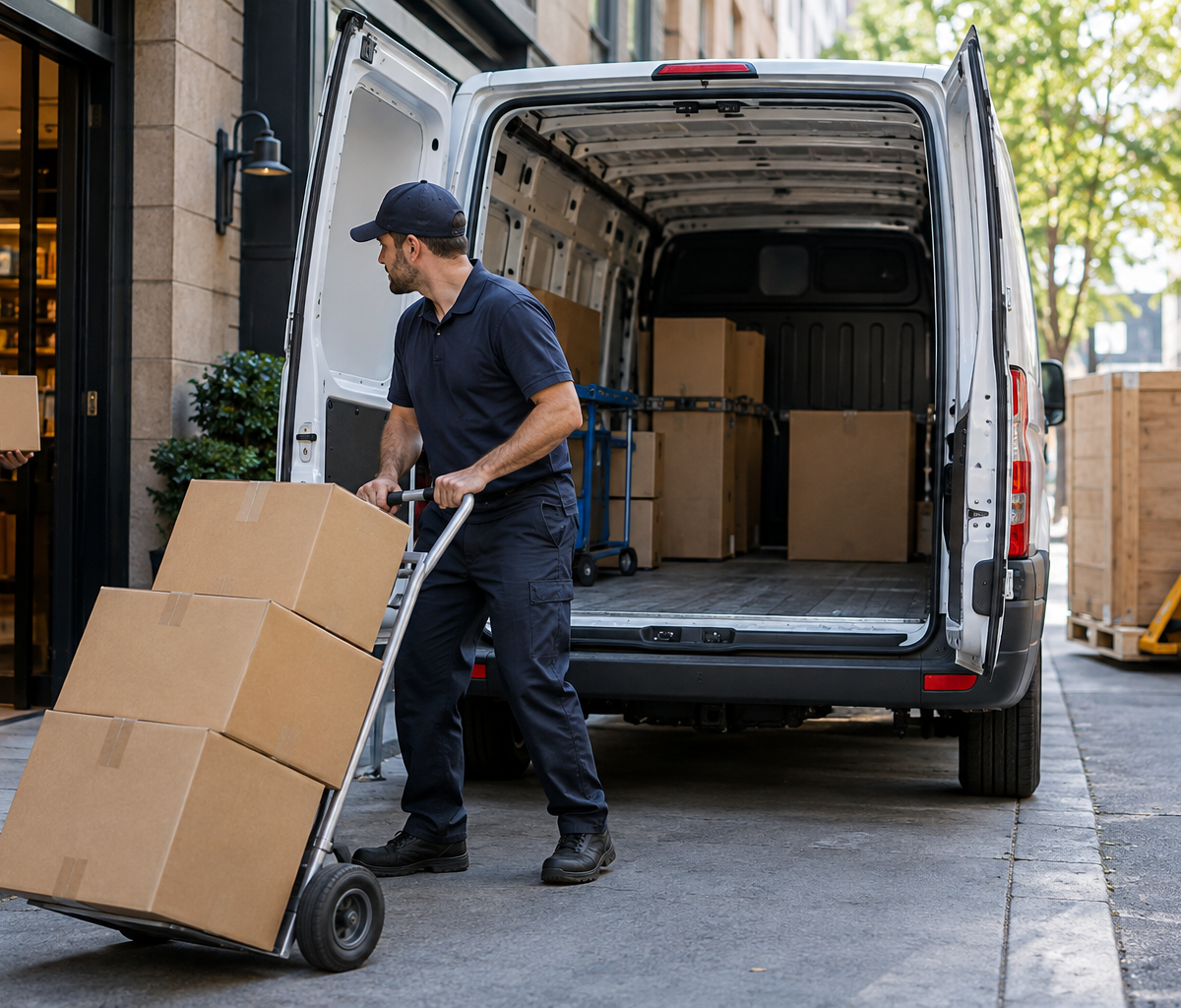
Fit a noon collection into a delivery route by tracking vehicle space after each stop and preserving the customer’s pickup and delivery windows.
A van leaves the depot nearly full of delivery parcels. A large pickup will be ready at noon, but the van cannot carry it until some deliveries are complete. Serving the pickup too early violates capacity; serving it too late misses the customer's collection window. Sequencing pickups with deliveries means placing stops so the van has enough usable space at the pickup time while still meeting existing delivery commitments.
This guide addresses the operational feasibility of one mixed route. It does not decide who has authority to change a driver's route or how a customer submits a pickup request. The pickup is already accepted into the work queue. The planner now has to test time, travel, service duration and load after each stop. A route that looks short on a map can still fail when the van fills again at noon.
Fix the pickup window and its real size
The pickup window is the period during which the freight can actually be collected, including any loading or site access requirements. Record its earliest ready time, latest permitted arrival or completion time, expected handling duration, location, contact and any vehicle restrictions. "Ready at noon" is not the same as "must be collected at noon." Clarify whether a driver arriving at 12:25 can still load the goods before a 12:30 closure.
Get a realistic description of the pickup: number of pieces, dimensions, weight, stackability, and any handling or separation requirement. Ten small envelopes and ten large cartons have very different effects on van space. If the customer can only estimate, use a conservative range and state what happens if the actual load is larger. A route promise based on a vague "one pickup" entry can fail at the curb.
Check the geographic position against existing deliveries. A pickup near the route's beginning may be convenient for travel yet impossible for capacity until deliveries unload the van. A pickup farther along may line up with both time and empty space. Map the travel time from candidate preceding stops to the pickup, including ordinary variability in the fleet's planning method. Avoid a schedule that requires every prior stop and every road segment to take its best-case time.
Google's route-optimization documentation treats pickup and delivery time windows as constraints on when a vehicle can serve a location. Its routing guidance also treats carrying capacity as a separate constraint. Those are model concepts, not a substitute for checking this van and customer. Here, both constraints have to hold at the same stop: arrival within the window and room for the freight when loading begins.
Measure vehicle capacity at each planned stop
Vehicle capacity is not one parcel-count number. Check weight, volume, usable floor area, securement, access to remaining deliveries and any product separation rules under the carrier's procedure. A van might have spare cubic volume but no safe way to place a long carton without blocking the doors. Use the binding measure for the proposed pickup. If the route plan expresses space in simplified units, confirm those units reflect actual package dimensions before dispatch.
Start with the load manifest and the physical vehicle. An item may be marked loaded but still on the dock, or an unmanifested return may occupy the cargo area. Confirm the starting load and any planned drop-offs. A delivery generally frees space only after the parcel has been handed off and removed from the vehicle; a failed delivery may leave it on board. The route model should allow for that possibility if failed stops are common enough to affect the pickup.
For the worked example, the van has a usable capacity of 30 illustrative space units and leaves with 26 units of delivery freight. The noon pickup is expected to add 15 units. Before the pickup, deliveries must remove at least 11 units: 26 minus 11 plus 15 equals 30. This arithmetic is a planning screen, not a loading instruction. Weight, shape and securing still need a physical check. A plan with only ten units removed reaches 31 and fails the stated capacity.
Build a small margin if the pickup estimate is uncertain. If the customer reports 15 units but the actual load may be 17, a route that frees exactly 11 units has no room for the upper estimate. The planner can arrange an additional early delivery, a different vehicle or a second pickup trip rather than asking the driver to improvise an unsafe load. Sequencing pickups with deliveries should remain feasible when ordinary variation appears.
Trace the load trajectory through the route
The load trajectory is the amount and type of freight carried after each stop. Write a simple row for every planned action: starting load, delivery removed, pickup added and resulting load. Keep the location and time beside the load row. This reveals the exact point of maximum occupancy. A total of 26 units delivered and 15 picked up over the day says nothing about whether the van briefly held 41 units at noon.
Suppose three deliveries before noon remove four units each. The van drops from 26 to 22, then 18, then 14. Adding the 15-unit pickup brings it to 29, within the illustrative 30-unit capacity. If the third delivery fails and its four units stay aboard, the van arrives with 18 and would rise to 33. The driver needs a defined exception path: contact dispatch, use another authorized vehicle or arrange a later approved collection. A failed handoff should not force an overload.
Check whether the pickups are one-way additions or include exchanges. A site may hand over a new batch while receiving delivered cartons at the same stop. Record the physical order of unloading and loading. If the delivered cartons remain in the van until a recipient signs, the space is not yet free. A spreadsheet that subtracts them before the actual handoff may show a feasible load that the driver cannot create at the site.
Do not rely only on a capacity field in routing software. Google's routing documentation describes cumulative load dimensions to track weight along a route. The configured model can be useful, but it may omit package shape, blocking access, temperature separation or a customer loading rule. Compare the model's load trajectory with the manifest and van layout before treating it as an executable sequence.
Protect delivery promises while freeing space
Delivery promises determine which stops can move before noon. A customer with an early time window may already need to be served before the pickup; another may have an afternoon appointment that should not be forced earlier. List the committed windows and expected service times for the candidate deliveries. The route must free at least 11 units without placing another promised handoff outside its window.
Test travel time between stops. If the first three deliveries each free four units but the third lies forty minutes away from the pickup, completing it at 11:50 cannot support a 12:10 collection. Conversely, a nearby delivery of only one unit might fit in the path but not free enough space. The best preceding stops satisfy both the volume requirement and the noon arrival. A map optimized for short driving distance alone can miss that combined constraint.
Consider the work after the pickup as well. With 29 units on board, the van still has remaining deliveries and may need to reach a depot or handoff before the route ends. Check whether the pickup freight must be returned by a carrier cutoff, and whether it can ride alongside the undelivered packages under the operation's rules. If the pickup has a separate drop deadline, its handoff becomes another time window in the route.
When a feasible sequence would break a delivery commitment, do not silently move that stop. Compare alternatives: another vehicle could take the pickup, a nearby driver could take one delivery, or the pickup customer could approve a different collection time through the authorized process. The route's original service promises are part of feasibility, not optional decoration around a convenient noon stop.
Build the noon sequence and test its margin
For the example, suppose the three four-unit deliveries are scheduled for 9:40, 10:30 and 11:15. Estimated travel and service place the van at the pickup at 12:10, within a noon-to-12:30 collection window. After those deliveries, load is 14 units; the pickup adds 15, for 29. The plan has one unit of modeled spare capacity and twenty minutes of pickup-window slack. Both margins are thin, so the planner should examine normal variation before dispatch.
Run a late-stop case. If the 11:15 delivery takes twenty extra minutes, the van may reach the pickup around 12:30, leaving no time to load if the site closes then. A valid response might move the third delivery earlier, choose another delivery that frees similar space closer to the pickup, or assign a different van. Simply deleting the travel buffer from the route plan does not create time.
Run a larger-pickup case. If the customer actually has 17 space units, the planned load becomes 31 after the three deliveries. A fourth early delivery freeing at least one unit could work only if it fits the time window and the resulting layout is safe. Otherwise the pickup needs a different vehicle or a split collection approved by the operation and customer. Capacity can force a route revision even when arrival time remains valid.
Run a failed-delivery case. If one four-unit parcel remains aboard, the pickup would bring the modeled load to 33. The driver should know before leaving whom to contact and what alternatives are available. The route owner can monitor the first three stops and make a decision before the pickup window closes. Sequencing pickups with deliveries is stronger when it includes a response to the most consequential failure, not only the expected path.
Record the route handoff and actual load
The route handoff should give the driver the pickup window, expected freight, sequence, capacity assumption and exception contact. It should also show which deliveries need to be completed first to create room. A driver who only sees a new noon stop may accept freight without knowing the 30-unit plan or may arrive too early. The dispatch record needs to state the operational reason for the order.
After each relevant stop, use reliable delivery and pickup events to update the route state. A delivered parcel frees modeled capacity only when it is no longer in the van. If a stop fails, the route owner should recalculate before the pickup. At collection, record the actual piece count and relevant load details, then verify that the freight fits the vehicle and does not obstruct safe access to remaining deliveries. Do not use a completed pickup scan as proof the load was physically suitable.
At the depot or next custody point, reconcile the collected freight with the pickup record. A large pickup may create several parcels or containers, and the driver may have collected a different count than estimated. Preserve the actual handoff and any exception. Comparing planned and actual load can improve future estimates for this customer and show whether the one-unit modeled margin was consistently too narrow.
Compare the route's predicted arrival with the actual pickup time. If the van reached the customer at 12:10 but waited until 12:25 for freight, the tight window arose from customer readiness rather than the preceding deliveries. If it arrived at 12:35 because the third stop ran long, the route sequence lacked enough time margin. These cases need different corrections. Keep arrival, loading start and departure as separate events when the operation can capture them; a single pickup-complete timestamp cannot show whether the delay occurred on the road or at the dock.
If the route cannot meet both the window and capacity limits, make that clear early. A feasible alternative may require another vehicle, a later authorized pickup, or moving a delivery to another route through the normal decision owner. Related readers can browse the driver guide hub and the Fort Wayne driver careers page. The noon pickup belongs on this van only when the preceding deliveries create real space in time and the remaining promises still hold.
Continue with Delpack
Review the Fort Wayne career overview or contact Delpack with a question about the company.