Warehouse maintenance work: would you trace the fault and restore the line?
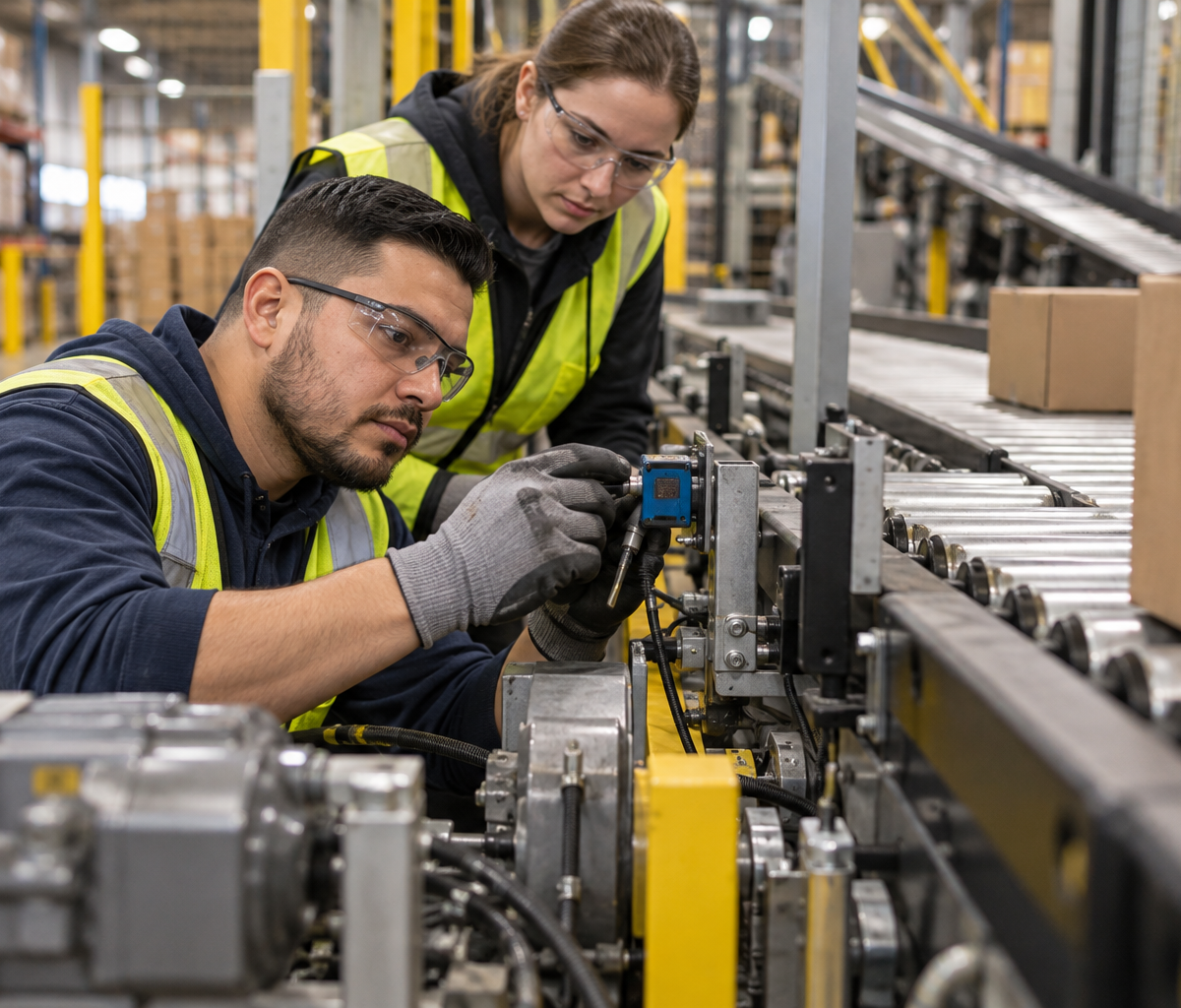
Explore whether diagnosing warehouse equipment, working under safe isolation, repairing within authority, and documenting restart fit you.
A conveyor feeding a packing line stops several times in one shift. Operators reset it, but the same sensor alert returns. Someone has to examine the fault under the site’s safety process, determine whether the sensor, wiring, product flow, or another component is responsible, and document the repair before the line returns to service. Warehouse maintenance work may fit a person who likes hands-on diagnosis and reliable equipment more than a purely screen-based support role.
Warehouse maintenance can include conveyors, dock doors, packaging machines, lifts, building systems, and other equipment. A specific opening may cover only some of these. It may require mechanical, electrical, or controls skills, and the employer decides what a worker may repair. A candidate should ask which assets the team owns, how training is provided, and when a problem is escalated to a specialist.
Start with the fault report and equipment history
A fault report tells maintenance what happened, where, and when. “Conveyor broken” is less useful than a report naming the line, repeated sensor alert, conditions at each stop, and any safe observations made by operators. The technician should compare the report with the equipment’s history, not assume the latest alert identifies the failed part.
In the packing-line example, a sensor alert might recur only when a certain carton size passes, after a long run, or during startup. Those patterns suggest different questions. The technician may inspect logs, observe the line under an approved procedure, and ask operators what they saw. A candidate who enjoys asking precise questions before picking up a tool may like this stage of the job.
Past work orders can reveal a repeat problem. If the same sensor was replaced twice, the underlying cause may be alignment, contamination, wiring, product presentation, or a process condition. The technician should not repeatedly swap a part without considering why the fault returns. The actual diagnosis depends on equipment details and qualified testing, which this career article cannot provide.
The Bureau of Labor Statistics describes industrial machinery mechanics and maintenance workers as maintaining and repairing conveying systems and other industrial equipment. It is broad occupational context, not a specification for one warehouse job. Ask whether the opening includes preventive inspections, emergency calls, installations, or a mix, and what share of the shift is spent on each.
A maintenance role can be interrupted often. The candidate should ask how work requests arrive, how equipment history is stored, and whether a technician has time to investigate a recurring fault after restoring immediate operation. A job that only clears alerts can feel different from one that supports durable repairs.
Use safe isolation before hands-on work
Safe isolation means following the employer’s applicable energy-control procedure before servicing equipment where unexpected startup or stored energy could harm someone. Conveyors and doors can have electrical, mechanical, or other hazards. The technician must be trained and authorized for the equipment and task. This article does not give a lockout procedure; the site’s written rules and qualified supervision govern the work.
OSHA’s control-of-hazardous-energy standard addresses servicing and maintenance when unexpected energization or release of stored energy could injure workers. Its lockout/tagout resources explain why a simple stop button is not necessarily a safe maintenance condition. A candidate should ask about the employer’s training, equipment-specific procedures, and how authorized workers verify isolation.
In the sensor example, the line may need controlled observation while operating to understand when the fault occurs, followed by an appropriate safe state for hands-on inspection. The exact sequence is technical and site-specific. The candidate should know who authorizes testing that requires energy and how people near the line are protected. They should not learn these rules by trial and error during a production stop.
Ask how maintenance coordinates with packing staff before taking a line out of service. Operators need to know what is unavailable, where work is occurring, and when the line is cleared to restart. The technician’s safety process and communication are part of the repair, not an optional administrative step.
Dock doors and other warehouse equipment have different hazards from a conveyor. A role covering many asset types should provide training for each assigned system and a clear escalation route for work outside the technician’s competence. A candidate should be comfortable saying when a job needs a specialist.
Diagnose the conveyor sensor fault
A sensor fault is a signal or behavior suggesting that a sensing component or its surrounding process is not working as expected. The sensor itself may be sound. A carton may block it too long, a mount may have moved, a cable may be damaged, or a downstream jam may make the alert appear. A technician has to test the possibilities allowed by the equipment procedure.
For the repeated stop, begin with evidence: what the control system recorded, what operators observed, when the stop occurred, and whether the same item path was involved each time. Then inspect the relevant equipment under safe conditions. Replacing a sensor because its name appears in an alarm can waste parts and leave the real cause in place.
The candidate should ask what diagnostic tools the role uses. It may involve equipment manuals, electrical meters, controls displays, work-order history, or mechanical measurements. Some employers expect one technician to cover several disciplines; others divide electrical, mechanical, and controls work among specialists. The applicant should match their current skills to the actual responsibility.
Temporary recovery and root-cause repair are different outcomes. Clearing a carton jam can restore flow, but the team should ask why that location jams repeatedly. Adjusting a bracket may stop the alert, but the change needs to follow approved tolerances. A technician should document what was observed and tested so another worker can understand what remains uncertain.
Software support can be involved if the fault is in a warehouse management system or control application. This article is about physical equipment reliability and qualified maintenance. Ask which team owns configuration changes and what evidence maintenance must provide when it escalates a problem to controls or IT.
Know the repair boundary and when to escalate
A repair boundary is the limit of what the technician is trained and authorized to do. One worker may replace a mechanical component but not edit controller logic. Another may test electrical circuits but must call a vendor for a specialized drive. The candidate should ask which work requires a licensed trade, a senior technician, or an external provider at the actual site.
In the conveyor example, suppose the evidence points to a loose sensor bracket. A qualified technician can use the approved method to correct it and verify the line under the site’s process. If the fault points to an intermittent controller issue outside their authority, the useful next action is an evidence-rich escalation: times, alarm codes, observations, tests already performed, and current equipment status.
Parts availability shapes the job. A common spare may be on site; an unusual component may take longer to obtain. Ask how the team records temporary operating restrictions, orders parts, and communicates unresolved faults. A workaround should be approved, documented, and safe under the employer’s rules rather than quietly becoming a permanent repair.
Maintenance work also includes prevention. Inspections, lubrication, alignment checks, and replacement of wear items may reduce future stops when performed under the manufacturer’s and site’s instructions. A candidate should ask whether planned maintenance receives protected time or is routinely displaced by urgent calls. That tells them whether the role can improve reliability or mostly reacts to failures.
Choosing which one of several failures gets repaired first is a separate operations decision involving safety, customer commitments, and resources. The technician supplies facts about equipment condition and repair options. This article helps a candidate decide whether the technical work itself fits, not how to rank a specific backlog of repairs.
Document return to service
Return to service is the controlled handoff from maintenance back to operations after the equipment is checked under the site’s procedure. A replaced part alone does not establish that the line is ready. The technician should record what was changed, what checks were completed, any remaining restriction, and who accepted the handoff.
For the sensor fault, the team may run the conveyor with representative cartons under an approved test, confirm the alert does not recur during that check, and tell packing staff what to watch. One successful test may not prove that an intermittent problem is gone forever. The work order can state the test’s limits and whether follow-up observation is needed.
Ask who removes energy-control devices and who authorizes restart. OSHA’s rule and the employer’s procedure define important responsibilities; a candidate should expect training on them. The technician should not assume that a line is safe to run merely because tools have been removed. The physical equipment, controls, and people nearby need a coordinated handoff.
Good records help the next shift. If the fault returns, another technician should be able to see the original symptoms, tests, parts, and result. If a vendor later needs to diagnose the system, that history may save time. A maintenance job with weak documentation can force workers to rediscover the same problem repeatedly.
Compare maintenance with other warehouse paths
An equipment operator uses a machine to move goods. A maintenance technician keeps the machine serviceable and responds when it fails. A systems-support worker may troubleshoot software or data flow. These roles cooperate, but they require different training and produce different work. Ask whether the opening is mainly mechanical, electrical, building maintenance, or technical coordination.
The sensor example is a useful interview prompt. What would the technician receive from operators? Which tests can they perform? How is the line isolated, and who releases it after repair? A concrete employer answer shows the training and authority behind the job. A vague expectation to “fix anything that breaks” should lead to more questions about support and safety.
The work may fit someone who likes solving a physical problem and seeing a line run again. It also brings irregular calls, noisy areas, time pressure, and tasks that cannot be completed until a part or specialist arrives. A candidate should ask about shift coverage, on-call duty, tools, mentoring, and the proportion of preventive work.
Delpack’s transferable skills for a delivery driver resume guide illustrates how to describe work experience precisely when changing roles. An operator can cite careful equipment observations and fault reporting, while being honest about whether they performed authorized repairs. Maintenance qualifications should be demonstrated through actual training and work.
Decide whether equipment reliability fits you
Before accepting a maintenance opening, ask which assets the team owns, what training and isolation procedures apply, how calls are prioritized, what repairs the role may perform, and how equipment returns to service. Confirm shift pattern, physical demands, tools, specialist support, and opportunities for preventive work.
Warehouse maintenance work may suit someone who wants to trace the repeated sensor stop beyond a reset, isolate equipment safely, repair within their authority, and leave a clear record for the next shift. The satisfying result is not only a moving conveyor; it is a reliable and understood handoff back to operations.
Delpack’s Fort Wayne driver careers page lists driver opportunities, not a maintenance-technician opening. Compare actual postings for qualifications, schedule, pay, and work conditions. A technical maintenance path requires a different preparation than driving or operating warehouse equipment, and the specific employer should explain its training route.
Continue with Delpack
Review the Fort Wayne career overview or contact Delpack with a question about the company.