Warehouse security-coordinator work: would you manage access and incidents?
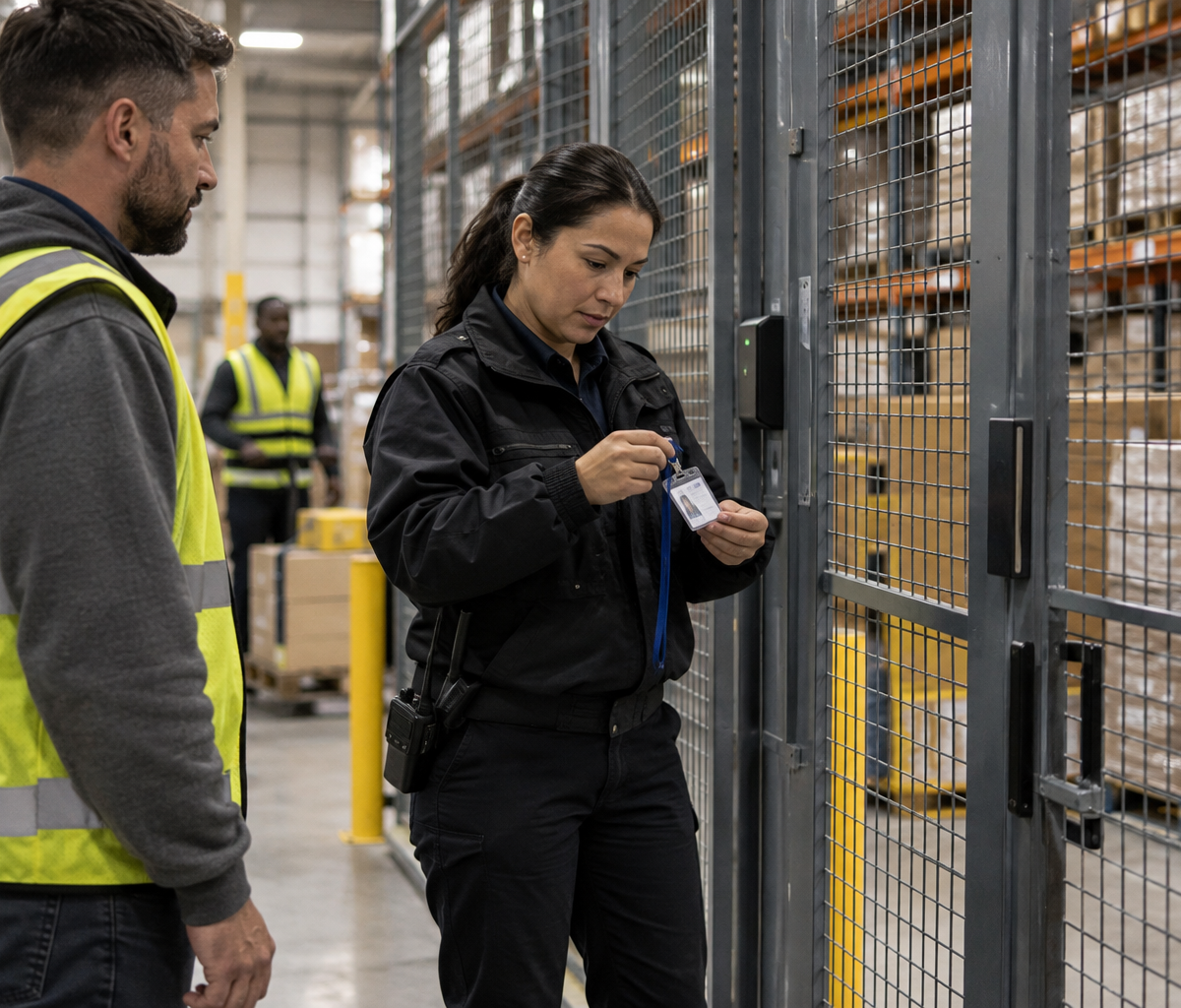
See whether facility access administration, careful incident evidence, and cross-team protective changes fit your interests.
A visitor enters a stock area without the escort required by a facility’s rules. Later, an inventory-security concern is reported from that area. A badge record shows when the visitor entered, but it does not by itself establish that the visitor caused a loss. Warehouse security-coordinator work may fit someone who can control access, preserve the relevant evidence, and coordinate a careful response without jumping to a conclusion.
Security work in a warehouse can involve people, goods, doors, credentials, cameras, records, and incident reports. A coordinator may design or administer procedures and work with guards, supervisors, facilities staff, and inventory teams. The exact authority varies by employer. Ask whether the opening is mainly an on-site guard assignment, an access-control administration role, an incident coordinator, or a mix.
Know the facility access rule before an incident
A facility access rule defines who may enter a particular area and under what conditions. It might involve employee badges, visitor check-in, escorts, time limits, or restricted stock zones. The coordinator should know which rule applied at the time of an event. A badge swipe is meaningful only when compared with the current authorization and expected workflow.
In the visitor example, perhaps the person was approved for a meeting but required an escort in the stock area. The coordinator can verify the approved destination, escort assignment, and entry time. They should not infer misconduct simply from a door record. A visitor may have been accompanied but the escort entry is missing, or a door may have been held open. The facts need separate confirmation.
CISA’s facility access-control guidance discusses planned controls for admitting people to facilities and managing visitors. Its publications cover contexts broader than a private warehouse, so the candidate should use them as general security background. The employer’s own policy and applicable law govern the actual site. Ask how a coordinator learns the current access map and how policy changes are communicated.
Access work includes routine administration. Who grants or removes badge permissions when a worker changes role? Who checks that a temporary visitor pass expires? How are after-hours contractors handled? A candidate who enjoys systematic permissions management may like this part of the career. Someone expecting only dramatic investigations may be surprised by the volume of ordinary access requests.
Ask how the site handles exceptions. A delivery driver, repair technician, or auditor may need temporary access outside a standard employee schedule. A clear request and escort process protects both the visitor and the operation. The coordinator should not bypass the rule because someone says they are in a hurry, but they also need a practical path for legitimate work.
Consider a technician called to repair a conveyor beside a restricted inventory cage. The visit may be approved, but the work route could pass through an area the technician is not authorized to enter alone. The coordinator can confirm the approved work location, identify an escort, and make sure the temporary credential covers the intended time and doors. That planning prevents an access exception from being discovered only after the person has already crossed the boundary.
Read an access log with its limits
An access log may record a badge identifier, door, time, and result. It can help establish that a credential was used at a controlled entry point. It does not always prove who physically walked through, whether others followed, or what happened after entry. The coordinator should understand how the system logs failed scans, open doors, and manual overrides before interpreting an event.
For the unescorted-visitor concern, the first useful question is what the log actually shows. Does it identify a visitor badge at the stock-area door? Was there a separate escort scan? Do camera or sign-in records cover the same time? The coordinator can compare records while preserving uncertainty. A missing escort scan may indicate a process failure, an incomplete record, or an actual unescorted entry.
Time accuracy matters. A camera clock and a badge system may not match exactly; a manual sign-in may be entered later. Ask how the employer synchronizes systems and records time zones or clock corrections. A timeline that treats every timestamp as perfectly aligned can falsely place a person near an event. Careful security work notices these limits.
Access logs can contain sensitive information about workers and visitors. Ask what systems the role may view, who authorizes access to records, how long evidence is kept, and how findings are shared. A coordinator should use the company’s privacy and investigation procedures rather than circulate a list of names to everyone who asks. The exact legal duties vary by location and employer.
CISA’s broader security recommendations include monitoring access-control information to detect suspicious physical access activity. That general principle does not mean every unusual swipe is an incident. A person may use an alternate door for an authorized task. The candidate should ask what the employer’s review thresholds and escalation rules are.
Preserve incident evidence before explaining it
Incident evidence can include access records, camera references, visitor logs, shipment or inventory records, and direct observations. The coordinator should preserve the relevant records under the site’s procedure before they are overwritten or changed. They should also keep a clear distinction between what a system recorded, what a person reported, and what the investigation later concludes.
In the stock-area example, a supervisor might report that a case of goods cannot be found. That report is a lead, not proof of theft. Inventory could have been moved, miscounted, or recorded under another location. The coordinator can preserve the badge and visitor evidence and work with the inventory team to establish whether there is a real unexplained difference. The investigation should not turn a stock discrepancy into an accusation by default.
Ask who owns interviews, footage review, and any contact with law enforcement. A coordinator may assemble a timeline, but the employer may reserve disciplinary or legal decisions for other teams. The candidate should know the boundary between documenting an incident and deciding responsibility. O*NET’s security-guard and supervisor profiles include observing irregularities, investigating disturbances, and writing reports, but those broad roles do not define one warehouse coordinator’s authority.
A useful report names the event, records reviewed, time span, immediate protective action, unresolved questions, and next owner. It avoids claims that the evidence cannot support. “Visitor badge entered at 14:06; escort status not confirmed in the available log” is more useful than “visitor stole inventory” when the inventory and movement facts remain open.
The coordinator may need to preserve a before-state when a control is changed. If access to the stock area is disabled for a credential, record who requested the change, when it took effect, and what prompted it. That makes later review possible without delaying an authorized protective action. The employer’s incident process should define who can make urgent changes.
An evidence trail can be short and still useful. The worker might record the original alert, the badge event, a camera file reference, the visitor check-in record, and the inventory team’s separate count finding. Each item should retain its source and time. If a later reviewer finds that the camera clock was five minutes fast, they can revise the timeline without losing the underlying records. That is much stronger than a narrative written from memory after the shift.
Coordinate a protective process change
A protective process change addresses a weakness shown by an incident or near miss. In the visitor example, the site might need clearer escort handoff, a door alarm review, or better visitor-pass controls. The evidence should drive the recommendation. A missing log entry alone does not prove the door needs new hardware; an equipment problem might be one of several explanations.
Ask how security proposals move from observation to action. Who owns physical doors, badge software, visitor reception, and warehouse operations? A coordinator may not control all of them. The role can still be valuable if it identifies a specific failure mode, documents the affected area, and gets the right owners to test a change.
After a change, the team should check whether it works in normal operations. A new visitor sign-in field might be completed during quiet hours and skipped during busy receiving windows. A revised escort rule might be unclear to contractors. The coordinator can review a small sample of later visits under company policy and report whether the control is being used as intended.
Controls have tradeoffs. Restricting a door can interfere with legitimate material movement or emergency access if poorly planned. The coordinator should involve facilities and operations before changing a route. Safety rules and emergency plans remain separate obligations. This security career focuses on access and inventory incidents, not on managing all workplace hazards.
Some issues may require technical repair rather than policy reminders. A badge reader that records the wrong door or a camera that lacks the relevant view will not improve because employees attend another briefing. Ask whether the role can request a system check and how defective controls are tracked until repaired.
The role also has a communication side. Operations may need to know why a door is temporarily restricted; reception needs the current visitor route; inventory staff may need a request to preserve count records. The coordinator should share the action each team needs without distributing more personal or investigative detail than the employer’s process permits. Ask who approves those messages during an open incident and who tells teams when normal access resumes.
Compare security coordination with nearby roles
A guard may monitor a post, check entrants, and respond to alarms. A warehouse security coordinator may organize access rules, evidence, and incident follow-up across teams. A safety coordinator focuses on preventing injuries and managing workplace safety processes. Inventory staff investigate stock records and counts. The roles can cooperate closely, but their main decisions differ.
Stock shrinkage is a category of loss or unexplained reduction; it is not a job description or proof of a security event. A coordinator may investigate one possible security dimension of an inventory concern, while an inventory analyst checks transaction and movement records. Ask how the employer divides those investigations and who decides when an issue moves from a routine discrepancy to a formal incident.
The visitor example is a good interview test. What would the coordinator do after an unescorted entry is reported and stock is later missing? A sound answer should involve checking the access rule, preserving records, confirming the inventory facts, and routing unresolved questions to authorized owners. It should not rely on one badge event as a complete explanation.
Delpack’s transferable skills for a delivery driver resume guide can help applicants describe real security-related experience when changing logistics roles. State what access checks or incident records you actually handled. Do not imply investigative authority from a job that involved only greeting visitors.
Decide whether careful access work fits you
Before accepting, ask which areas the role controls, what systems it can access, how visitor exceptions are approved, who owns incident investigations, and what happens after a finding. Confirm shift coverage, on-call expectations, training, privacy rules, and whether the job includes standing guard duties. Those details determine the workday more than the word “security” alone.
Warehouse security-coordinator work may fit someone who is comfortable with a slow, evidence-led answer. The badge record in the example helps establish a timeline, while inventory and visitor facts still need checking. The coordinator’s contribution is to preserve the trail, prevent an unsupported conclusion, and help the facility close a real access weakness.
Delpack’s Fort Wayne driver careers page lists driver opportunities, not a warehouse-security opening. Compare actual postings for qualifications, pay, schedule, duties, and employer authority. If access rules, records, and incident follow-up interest you more than moving goods, this career path is worth a closer look.
Continue with Delpack
Review the Fort Wayne career overview or contact Delpack with a question about the company.