Warehouse slotting specialist work: is location design your career?
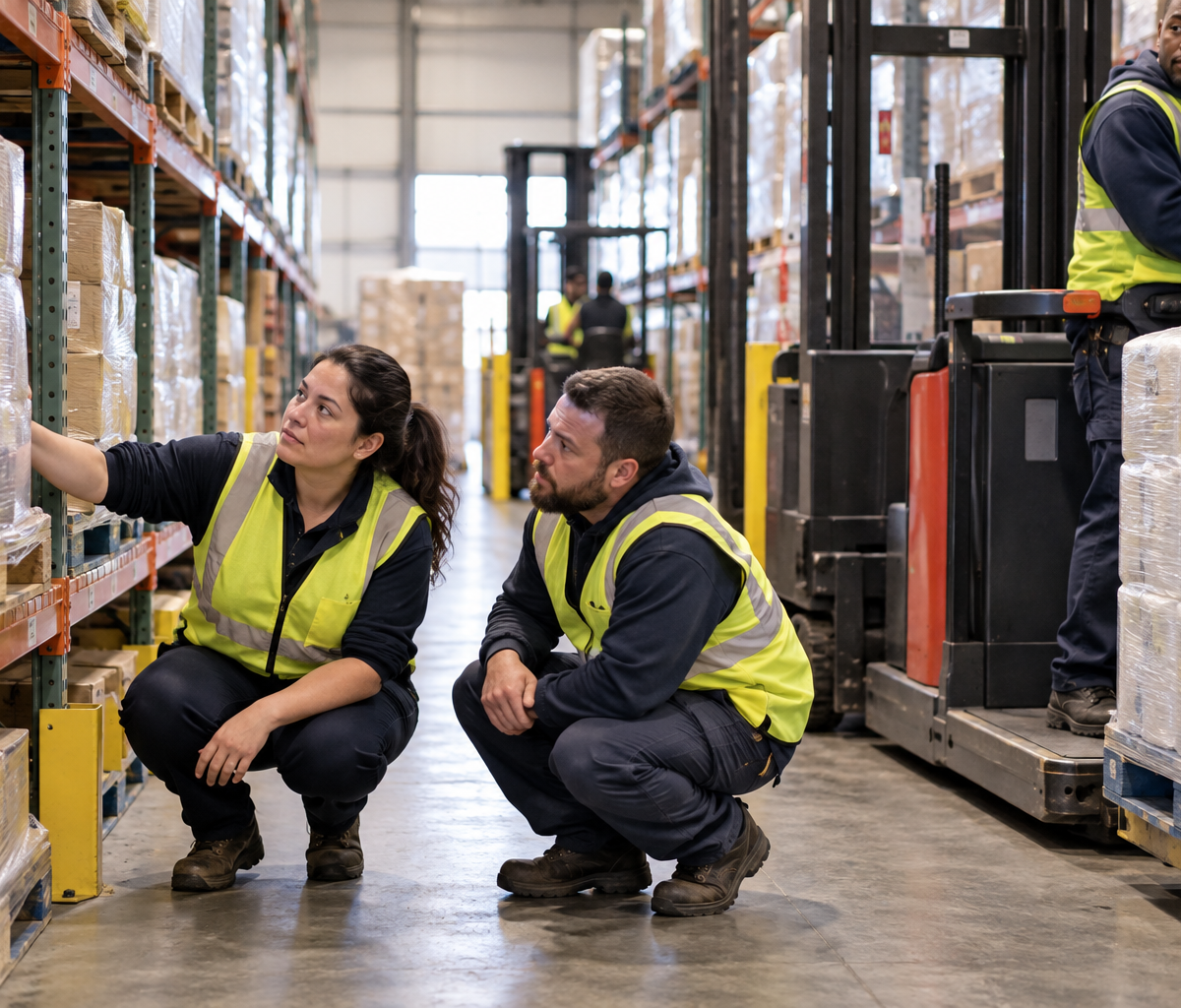
Explore the analytical role behind product locations by weighing pick travel, space and replenishment for a bulky fast-moving item.
A warehouse has a bulky product that sells quickly. Pickers walk a long way to reach it, so a planner proposes moving it close to the pick line. The new location shortens each pick trip, but it holds fewer cases and now needs frequent replenishment. The useful answer is not simply “put fast movers near the front.” Warehouse slotting specialist work asks someone to weigh travel, space, handling, and refill effort before changing where items live. A candidate considering the role should find out whether they enjoy that kind of analysis and its real-world follow-through.
Slotting is the assignment of products to warehouse locations under a facility’s rules. It affects the people who pick, replenish, count, and move goods. A specialist may study demand and location data, propose changes, coordinate with operations, and measure what happened afterward. The job can be more analytical than physical picking, but its exact mix of desk work, floor observation, system setup, and project ownership depends on the employer.
Start with item movement and location data
Item movement tells the specialist how often a product is picked, in what quantities, and under which order patterns. A location record describes where it can be stored or picked. The candidate should ask what data the team receives and how reliable it is. A slotting proposal based on yesterday’s demand alone may misread a seasonal or promotional surge; a location map that omits current shelves or equipment will produce an impractical suggestion.
In the bulky-product example, the item appears in many orders each day. Its current slot is far from the usual pick path. A specialist would want more than the total order count: cases per pick, package dimensions, storage constraints, nearby items, and how frequently the pick location runs out. Those details determine whether moving the product closer helps more than it disrupts.
The candidate need not be an expert in one software product before exploring the career. They should be comfortable asking where numbers come from and whether they match the floor. If the system says a bin holds ten cases but workers can safely and reliably fit only six, the planning assumption needs correction. Visiting the location and listening to replenishment staff can reveal a problem that a spreadsheet does not show.
Data freshness matters too. A product may look slow because it was out of stock for a week, not because demand vanished. A recent promotion may make another item look permanently fast. The specialist needs to ask what period the report covers and whether shortages, new products, or one-time events distort it. The candidate who likes investigating those causes may enjoy the work more than someone who expects a clean ranking to settle every choice.
The U.S. Bureau of Labor Statistics describes logisticians as analyzing and coordinating supply-chain activity. That is broad occupational context, not a certification of a specific “slotting specialist” title. The employer must explain its role: who owns the data, who can approve location changes, and whether the specialist is expected to configure a warehouse management system or mainly recommend changes.
Balance pick travel against replenishment
Pick travel is one reason to place frequently selected items near an efficient route. Moving the bulky product closer could save time across many picks. But the closer slot may be smaller, harder to restock, or needed for another item. A good analysis measures the cost of both picking and keeping the location supplied. It does not treat the shortest walking distance as the only outcome.
Suppose the current location holds a day’s demand, while the proposed near-line slot holds only a few hours. Pickers may walk less, yet a replenishment worker must refill the slot several times each day. That work can block an aisle or interrupt picking. The specialist should compare the saved travel with the added refill labor and congestion under the site’s actual conditions. The example uses no universal threshold; the conclusion depends on local volume and layout.
Microsoft’s warehouse-slotting documentation describes plans that place inventory into locations and create replenishment work. Oracle’s reslotting documentation likewise discusses matching product movement with location rankings and generating tasks when material needs to move. Those product workflows show why slotting and replenishment connect. They do not prove that every warehouse uses the same rules, screens, or automatic recommendations.
A candidate who enjoys solving one-variable puzzles may be surprised by this tradeoff. The specialist has to test whether a solution for pickers creates an equal or larger problem for replenishment. They may need to present two workable options: a nearer but larger slot that is slightly off the shortest path, or a smaller prime slot with planned frequent refill. The operations team can then choose using real capacity and staffing information.
Check location capacity and handling limits
Location capacity involves more than a bin’s printed dimensions. Product packaging, unit weight, reach, equipment access, and the facility’s storage rules can all affect a usable slot. The specialist must use the employer’s actual constraints and involve the people responsible for safe storage. A model that fits a bulky case into a location on paper but makes it awkward or impermissible to handle is not ready to implement.
For the example item, the specialist may discover that the proposed slot is wide enough but too shallow for the case orientation needed by the pick method. Another location may have sufficient volume but poor access for replenishment. These are reasons to inspect the candidate locations and confirm assumptions with floor staff. The analytical work is tied to physical reality, even when the specialist never personally moves the product.
Space is also scarce. A high-demand product placed near the pick line displaces something else. The specialist should identify the displaced item and the consequences of moving it. If that item is also frequently picked, the net travel gain may be small. If it has special handling requirements, moving it could be unacceptable. The proposal should show the complete exchange of locations, not just the attractive half of it.
This responsibility differs from an individual worker’s decision about where to put one received case. The specialist designs or evaluates location assignments across items and time. Receiving and putaway teams then execute approved moves and records under the facility’s process. The candidate should ask whether the role has authority to change rules directly or must obtain operations approval.
Use floor observation before and after a change
Floor observation tests the data against the way people actually work. A specialist may watch a picking wave, note where replenishment interrupts travel, and compare those observations with system timestamps. A dashboard can show a long travel estimate but miss a door that stays closed, an aisle with periodic congestion, or a workaround workers use because a location record is wrong.
Before changing the bulky item’s slot, the specialist could ask pickers how they reach it and ask replenishment staff how often they fill it. After the change, they could check whether pick travel fell, whether refill work rose as expected, and whether other products became harder to reach. A result should be measured over an appropriate period, not judged from the first hour after workers learn a new location.
A candidate who likes continuous improvement may enjoy this loop: form a hypothesis, verify constraints, implement with the team, and evaluate the result. Someone who wants a purely desk-based role should ask how much time the employer expects on the warehouse floor. Someone who prefers hands-on picking may find the analysis and coordination less satisfying than the direct task. Both preferences are valid; they point to different roles.
The specialist also needs a way to communicate a change. Workers should know when a product moves, what the new location is, and how old stock or open work is handled. The employer’s system and process determine the details. A good location plan that is not reflected in records and training can leave workers searching in the old place and undermine the measurement of the change.
Before comparing results, the team should decide which outcome will show that the change helped. It might track pick travel, refill frequency, congestion, location errors, or several of these together. A shorter walk is a real gain, but it is not a success if the new slot repeatedly runs empty. A candidate can ask how the employer measures improvements and whether staff feedback is considered when the recorded numbers look better than the shift feels.
Learn which decisions the role owns
A job posting may use “slotting” to mean analysis, daily location maintenance, software configuration, or a mix. Ask for a recent project: What triggered it? Who gathered the data? Who approved the proposal? Who moved inventory? Who updated the system? Who decided whether the change worked? The answers reveal whether the open role is a specialist who designs policy or a coordinator who carries out established rules.
Some teams may expect spreadsheet analysis and presentations. Others may require familiarity with a particular warehouse management system, inventory controls, or operational measurements. The candidate should ask which tools are essential on day one and which the employer trains. A title cannot establish a universal degree, credential, or software requirement. Those belong to the actual posting and employer.
The bulky-product case gives the candidate a useful interview conversation. They can explain how they would ask about pick frequency, size, refill cadence, alternative locations, and the effect on nearby items. They need not announce a final slot without data. The quality of the questions shows analytical judgment and respect for the people who will use the new arrangement.
The role may work with warehouse supervisors, inventory control, replenishment teams, pickers, and systems staff. The specialist should be able to explain a tradeoff in plain terms. “This move saves pick travel but adds two refill trips” is more actionable than saying the algorithm gave the slot a higher score. A candidate who enjoys turning measurements into a decision colleagues can test may find that collaboration rewarding.
Keep the career question separate from one slot choice
A separate article can decide where one fast-moving item should go in a specific warehouse. This article asks whether a person wants to make that class of decisions repeatedly, with incomplete data and competing constraints. The candidate should picture gathering evidence, proposing changes, coordinating implementation, and checking outcomes across many items. A single clever answer to the bulky-product example does not describe the whole job.
It is also distinct from physical picking. A picker follows a work instruction to collect items accurately and may report that a location is difficult. A slotting specialist studies those reports and the broader pattern, then helps redesign locations under the employer’s authority. An employer might combine duties in a smaller operation, so the candidate should ask how much of the week is spent picking versus analyzing and changing locations.
Someone moving between warehouse and delivery careers can still use accurate examples of data, labels, route or location checks, and exception reporting. Delpack’s transferable skills for a delivery driver resume guide helps readers describe such experience truthfully when applying for driving work. Its Fort Wayne driver careers page covers current driver opportunities. Neither page advertises a Delpack slotting-specialist opening.
Decide whether the analysis-and-implementation loop fits
Warehouse slotting specialist work may fit someone who likes examining item movement, testing location capacity, balancing pick travel with replenishment, and revising a plan after seeing it operate. The job requires enough interest in the warehouse floor to verify that a proposed improvement can actually be used there. It is less likely to satisfy someone who wants only direct picking tasks or only abstract modeling without operational follow-through.
The candidate should leave an interview knowing which data and tools the team uses, how often the role observes work on the floor, who approves location changes, and how results are measured. In the fast-moving bulky-item case, moving closer is only a proposal until the team has checked space, refill effort, and the effect on other items. That unresolved tradeoff is the kind of work the role exists to handle.
Continue with Delpack
Review the Fort Wayne career overview or contact Delpack with a question about the company.